Showing posts with label Willow Creek. Show all posts

Sunday, July 30, 2023

Dry Creek Station to Arapahoe Station


At Dry Creek Station, the day promised (and delivered) sun and heat.
There was a chance of thunder storms. Barometric pressure was dropping and humidity was in the upper 40 percent. But I wasn't holding my breath (I needed all I could conserve.)

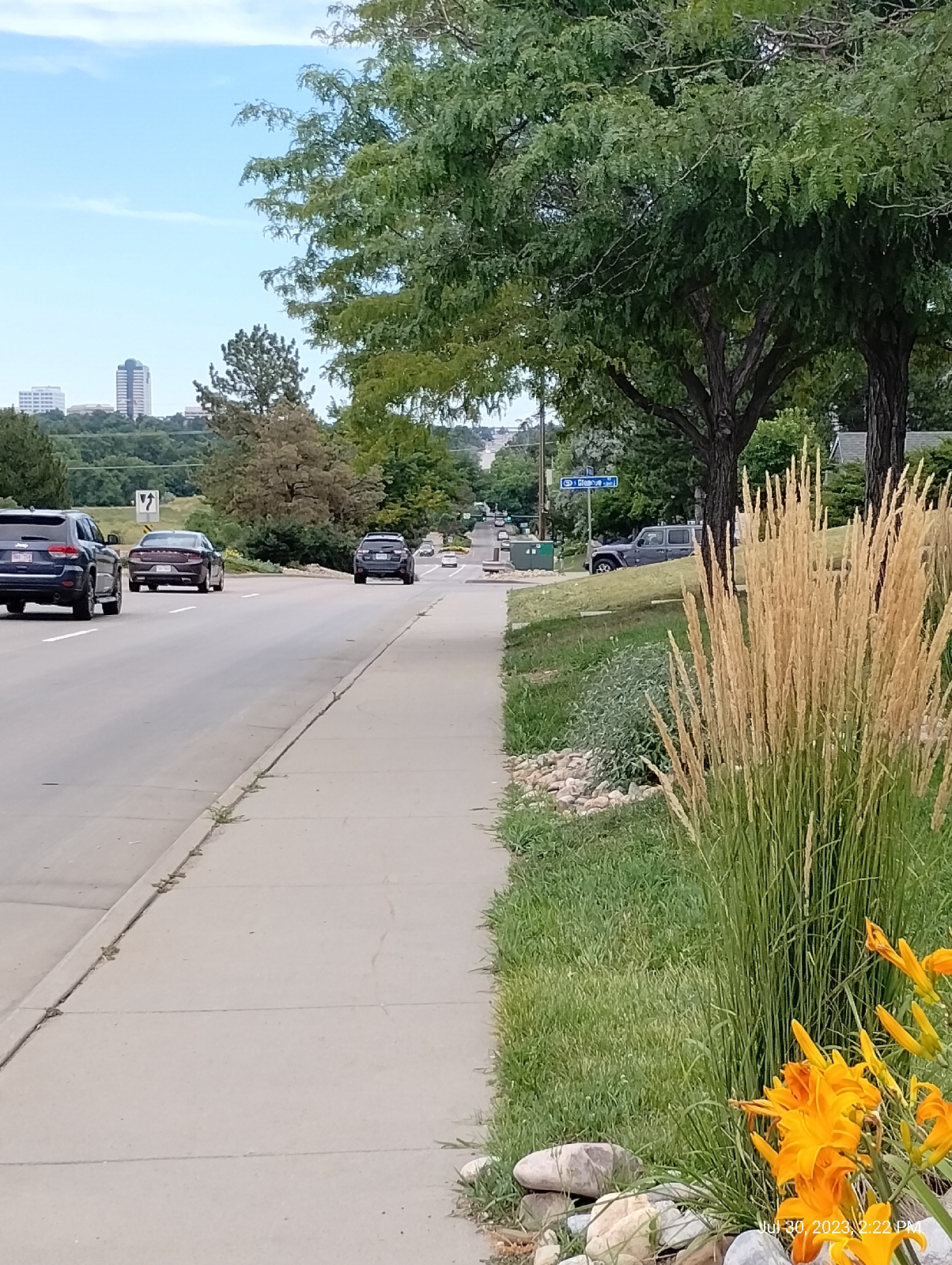
The requisite shot of the Rockies, this time from Dry Creek Road. Dry Creek Road makes a straight shot toward South Platte Park and the Carson Nature Center so I was solidly on the divide between the South Platte River and Cherry Creek. This was home territory. The church with the sharp steeple is Good Samaritan Episcopal, a church I've attended several times since moving to Centennial. Willow Creek Covenant community is to the left and Willow Creek crosses the road a little further down. That was my destination.

These little guys are a feature in the Denver Metro area. I have a friend who distributes pellets of food laced with bubonic plague vaccine. The fleas prairie dogs host carry the plague. I'm sure that some would come up with the solution of just exterminating the creatures but they're an important step in the food chain.

They're pretty fascinating in their own right. As you near the prairie dog town, you hear them barking. It's been a focus of research because they have a complex language that includes identifiers for individual prairie dogs.

Also, they're cute.

At Willow Springs Green Space, Willow Creek has picked up a lot of water since drizzling out of the Bluffs, and is about to pick up more. This area isn't far from it's confluence with Little Dry Creek. There, the two will merge and become Little Dry Creek.

I'm not sure why that is, or if there is even a solid naming convention. By this point, Willow Creek has run a lot further than Little Dry Creek. There's not a lot of difference in size normally, but Willow Creek will flood occasionally and I can't find that Little Dry Creek ever has. About a month ago, the reservoir on Willow Creek was allowed to fill up due to our particularly wet monsoon season. There were boats out on the resulting lake. The United States Geological Survey has a hydrologic station on Little Dry Creek but (best I can tell) not on Willow Creek.

There is another blogger in the area that keeps an eye on Willow Creek and other local areas and maintains an interesting resource called "Naturalist Perspective". I check it occasionally for information in the area.

Sharon Pickens lives locally and explores the Denver Metro area, logging her explorations in Naturalist Perspective. She focuses on the nearby Willow Springs Open Space and is particularly interested in the wildlife and plants in the area, but she has somewhat to say about the geology of Willow Springs also. The website is well worth a look 


The "Springs" part of the park name gives an idea of where some of the water comes from. Willow Creek is never far from the aquifer that underlies Denver, but this open space brings it to the surface as several small branches that flow into the creek. At least three streams join Willow Creek in the open space.

The new South Suburban Parks and Recreation markers keep visitors up on where they are and what's available and they're not unsightly .

There's a good variety of plant life around the creek. This burdock is doing it's best to be photogenic. 

Willows with catkins

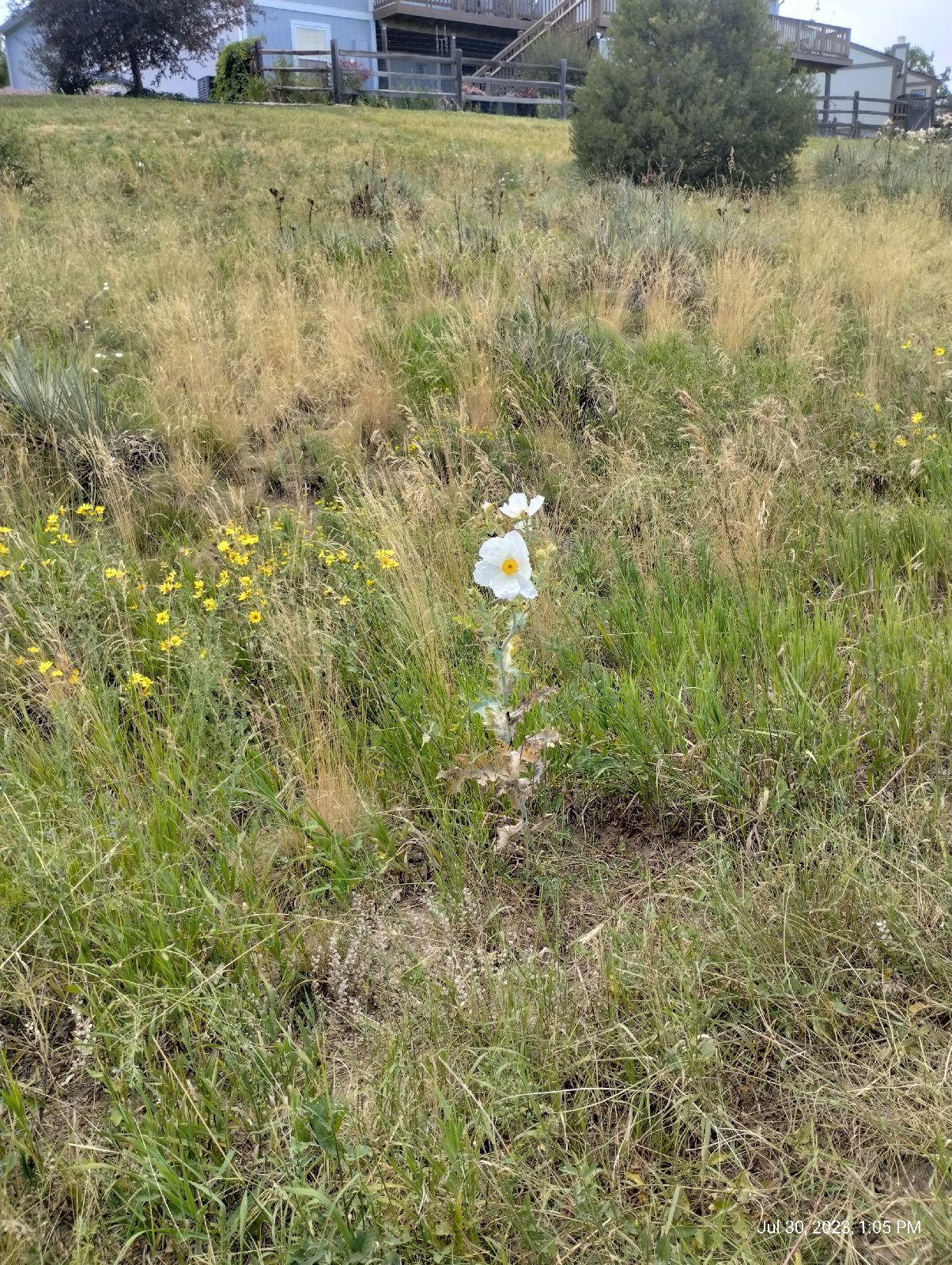
California (prickly) poppy
One of those springs

The park system has some off leash areas but most of the areas require dogs to be on leash. There are reasons and South Suburban tries to make those reasons explicit.

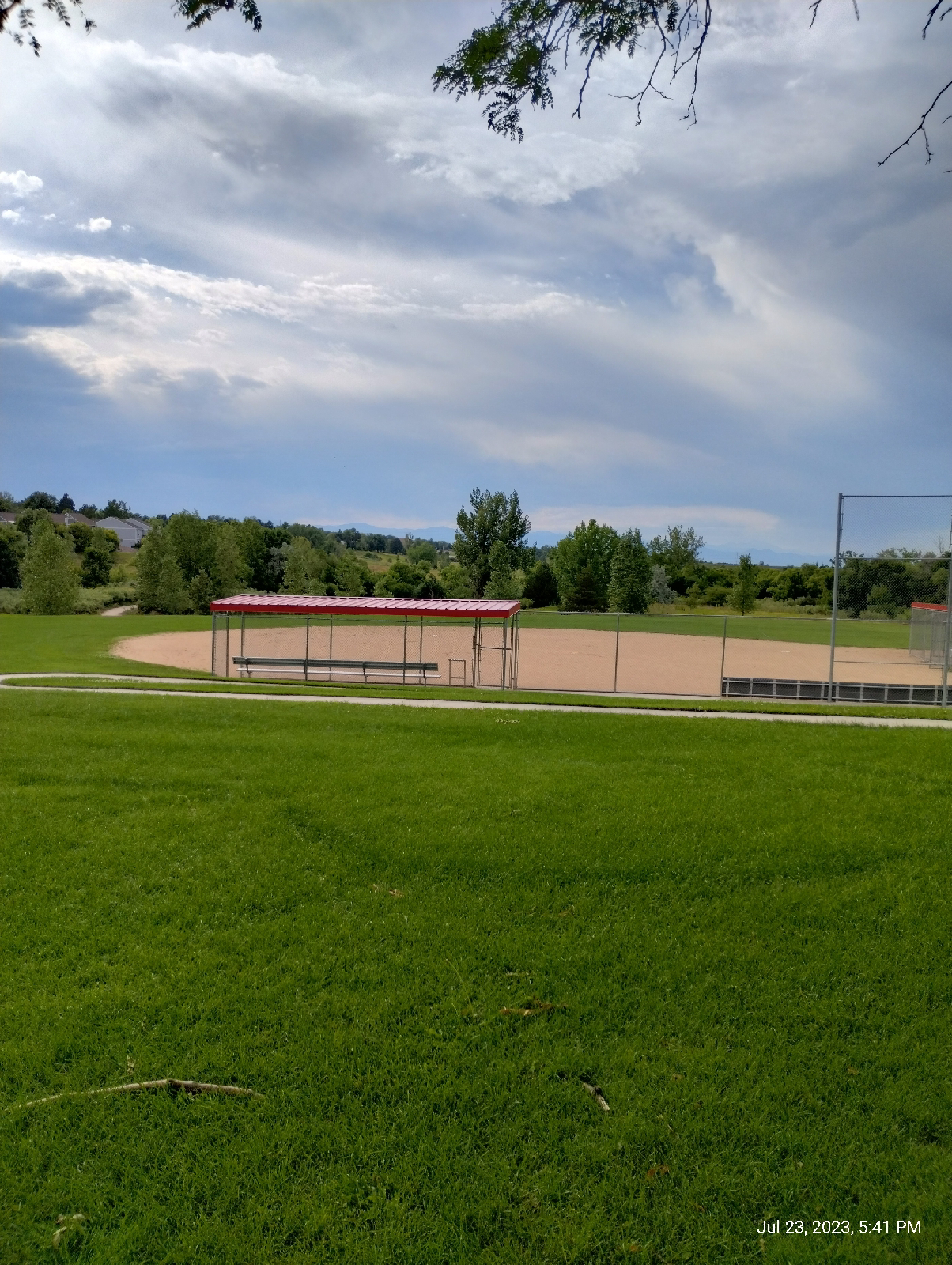
Willow Springs is located in and around Englewood Reservoir, a depression behind an earthen dam in Centennial. It infrequently becomes a lake. It's purpose is primarily flood control. But South Suburban is conscious of opportunities for education.

These plaques are scattered around the park explaining the purposes of the reservoir and conservation in the area. The dam, built in 1936, is 15 meters (50 feet) tall and 520 meters (1700 feet) long. It can impound 28 square kilometers (11 square miles) and 1,832,000 cubic meters of water. Usually, there's just a swampy area behind it.
That's the extent of the lake currently.

That's a bike park below the dam. There are nice views of the mountains from the top.
Arapahoe Road...I've walked up that grade way too many times. One of the grocery stores I use frequently is west of here. The photo doesn't come close to doing that hill justice. The tall building in the background is Village Center Tower One and it stands directly over Arapahoe light rail station. I'm going to cheat this time and not end up there. Home is at the top of that hill.

You're looking at the crest of the South Platte River valley. At the top is Interstate 25 and the light rail. The other side slopes down into Cherry Creek valley. Cherry Creek doesn't arise in the mountains. It's a plains stream that starts on Palmer's Divide near Castle Rock. One of the two major streams in the Denver Metro area, it joins the South Platte in downtown Denver.

Willow Creek joins Little Dry Creek a little northwest of this point. There's another of those flood control dams, Holly Reservoir, across the street.
And less than a mile east, Little Dry Creek passes under Arapahoe Road.
There's a stream gauge up there somewhere, but it's on private property in the middle of an HOA so this is as close as I'll go. It would just look like a metal box, anyway. I do get readings from it on my phone, though. 

The United States Geological Survey maintain hydrologic stations all over the country. Most of them transmit their data so the only human presence required is occasional maintenance.

The most primitive stage measure is just a ruler against a bridge support. There's one on Bear Creek at Knox Court.


The one in Sturbridge Community is a stillwell. The surface of streams tend to be turbulent, so it's hard to get precise measurements with a ruler. A Stillwell is a conduit from the stream to a vertical pipe. The surface of the water in the pipe is even with the surface of the water on the stream, except that it's still (thus, "still" well.). There are several setups that can convert water level to electronic data, for instance, a float connected to a pulley that drives a potentiometer. The electronic signal is then transmitted to the USGS site in Denver, or the water authorities in Centennial and Littleton, or to...my phone.

Little Dry Creek is at, eh, 

5.53 feet. I have two apps to track streams in my area: Flow Alert (by Shaina) and Rivercast (by Juggernaut Technologies Inc ). Both provide stage and flow data. The measurement shown above is a stage measurement. I can guarantee that Little Dry Creek isn't five feet deep there. Stage measurements are depths compared to some arbitrary vertical elevation. It might be sea level, or the surface of the stream at zero capacity (the problem with that is that the elevation of the stream bed changes with time and erosion), or a nearby survey marker. I don't know what they use here but it doesn't really matter since what you want is just a constant you can use for comparison over time. Here's what Little Dry Creek does over time.
We had a little spike on the twentieth, hardly flood stage at six feet  There was a little thunderstorm that day. I also get flow rate data.

Almost six cubic feet a second!

Streams have always fascinated me. I have an urge to follow them from beginning to end to see what they do. There may be meanders or waterfalls. My friends and I would dam up ponds to wade in. We'd camp on sand bars.

What do the streams in your area do? Do they ever flood? Is there a hydrologic station near you? How long does it take for the water level to rise after a rain? How long does it take to return to it's average stage?

Thursday, July 27, 2023

County Line Station to Dry Creek Station

The obligatory Rocky Mountains shot, this time from County Line Road.

A common city layout has straight roads in a grid with roads running east-west and north-south. In the Denver Metro area, the north-south roads are usually called "boulevards", and the east-west are avenues. The landscape tends to be hilly and obstruct long views on the boulevards but the avenues run down long slopes to the South Platte River and then back up the other side of the river valley. Going west, that affords some striking vistas of the Rocky Mountains.

The word "boulevard" looks French, and it is. It was originally the flat surface of a rampart but became the term for a promenade that ran along a city wall, then a road that circled a city, like circumferential bypasses in many modern cities.. It usually implies a broad thoroughfare planted with shade trees.

"Avenue" is also French and originally denoted a straight, tree lined street. Ironically, Denver has an Alameda Avenue. "Alameda" is the Spanish equivalent of the French "avenue". We have an Alameda Avenue in Denver.

County Line approximately follows the line between Douglas and Arapahoe counties. It also parallels Colorado 470, which is Denver's circumferential bypass.

 
Occasionally, I will lose a trail. Somehow I got off Willow Creek Trail and ended up in the middle of the Willow Creek Covenant community (aka HOA - Home Owners Association). These folks usually live in walled villages because they like the security of living around stable populations of homeowners and they tend to be suspicious of outsiders. Many of the popular trails in the Denver area run through HOAs. It always makes me edgy to find myself in an HOA. I've seen too many horror movies (The Stepford Wives, Black Cove, Fear Itself: Community, there was even an X-Files episode).

I did appreciate the appearance of this Little Free Library, a corner bookswap supported by the Little Free Library organization, and the facing title was Tenderness of Wolves by Stef Penney (it's, uh, not really about wolves, by the way).

Predictably, as I came to residents, they looked at me like "Who is this guy?" but, when I asked how to get back to the trail, they brightened up and became chatty.

When I rejoined Willow Creek, I found that it had grown considerably.

Most of these creeks have numerous tributaries, but they also run over active aquifers creating a dynamic give-and-take with the local ground water. The Dawson and Arapahoe formations are close to the surface around Willow Creek.
Willow Creek Open Space provides a wide park in the center of the Willow Creek community. It also provides a rare public restroom along the 8 mile trail.


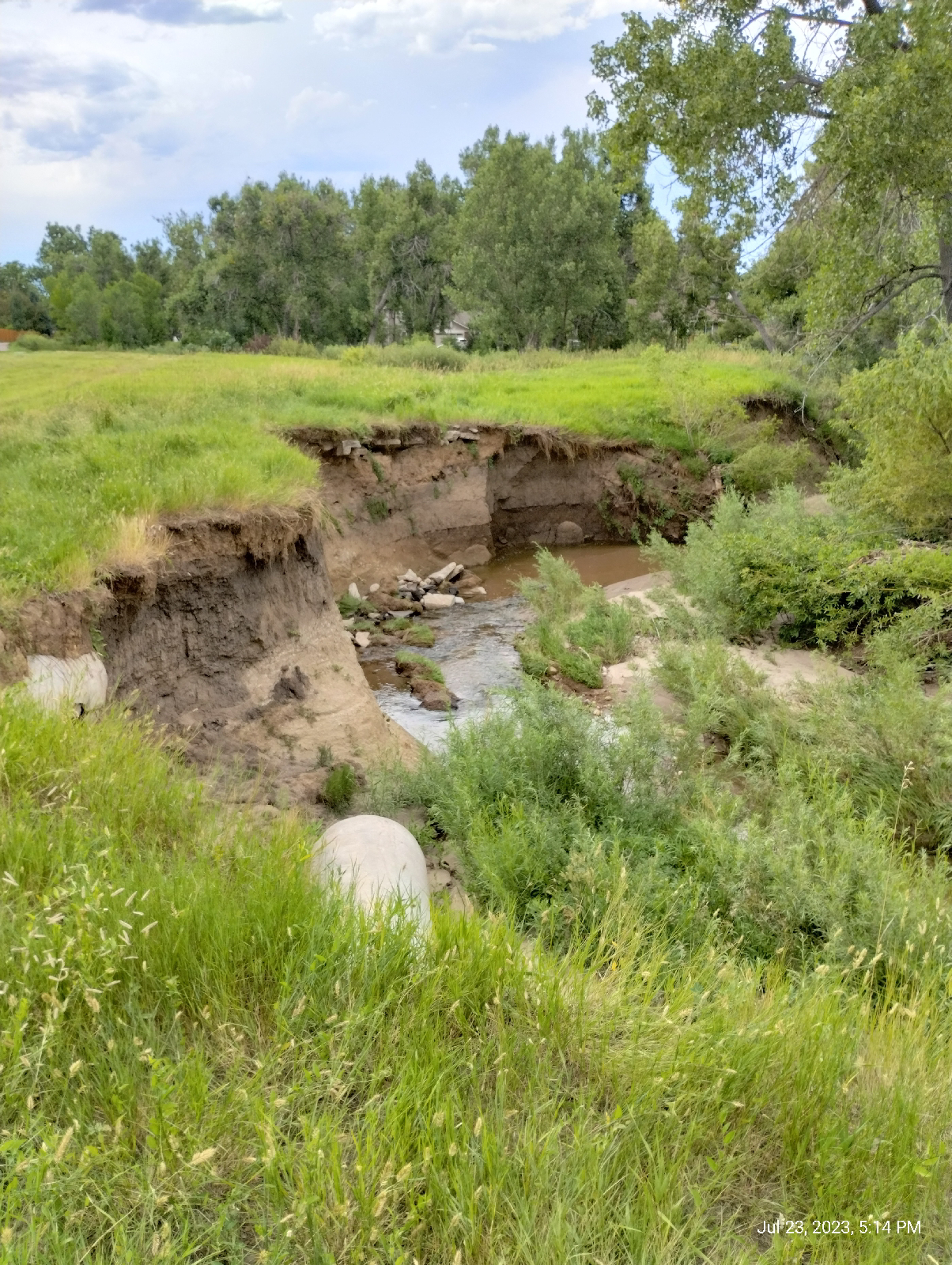
The stream gouges out some tall banks into the soft sandstone and clay of Arapahoe county.
I left Willow Creek at Homestead Elementary School on Dry Creek Road overlooking Englewood Reservoir. That will be the main point on the next station-to-station hike. I took a snack and long rest before continuing up the slope to Dry Creek Station. From here, I will be hiking along the divide between the South Platte River and Cherry Creek.

The school has a memorial to family members lost in the 9/11 attacks.
As I walked up Dry Creek Road, my neighborhood, Walnut Hill, was to the left and the Willow Creek community was to the right. This is home territory.
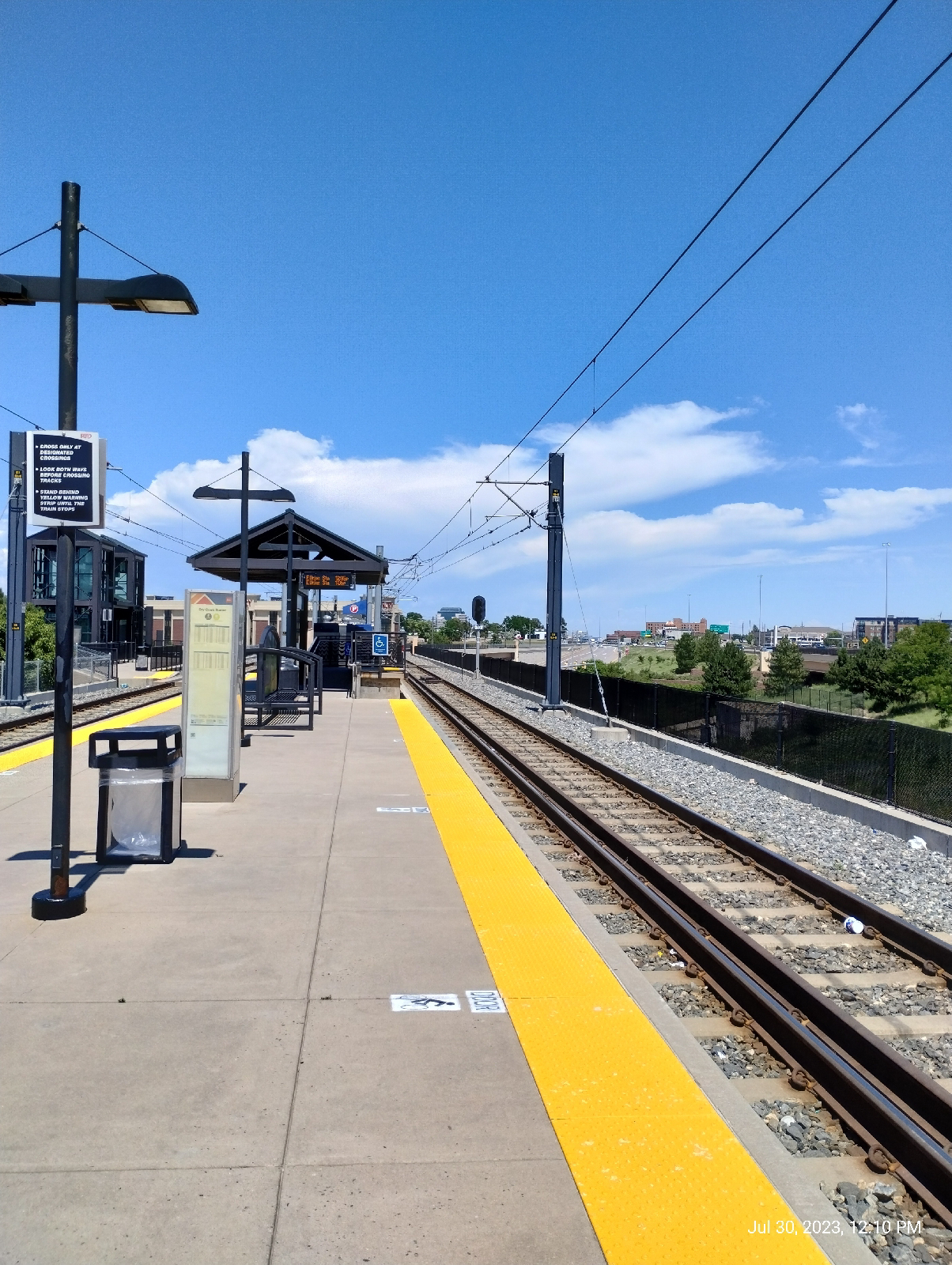
Dry Creek Station has the longest pedestrian bridge I've seen at any of the RTD stations.
Trains have traffic lights, too.

When a train leaves a station, the light at the next station comes on. It's not really there for the riders. The three colors mean about the same thing for the conductors as they do on traffic lights for cars. Green means the track ahead is clear, amber means to proceed with caution, and red means that there's a problem down the track.

The E/F Lines and the R/H Lines out to Peoria and the airport are complex with branches and parallel tracks that can turn into a single track that carries traffic in both directions. And the overhead lines that feed the electric light rail trains have to keep up with the rails. During the time I've been using RTD, these lines seem to have most of the technical problems. I'm going to assume the complexity has something to do with it.
But the train always arrives, eventually, and carries me on up the line and to home, which is currently Arapahoe at Village Center Station - next destination.

Monday, July 17, 2023

Lincoln Station to County Line Station


Blue skies. 91 degrees Fahrenheit on my weather meter. Those high, icy, citrus clouds mean that there's moist air moving in up there but down here, it's just hot and humid (33% humidity) and promises to get hotter. Atmospheric pressure is up and down and I don't expect any storms to break the pattern.

But, visually, the day is beautiful and I can focus on that.

These early E/H Line hikes explore Willow Creek. It is a nicely typical stream to explore.

 Notice that the Bluffs seem to curve around something...like a chunk has been gouged out in the middle. That's because a chunk has, indeed, been gouged out in the middle. Willow Creek did most of that.

Remember that most of these streams, in the past, were much larger. Willow Creek was, perhaps, not a huge stream. The pictures you'll see show a fairly narrow valley, much smaller than, for instance, Little Dry Creek Valley, despite the fact that it runs a longer course.

Typically, a stream begins it's journey at a steep gradient that gradually gets shallower the further it runs. The amount of water it carries also tends to increase and it's power to erode downward into the earth decreases, although it's sluggish meanders broaden it's valley as it continues it's course.

Willow Creek isn't long enough to get out of it's steep, wild section before it joins with Little Dry Creek. There, it takes the other streams name and becomes Little Dry Creek as it runs down to the South Platte River in Englewood.

Of the two creeks, Willow is more variable and more likely to flood, partially because the aquifers that feed it are more productive. Most of their volumes are contributed by runoff and Willow has a longer run to pick up storm water.

The area around Lincoln Station is affluent and much landscaped, but landscaping isn't just about artistry as this sign explains. This area collects storm water and provides a porous surface which also acts as a filter to trap contaminants.

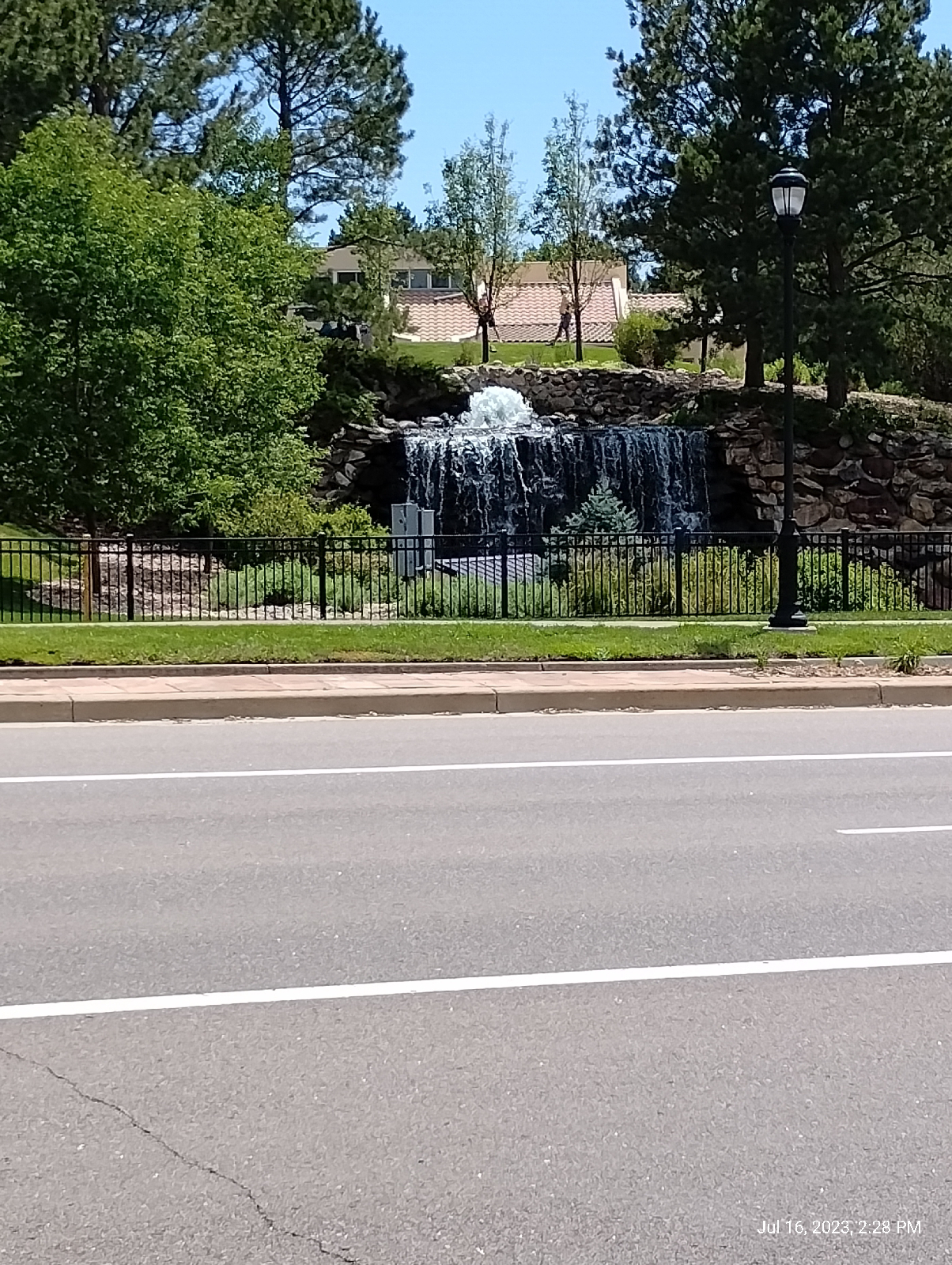
As usual, Lone Tree, a suburb of Denver, being a desert town, likes it's water features. If you want to see a waterfall in the Metro area, water features are your only options. This one is at the Lone Tree Golf Club.
This is a golf course so the landscape has been modified, but it does give an idea of how narrow and shallow the valley excavated by Willow Creek is.

On one hand, golf courses require a lot of water to maintain, pamper invasive lawn grasses, and sink a lot of agricultural chemicals into the ground, but they do manage the water they use and water fowl such as these egrets and ducks, like it.
Here is another shot of the valley back toward the headwaters.

After Lone Tree Golf Club, the creek flows through Sweetwater Park and the Park Meadows shopping district. Here it finds less managed, and softer land to cut into. Also, it has picked up water from Cook's  Creek and other sources. There are some interesting banks cut into muddy sandstones and sandy mudstones of the Dawson and Arapahoe formations.
I was pleased to see the tunnel under C470, the main bypass around Denver. The air in it is about 20 degrees cooler than the air outside.
There are some interesting stalactites hanging from a crack in the ceiling (Remember. If it's from the Ceiling, it's a stalaCtite. If it's from the Ground, it's a stalaGmite.) 

I suspect that these "cave formations" are made from gypsum redeposited from water percolating through  the sheetrock of the walls.

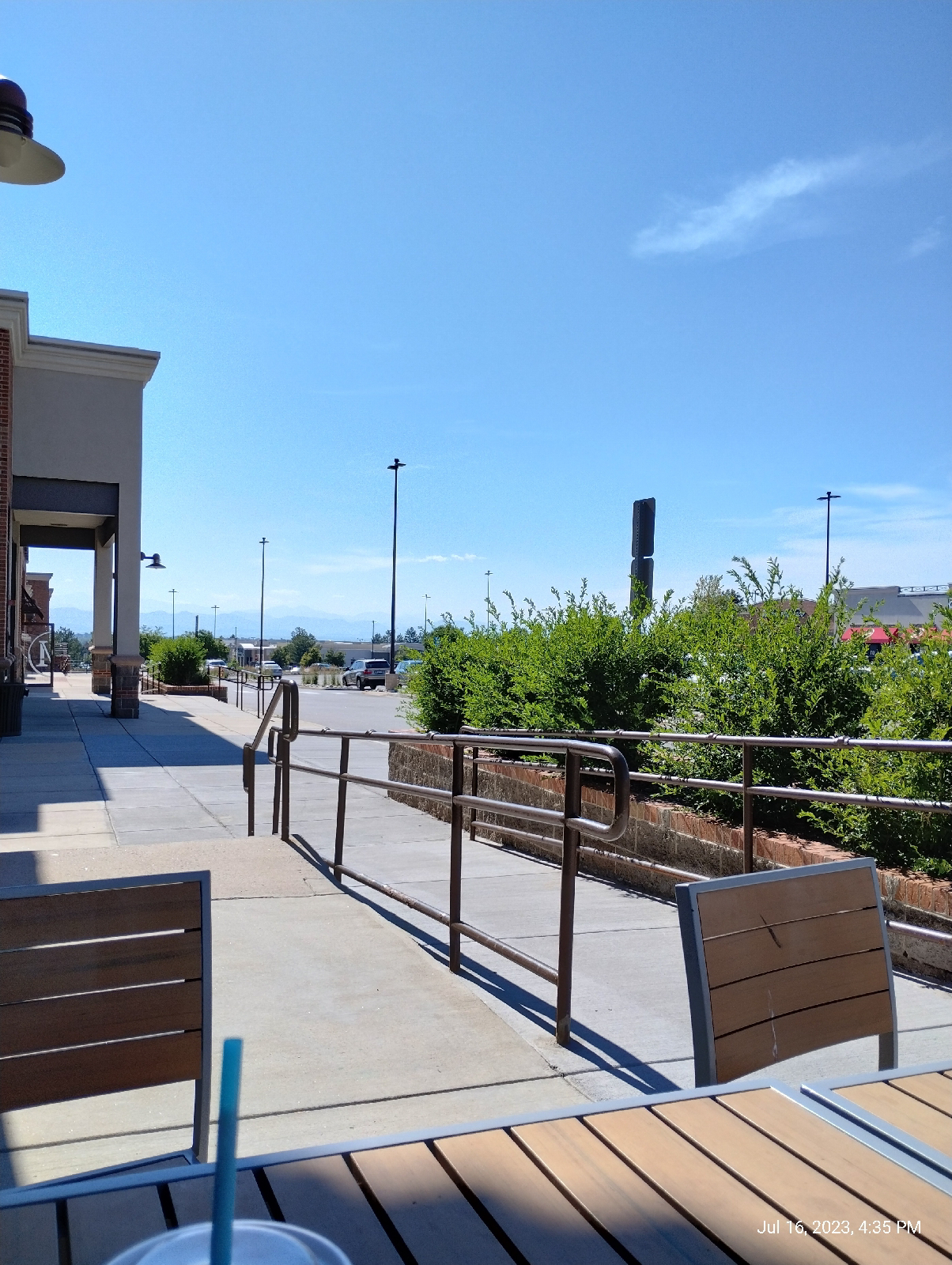
I really have to watch my hydration in this weather and, as I neared County Line Station, I really needed to cool off and get something to drink so I stopped at Tropical Smoothie Cafe for a large Watermelon Mojo Smoothie and a rest in the shade. Here's a view of the Rockies (and the top of my drink cup).

I took my time and felt much better when I walked the last short stretch to the station.

County Line Station is at the edge of the huge Park Meadows shopping area. The light rail and I-25 is on the other side of that wall.
In addition to a packed, sprawling parking lot, the station has some nice views of the surrounding countryside.

This hike brings me to very familiar territory. Little Dry Creek is the only stream in my neighborhood large enough to have a name but the southern ridge of Little Dry Creek valley is the northern ridge of Willow Creek. The next neighborhood to the South is Willow Creek covenant community and I will explore that on the next hike.