I started at the spring behind the Safeway offices. Everything above that is runoff.

My elevation was 5720 feet according to my topographical map. Air temperature was 74.7° F so I was shedding clothes. The stream water was at 3.5° C. It was coming directly from the Dawson formation so it was cold. I'm flip flopping between Fahrenheit and Centigrade because most weather is reported in Fahrenheit but I like to know how far above freezing things are. Water freezes at 0° C.
I tried to get an idea of the flow rate when I took samples for later analysis. I measured approximately average depth and width and tried to clock a piece of balsa wood floating downstream. But the wood wouldn't move. The flow rate at all three sites was "a trickle". I know that the water was moving because it was flowing over the weirs
The stream here was two inches deep and 12 inches wide.
The Dawson aquifer isn't very productive and having watched the flow rate recorder by the gauge near Arapahoe (It has been nonfunctioning for a couple of months now) and keeping an eye on the spring, it looks like the flow rate responds to rain fall and snow melt almost entirely.
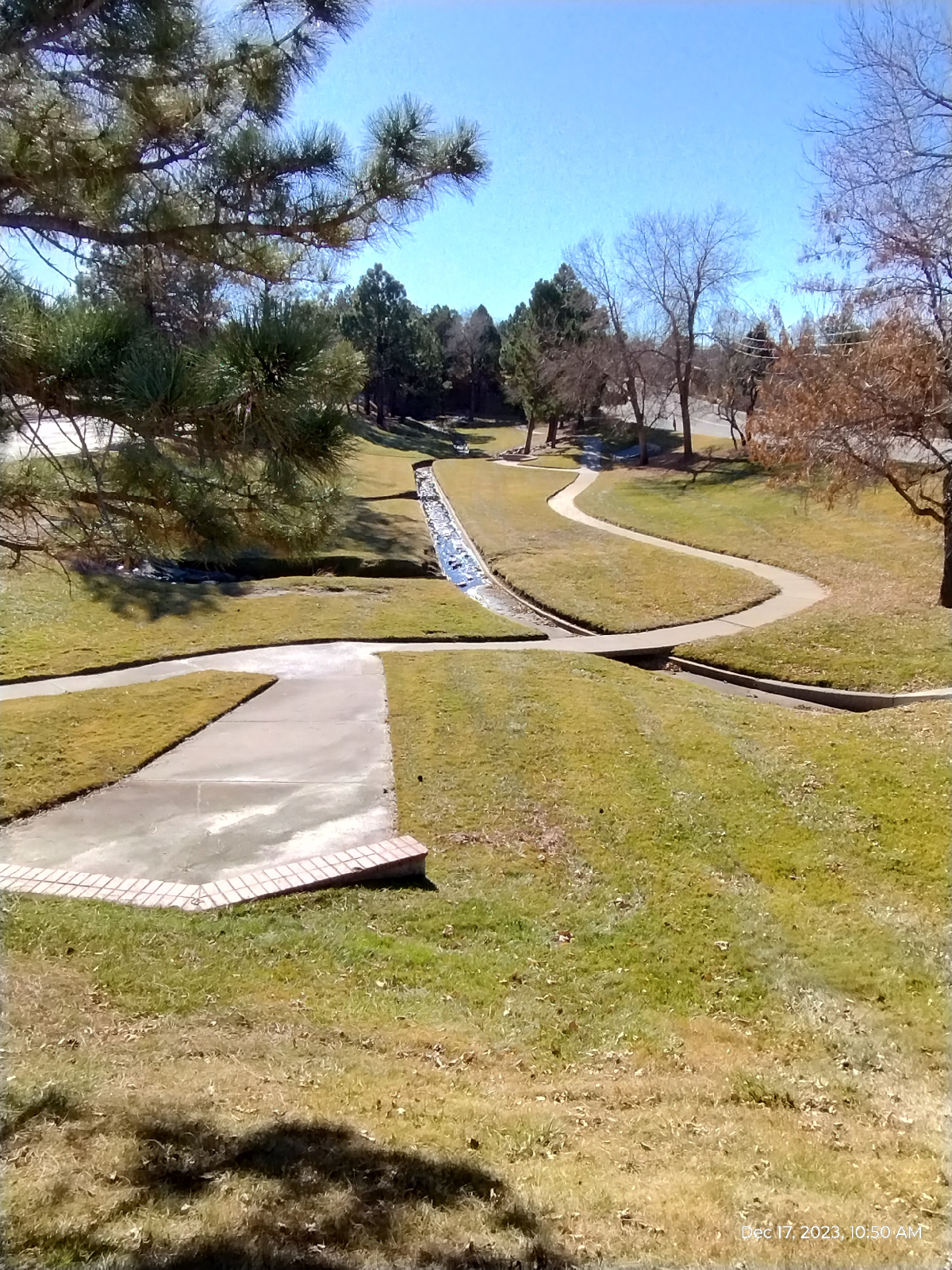
A network of runoff channels between Yosemite and Alton Way carry Stormwater into Little Dry Creek for and initial boost. The creek shows a good start at valley building.

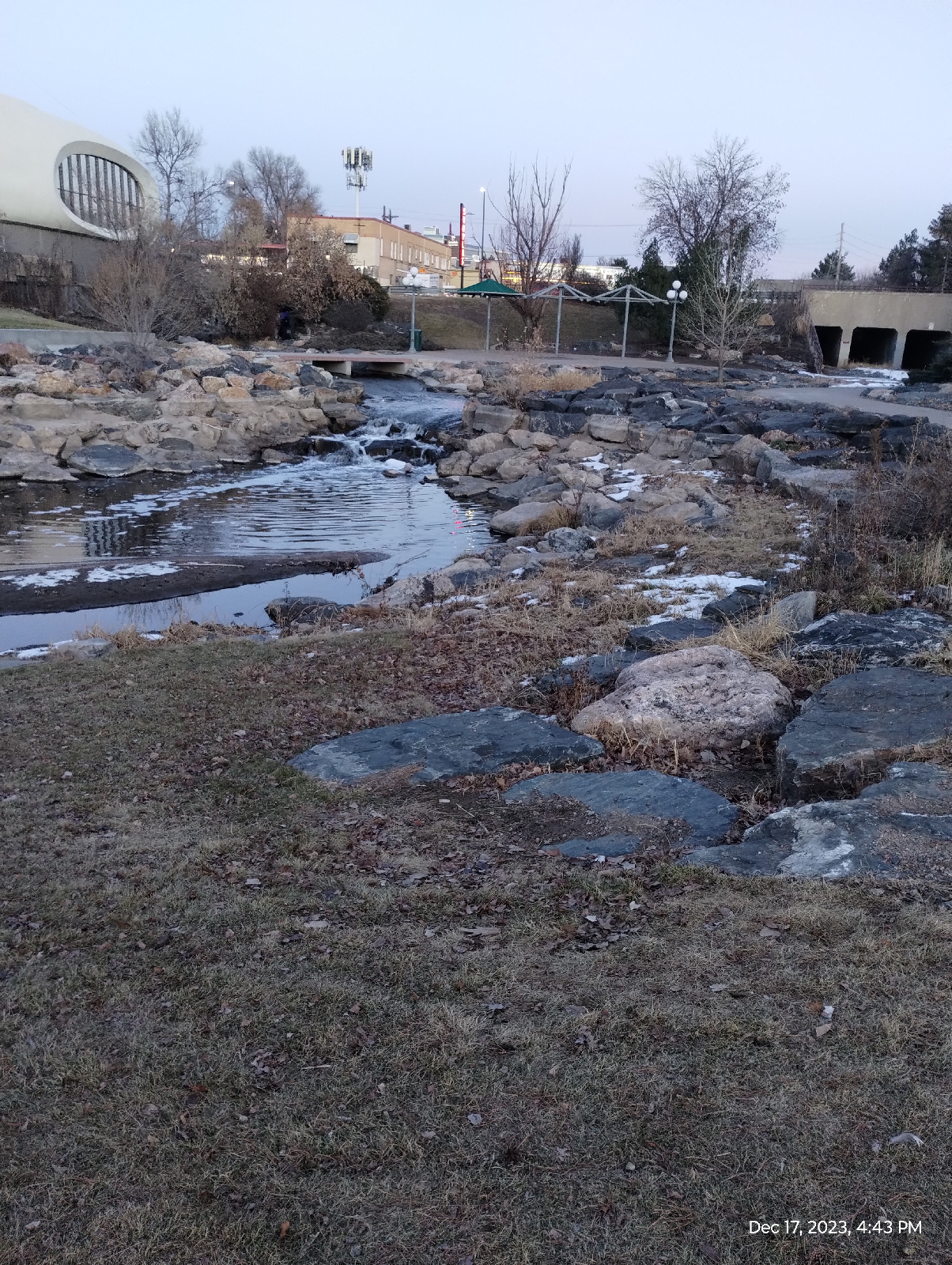
This view is just west of Yosemite from the spring at the beginning of the Little Dry Creek Greenway. From here on, rocks and weirs (overflow dams) have been added to the bed and shoulders to manage erosion.
Any large rocks in the area are primarily brought in for landscaping and erosion control, so this is not a good area for studying the indigenous bedrock. The top soil is shallow and the underlying material is clayey, weathered bedrock. The bedrock is colluvium, the pulverized material washed out of the Rockies that filled the Denver Basin in recent geologic times

My second sampling site was between Little Dry Creek Park and Uinta Street. The banks of the stream are steep and there are several slumps where gravity is pulling chunks of the bank into the creek. Closer inspection show these slumps to be saturated with water. They look like seeps, slow moving springs from the underlying Dawson aquifer.
There was a small slump that was just big enough for a foot and a knee. I knelt on that to take a temperature reading and water sample. The temperature was 6.6° C. Trying to stand, I overbalanced and went in head first.
I came out really quickly
Little Dry Creek is polluted and smells bad. I hoped that the rest of the ten mile hike would give me a chance to dry and air out. On the train back home, no one looked particularly offended so it must have worked.
The water here was 3 degrees warmer than at the spring. I would be tempted to credit that to kinetic energy of flow but it probably had much more to do with the amount of surface area exposed to the sun. The creek was 50 inches wide there. The depth was 14 inches (just enough to totally submerge me and make me actually swim to get out.) Air temperature was down from the spring....68° F., about 7 degrees colder.
This was where I gave up trying to measure the flow rate by throwing chips of balsa into the water. There was flow. Water was trickling over the weir downstream, but the surface was dead calm. There was an active storm sewer dumping into the creek upstream and the aquifer was adding volume at the seeps.
The creek is geologically young but the material under it is clayey debris and crumbly arkose sandstone so it has no problem cutting into it. The whole length has vertical banks from 2 to over 20 feet high, moderate meanders, and a broad valley.

Here's a topographic view of the first quarter of the course of Little Dry Creek from "Highlands Ranch Quadrangle, Colorado, 7.5 minute series." If you're not familiar with topographic maps, the brown lines are elevation contours. The closer they are, the steeper the incline. The v-shaped contours around the creek point upstream.
One advantage of this hike is that it follows a creek that's flowing downhill. There's not a lot of "up".

The third (and last) sampling site is a pretty little cascade just before Spruce Street. It's not "natural". Those granite and gneiss boulders were artistically placed there by Parks and Recreation workers. They did a nice job. A culvert empties an intermittent tributary into Little Dry Creek below where I sampled. (See the blog "Walnut Hills: The Big Hill")
Little Dry Creek was colder here (3.4° C), almost as cold as at the spring. That's interesting since the air was warmer (68.2° F) than at the second site. And I would have expected those rocks to have been soaking up sunlight and transferring the heat to the water.
The stream was 112 inches wide here and 16 inches deep. Of course, the stream dimensions can change but there was no reason for big fluctuations Little Dry Creek is historically pretty consistent, so it's reasonable to compare them from site to site. Within about half a mile, the stream has more than doubled. Runoff isn't large so I'll assume that it's being fed by that aquifer.
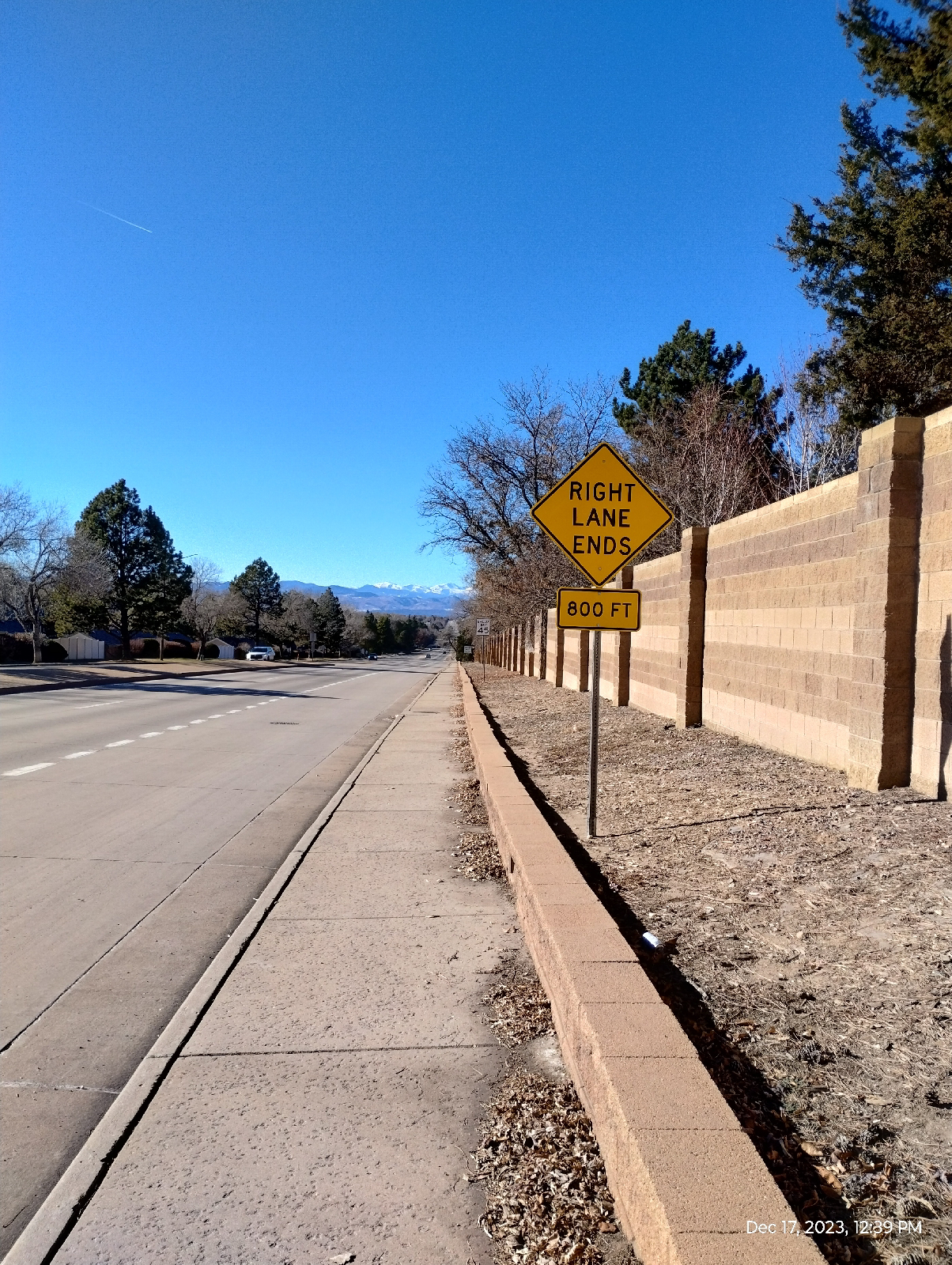
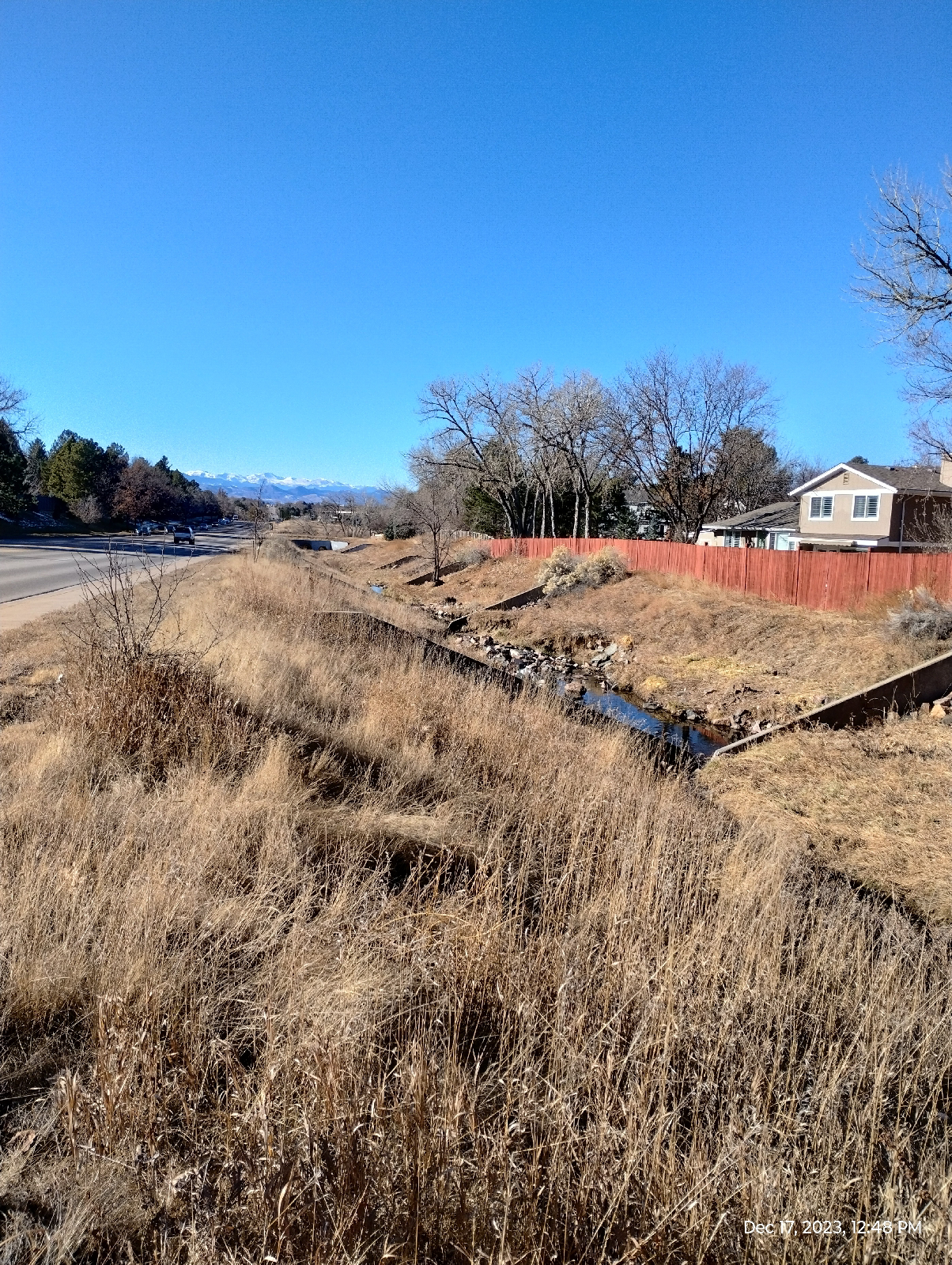
Past Quebec, Little Dry Creek flows through an HOA, requiring a detour up to Arapahoe and down to where the stream emerges from under Arapahoe to continue it's journey into Holly Reservoir. The approach is over a series of weirs (the area is always flood conscious) that parallel the road.

There used to be a pedestrian tunnel that passed under Arapahoe beside the creek, but they closed it off before I moved to the area over three years ago. People must have still tried to use it, because the county then covered the approach ramp with crushed granite.

Holly Reservoir (by Holly Road) is home to a recreational center with tennis courts, a swimming pool, and water slide. The creek meanders it's way through the basin and under the dam. In the case of a massive(!) storm, there could be a lake here. I can't find any record of there ever having been such an event but better safe that sorry.

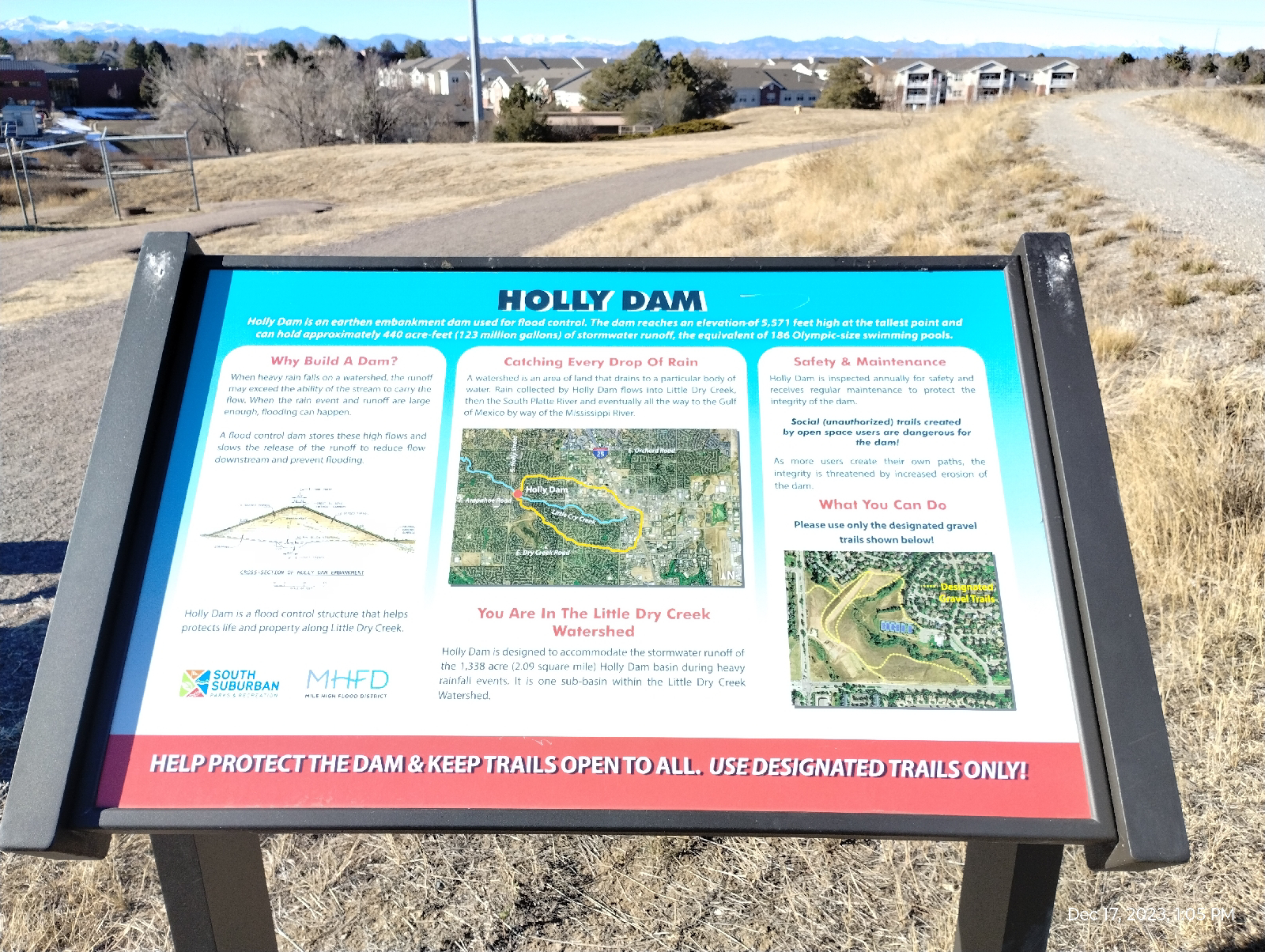

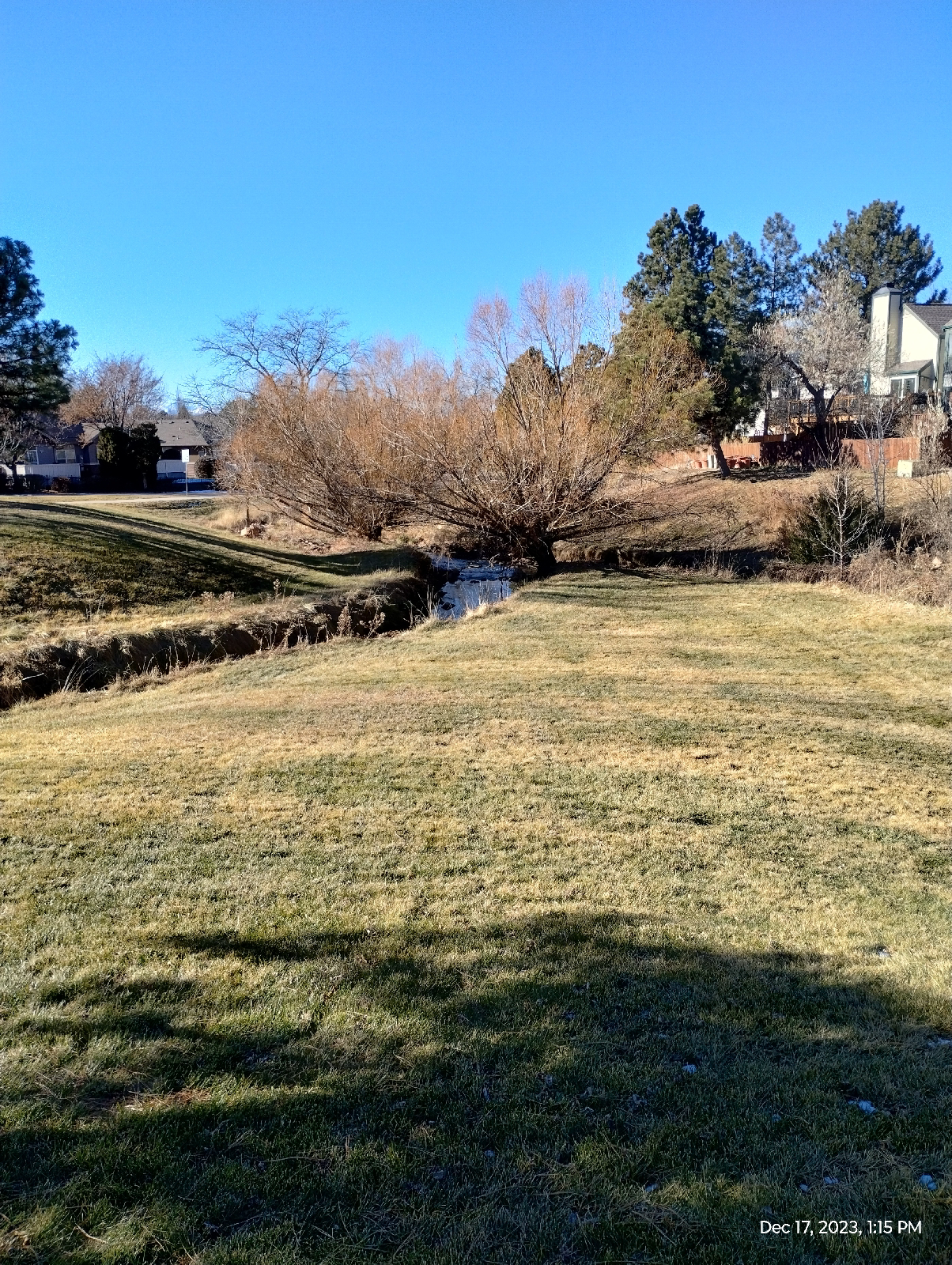
Just below Holly Dam, Little Dry Creek and Willow Creek merge. Usually the resulting Creek takes the name of the larger stream, but not in this case. Willow Creek is usually larger, has traveled further, and occasionally will create a lake behind Englewood Dam but the creek that flows from this confluence is called Little Dry Creek.

That's Willow coming in from the left.


In this stretch, Little Dry Creek widens out and cuts a fairly deep gorge. There's also a steepening incline.
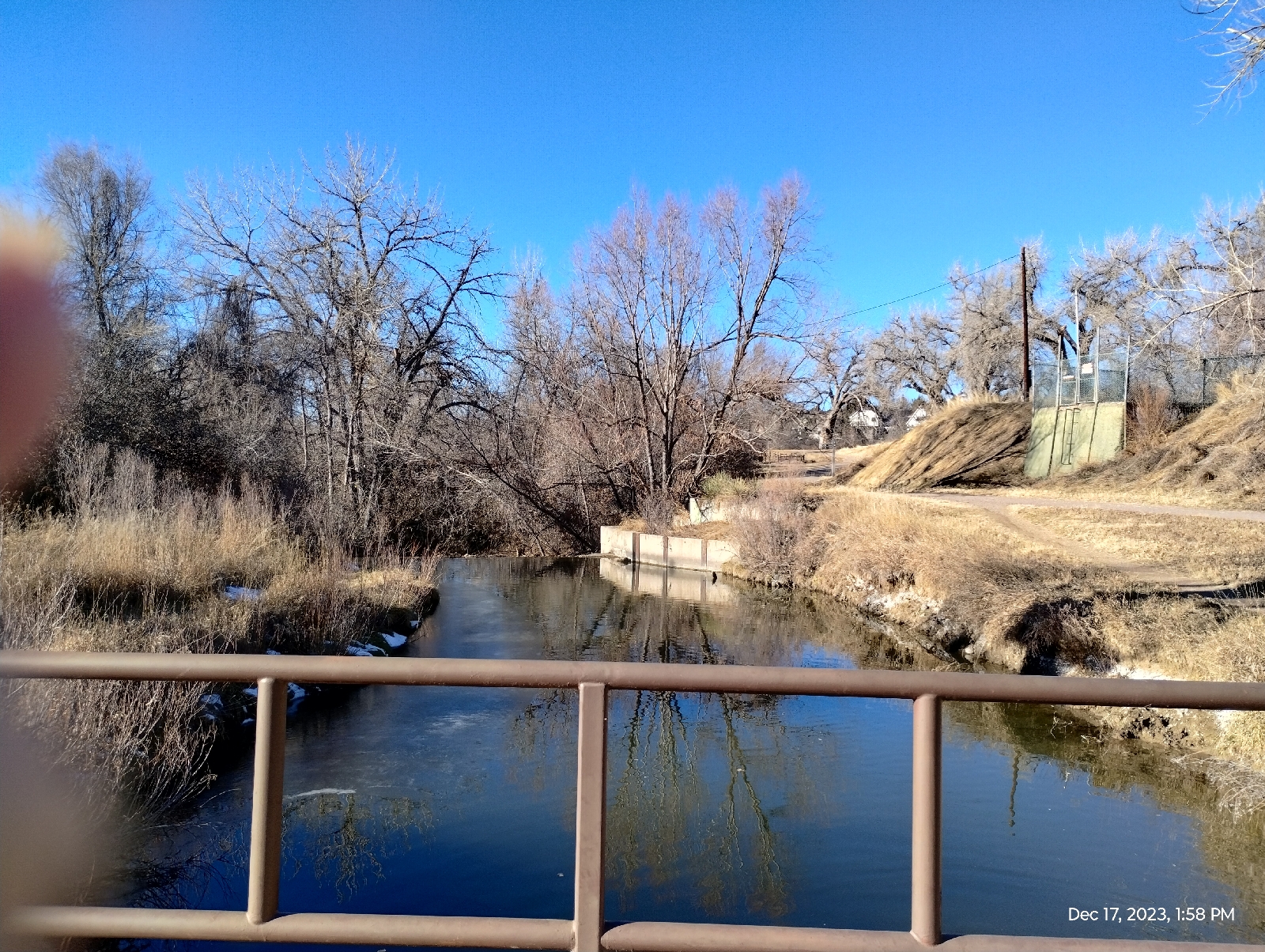
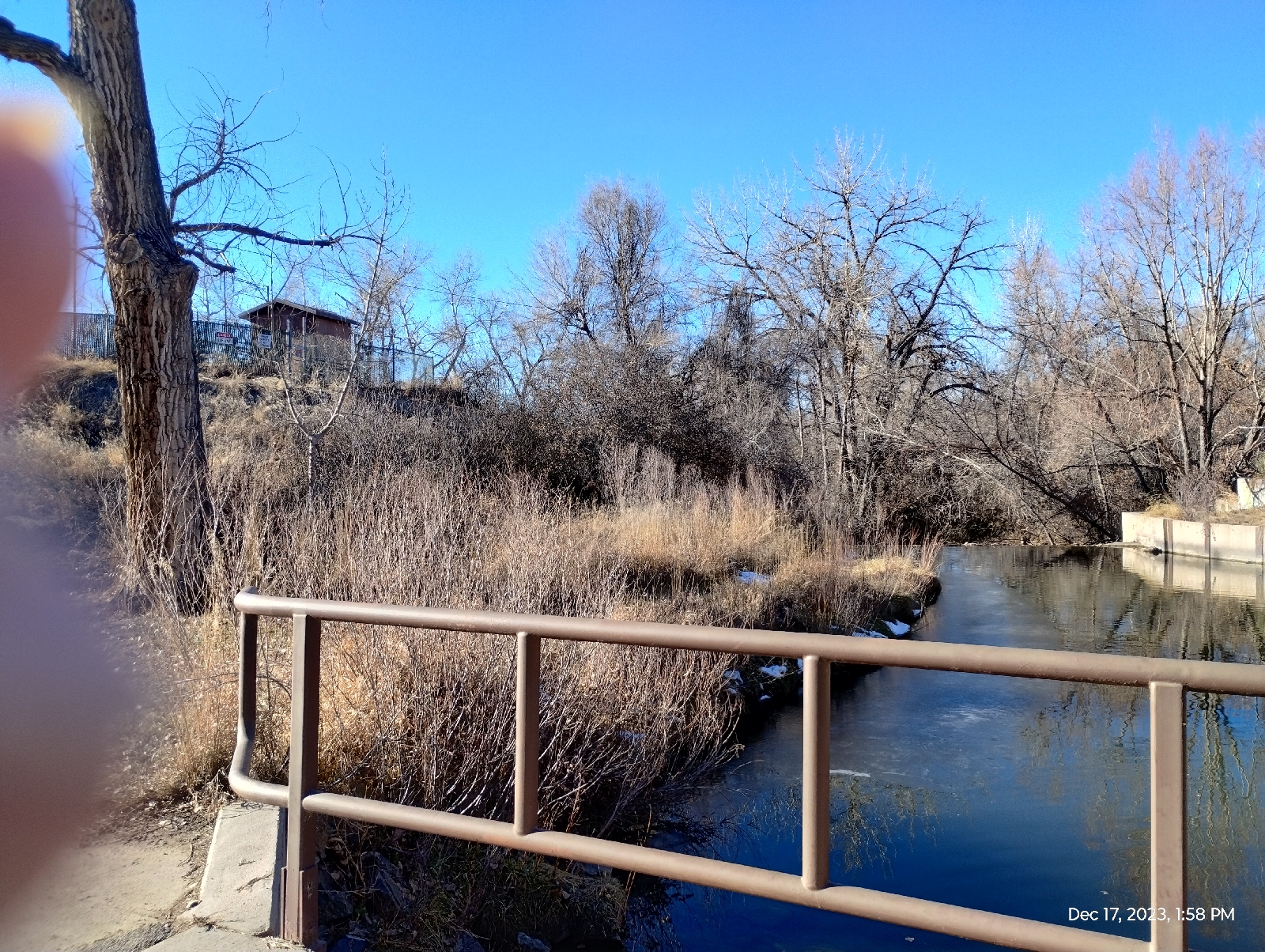
The Highline Canal leaves the mountains in Watertown Canyon and flows under the influence of gravity for 66 miles (in the past as much as 71 miles) to the Rocky Mountains Arsenal in northeastern Denver. Along the way, it crosses several natural streams, including Little Dry Creek. It does so by following lines of elevation contour. Natural streams generally cross contours at right angles. The crossings present engineering problems.
There are several places where the canal crosses over streams on water bridges called "aqueducts". The photos above show the syphon where the canal crosses under Little Dry Creek. I would have taken a picture from the top except the canal usually doesn't flow during the winter months.
The canal flows into the tunnel from the left (south) and exits a little lower from the right (north). It works pretty much like syphoning gasoline (or any other fluid) from a tank. The starting level is above the outflow level, so the syphon doesn't have to be primed, which is good since the canal is dry for most of the year.

Little Dry Creek is temporary home to many water fowl. Ducks are common but I've seen many others including egrets and herons. They don't usually make themselves at home but they visit often.

After a brief run down between a meander in the Highland canal, the creek takes off through backyards in Cherry Village, so I had to start some road work down Orchard and Long to University Boulevard where I picked it up again near Quincy. From there, it's an urban aqueduct, flowing between concrete walls.

It feeds some private lakes...
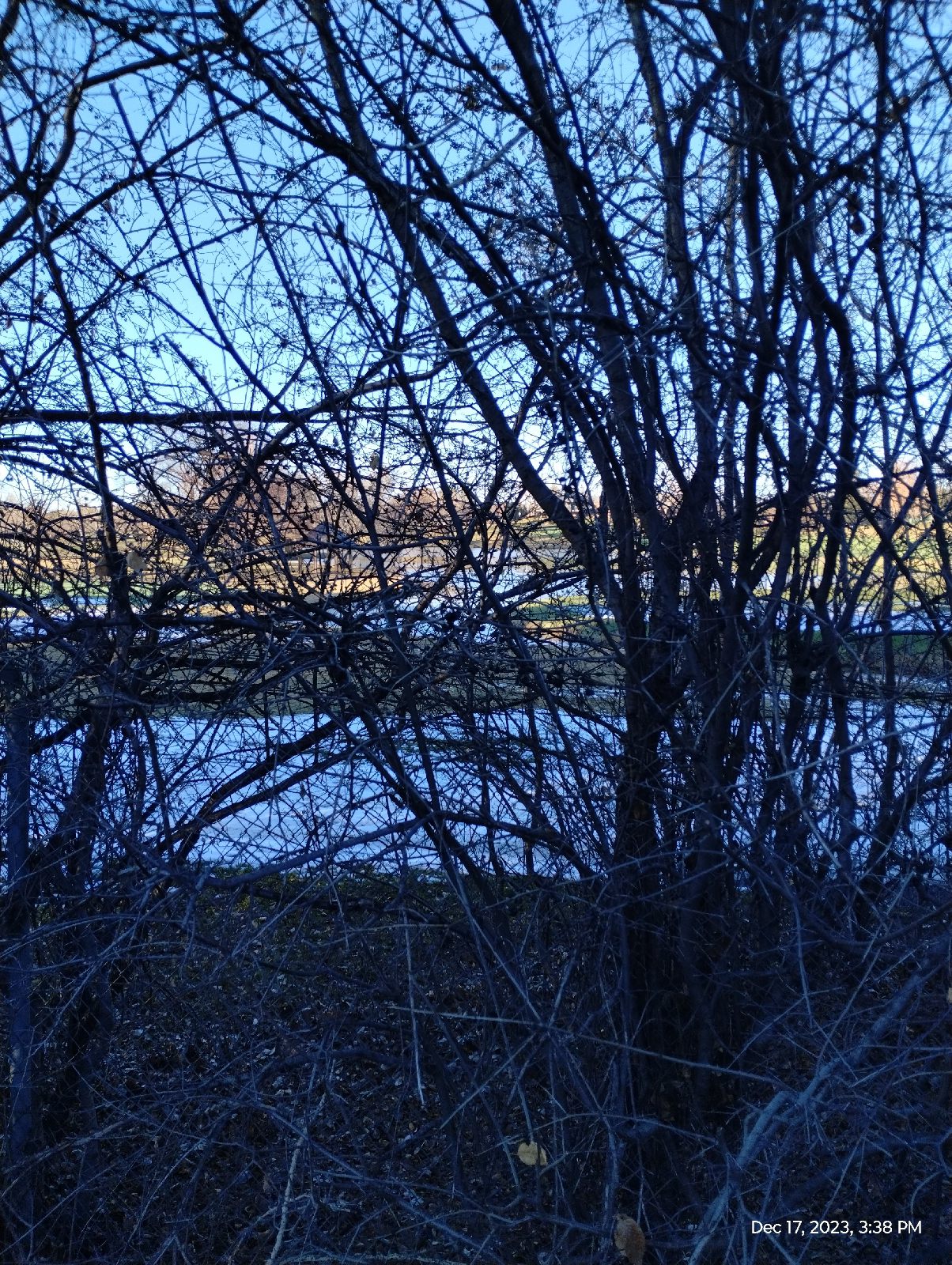
and water features in a golf course.

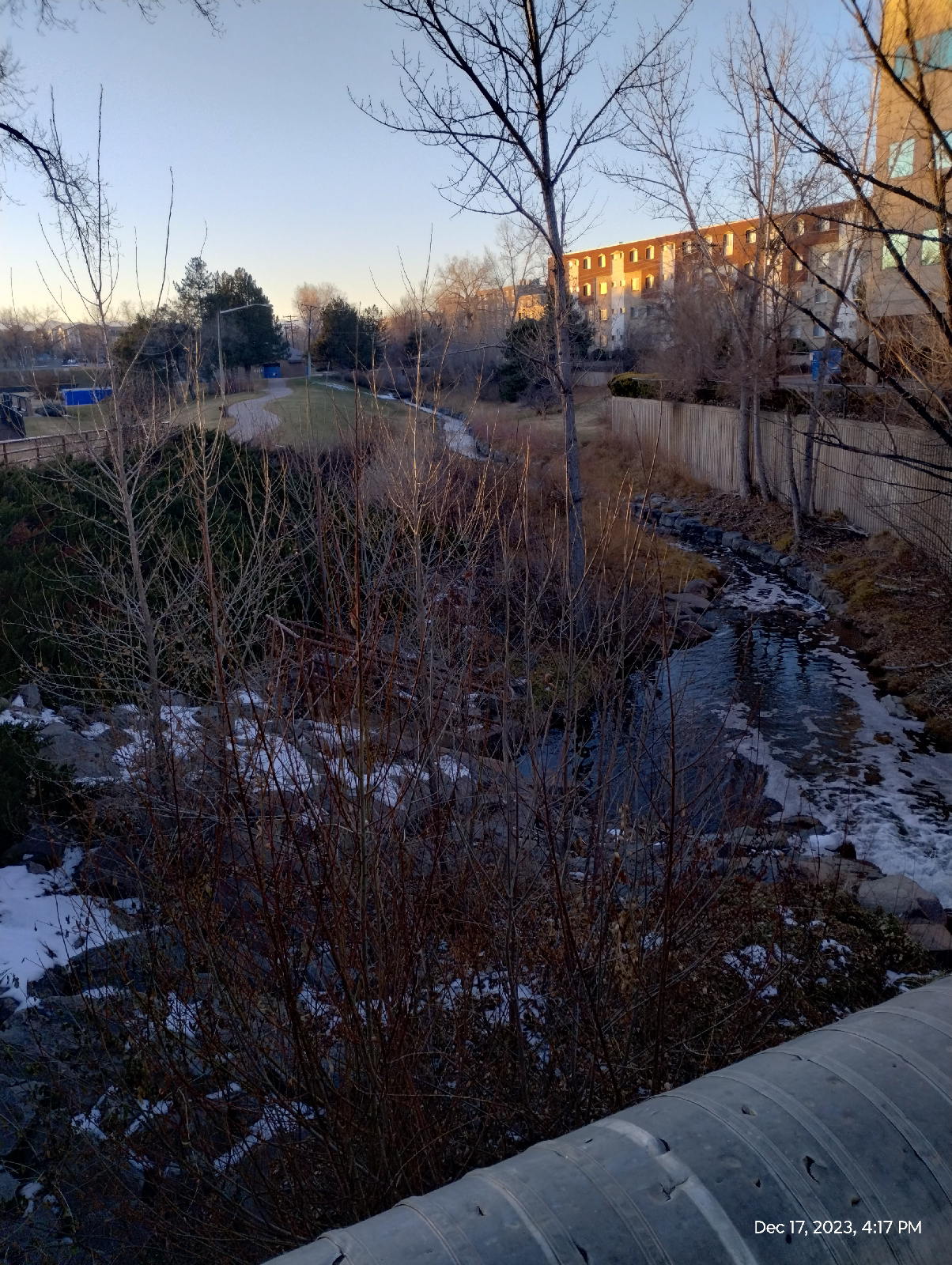
but most of it looks like this for the rest of it's course.
This is South Denver and Englewood with many shopping areas and apartments so flood control is pretty tight. As many tributaries that have joined the creek, I would not be surprised to see it clear its banks (I've never seen it but I wouldn't be surprised.) It doesn't get water directly from the mountains so the main thing that leads to flooding, melting snow pack, isn't that much of an issue.
Concrete culverts don't really draw me, but there are some points of interest here


This was a surprise to me. I have seen many of the early sites of gold finds...Clear Creek, Montana City, Bear Creek confluence with the South Platte. These are all streams from the mountains. They erode mineralized, crystalline rock. This first significant gold find was from Little Dry Creek, a creek that runs it's entire course through the debris that has been washed from the Rocky Mountains. That means that a pocket of gold must have collected somewhere by an ancient stream, waiting until Little Dry Creek found it and washed it down to present day Englewood where it waited for William Green Russell to come along from Georgia to pan it out. Why was he even looking here?
Nearby, the creek runs below ground to travel under the Englewood shopping district.

By the time I got to the other side, it was too dark to finish photographing the last section of Little Dry Creek, but a couple of weeks later I made a supply run to the area and finished the tour.

The tunnel in the background is where Little Dry Creek emerges from underground in Cushing Park. Here at the confluence with a drainage stream from the park, it looks like a rushing mountain stream. It's landscapes....the rocks were placed.... there's no telling where they're from. They're there to prevent erosion of the bank.

A little further down the rocks give way to a concrete channel as the creek passes under the railroads and the CanAm Highway (Santa Fe) on its last approach to the river


The underpass is decorated by a mural by Boulder muralist and graphic artist Amanda Wolf (2021).


An overlook over the South Platte River gives a good view of the confluence.

You have to cross the river by the nearby footbridge to see the mouth of the creek


There's a low overflow dam just upstream.
At the river, I checked the elevation again and found it to be 5256 feet. That's an elevation loss of 464 feet. I'm glad it was mostly downhill.
So that's the Little Dry Creek from beginning to end. I'll be saying more about its contents. And I'll show you some rocks I encountered along the tour.
Have you ever followed a creek from beginning to end? Do your homework first and stay safe.