Showing posts with label sundial. Show all posts

Monday, November 9, 2020

A universal sundial

A world globe can be used as a sundial that can tell you the time of day anywhere on Earth, time of sunrise and sunset, how the seasons work, and many other things. All you have to do is orient it in the same direction relative to the sun as the Earth. That way, it models Earth in space. Here's how you do it.

You will need a surface that can be tilted (and, possibly a clamp for the base of the globe to keep it from tilting over. Alternately, there are globes that can be tilted in respect to the base.) You will also need a mini-gnomon. A gnomon is just a vertical rod that will cast a shadow in the sun. It has to be small enough to position on the globe's surface. I used a plastic bottle cap and drove a screw through the center from underneath. (The screw should be as near a right angle to the surface of the cap as you can make it. You can test it with a carpenter's angle or even the sides of a sheet of paper.) After using a carpenter's level, or a phone app level to level the surface you will place the globe on, place the cap on the surface and mark the edge at the point north of the screw. Use a magnetic compass or a phone app but don't forget to look up the correction for true north from where you live and add or subtract it from your compass bearing. (Do an Internet search for "magnetic declination".)

With the line between the screw and the edge mark pointing north, make another mark with an erasable marker at the end of the screw's shadow from the sun.


Now, set your globe on the surface with the north pole pointing north (according to your compass with the correction to true north.). Rotate the globe until your position is on top.
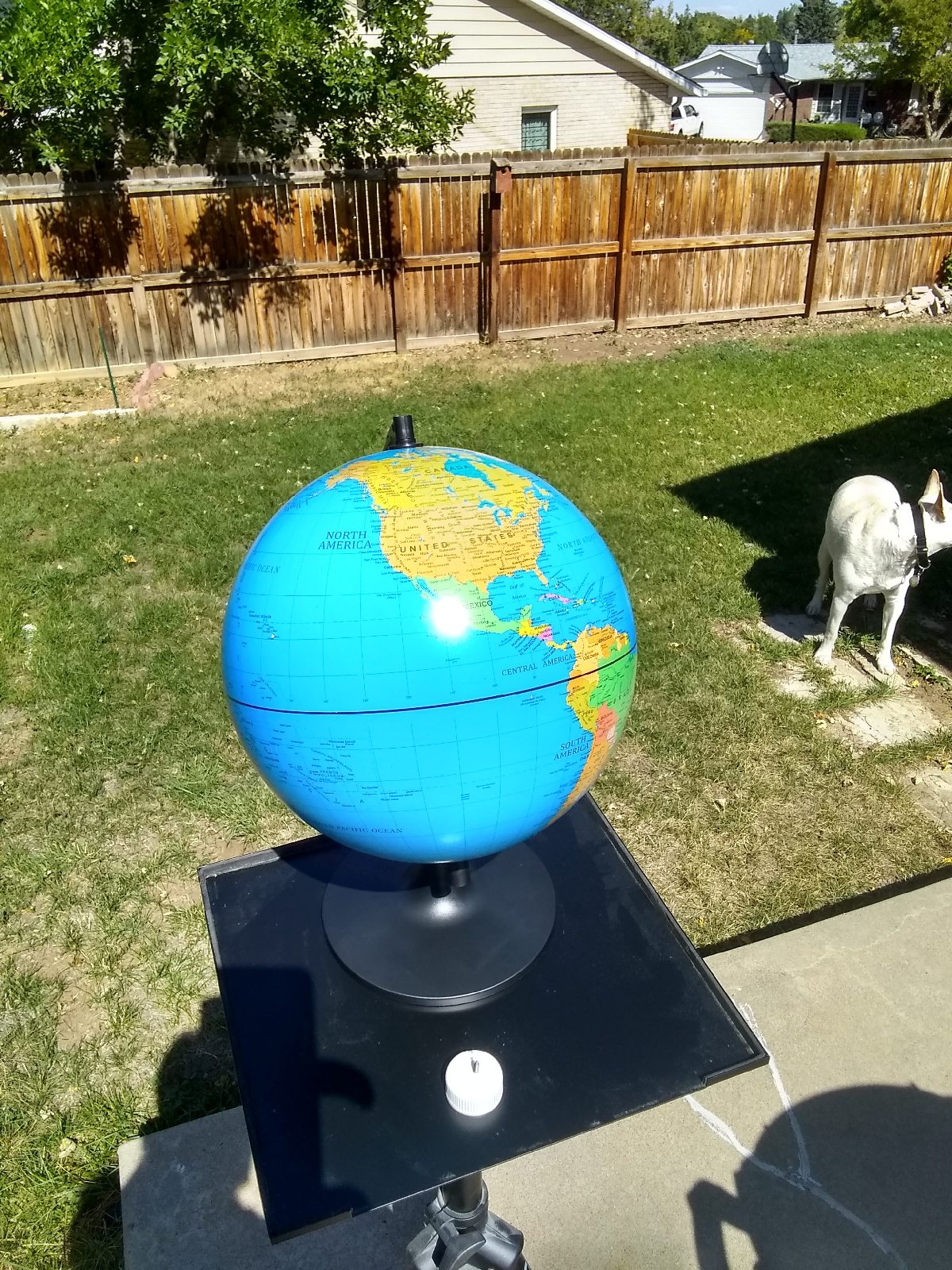

Now for the fine tuning. Place the mini-gnomon pointing north directly over your position on the globe. If the sun's shadow on the globe and the sun's shadow on the Earth are oriented the same, they will both be oriented the same in space in respect to the sun, so tilt and rotate your globe until the tip of the screw's shadow touches the mark you made earlier at the shadow's tip. Your globe is now aligned.


What time is it? One way to tell is to watch your mini-gnomon to see when it's shadow is shortest - that's solar noon. During daylight savings, the local time will be an hour behind solar noon.

You can find where on the globe that it's solar noon by moving the mini-gnomon around to find the place where it's shadow is shortest. That will be a line of longitude. Knowing that every 15 degrees of longitude is an hour will allow you to calculate the time anywhere on Earth (at least, while the sun is out.)

You may have heard that the sun is directly overhead on the equator at noon each day. Try it out.

When it's solar noon where you are, place the mini-gnomon directly over your position and slide it straight down your line of longitude to the equator. Does the screw cast a shadow? Not if it's one of the two annual equinoxes. On any other day, the sun will be exactly overhead somewhere north or south of the equator.


You can easily see where sunset and sunrise is by finding the day-night divider line on your globe.


At my current time, here, sunset is slowly creeping off Africa into the Atlantic.

There is a lot you can do with the universal sundial. Can you use a thermometer to measure differences in temperature on the surface of your globe according to the angle the sun is shining on it? That's what causes the seasons.

Once you have a globe oriented, you can use a clamp or clay or some other way to freeze it in position and make a cover to keep it out of the weather. Then you can use it all year.

Saturday, July 27, 2019


--- Some legal research ---

My other website is the Therian Timeline. Part of its purpose is to provide substantive information about the therian community to therians and others interested in them. It's not that difficult since there's a growing body of research about therianthropy. I just have to keep up.

A therian, for those unfamiliar with the situation, is a human that identifies as a nonhuman. They may live happy, productive lives, but they identify as a horse or a wolf or a tiger. But no one's life is perfect so anyone needs information eventually to get through some life crisis.

I've been writing a series of guides for professionals with therian clients and I have a general guide and guides for therapists and pastoral counselors. Then, I began looking for information for legal professionals, but that was a brick wall. There's just not any such information in the legal literature. A poster in the legal advise subreddit suggested that I talk to a law librarian, so I shouldered my backpack and headed for the Ralph Carr Supreme Court Building near the State Capitol.

It was shadow o'clock according to the sundial on the Newman Center for the Performing Arts, and the walk to University Station took me through the University of Denver Water Garden which was spectacular in the heat of summer.


                                                        [Newman Auditorium sundial]


                                                   [University of Denver Water Garden]

After a walk from California and 16th Street Station to Civic Center Park, the Ralph Carr Building was welcomed coolness.

                                                   [Ralph Carr Supreme Court Building]

As advertised, the law librarian was friendly and aimed to be useful. I sat for a few hours pouring through the books she dug out of the stacks. Sure enough, there was nothing about therianthropy, but I did find information that may be relevant so, although I can't write a guide for legal professionals, I can write an essay that might provide useful information for later court dramas.

After work, I enjoyed some walking and climbing in the Denver Central Public Library, next door to the Carr Building. Besides being a library, the fifth floor has a history museum, currently displaying exhibits about the history of railroads in the U.S. The seventh floor displays contemporary art works.

Not all law libraries are open to the public, for instance the University of Denver law library is dedicated to serving the legal community, including legal professionals and students of law. But institutions such as the Ralph Carr Supreme Court are public treasures. It's a mistake to see them as only the place that court cases are decided. Courts in the United States should be for the people and a visit to a court building can often be an educational, enjoyable experience. Try one near you.


Wednesday, August 15, 2018


--- Evans to Broadway ---

The hike from Evans station to Broadway station is short but there are some interesting highlights along the way. Pasquinel's Landing and Overland Park takes up the length of the Mary Carter Greenway between Evans and Mississippi Avenues along the South Platte River. On the other side of Platte River Drive is Ruby Hill park.

The light rail station at Evans is a short walk along an overpass over Sante Fe Boulevard. As an example of how Denver has ornamented its public places, here is some of the art on the overpass.  Denver has encouraged the public expression of art in murals and sculptures.

                                                                    [Evans overpass]

Pasquinel's Landing is directly across Evans Boulevard from Grant Frontier Park and begins with a fitness park with a set of exercise equipment. I investigated them but didn't use them. I still had Ruby Hill to deal with. Still, with the trail itself, they looked like a pretty complete workout.

Fitness parks seem to be a feature of our landscape now. The Rails-to-Trails trail in Valley had one as did the park near the stadium in Selma and I knew of several other city parks in Alabama with exercise stations.


                                                            [Pasquinel's Landing]

This is also a boat landing for people who want to canoe or kayak on the river, and the water birds seem to like this area. I saw these herons and also a snowy egret (I couldn't get a good picture of the egret because it kept its back to me.)


                                                                           [Herons]

Along the river, the area has been planted to provide examples of ecosystems in the Denver area from the southern hills to the alpine regions above 900 feet in the Rockies. Plaques along the trail offer a self guided tour.

The land to the west of the river is hilly and a couple of the hills really stand out. The panorama for this blog was taken from Loretto Heights and is one of the best views of the area around. Ruby Hill is also a popular prominence, especially in the winter when it provides gentle, clear slopes for snow sledding. The lawn is kept well maintained but the slopes at the bottom near the river are allowed to grow in a more natural state.  The several varieties of trees provide nesting for raptors like eagles and hawks.

A trail circles the hill to the top and back to the base where Florida Avenue crosses Platte River Drive. Denver has themes. Further South, the streets are named for colleges. Here, they are names for states. To the north, in Denver proper, they start getting numbers.


                                                                        [Ruby Hill]

The crown of Ruby Hill offers good views east across the plains, and the tall buildings in downtown Denver.


                                                                        [Vistas]

There is also a large pavilion on top with picnic tables and a modernistic Stonehenge type sundial. This day was not sunny, so I didn't get a picture of it working, but you can get an idea of how it works from these pictures. When I start writing blogs about astronomy in a couple of years, I'll have to revisit the many sundials in the area.


                                                             [Pavillion and sundial]

Sanderson Gulch is the northernmost point that I've hiked on the South Platte River to date. Like Harvard Gulch, it is a man made canal created to drain storm waters off the slopes of the river valley. It runs about five miles from Lakewood, through North Harvey Park, to the Platte River at Ruby Hill. This is where it empties into the river.

                                                                [Sanderson Gulch]

This time, I continued a little further to Mississippi Boulevard. Here is a view of downtown Denver from the bridge over the river. I'm getting close.

                                                  [Denver from Mississippi Boulevard]

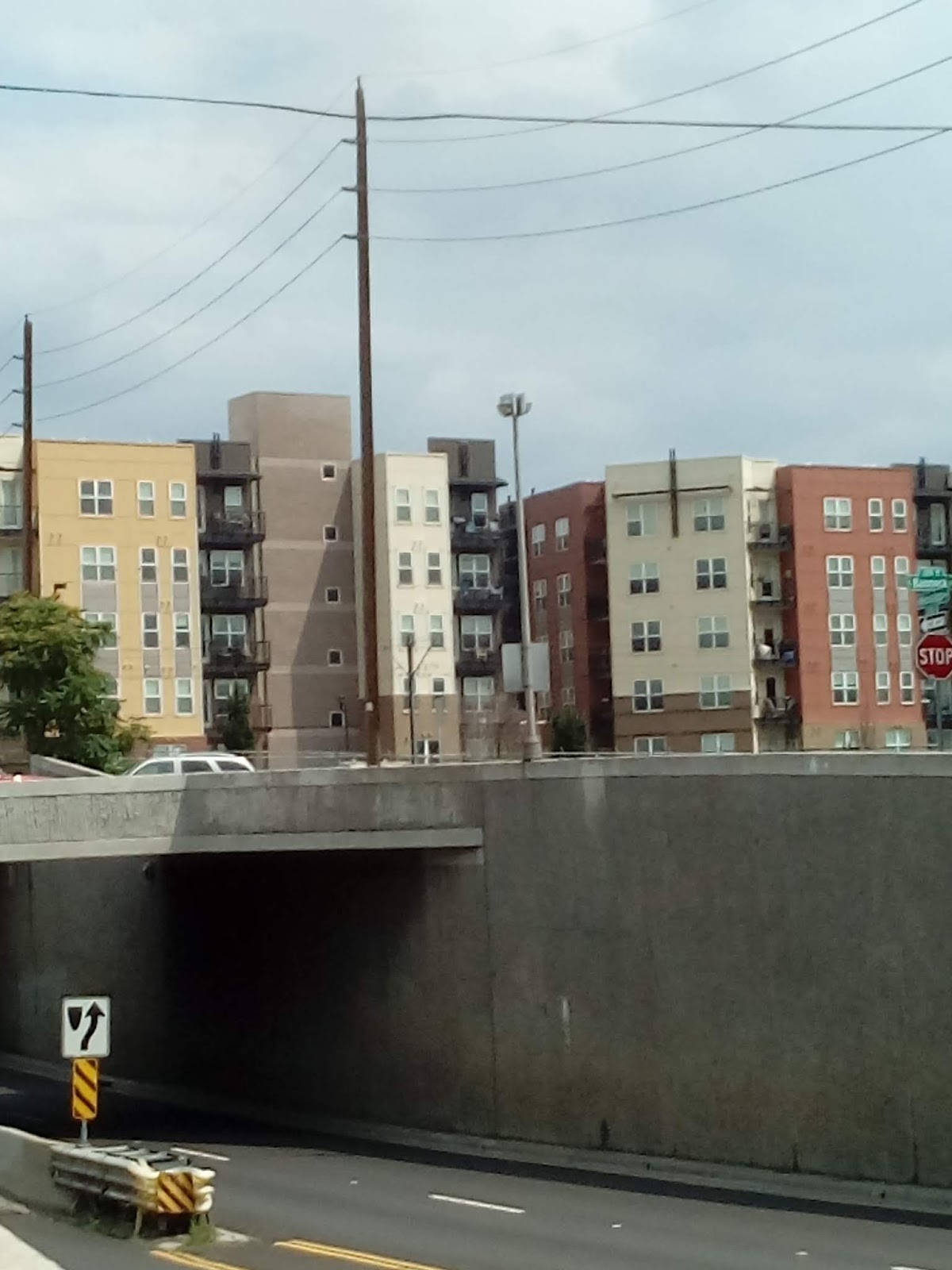
I grabbed a bite at the Breakfast King on Mississippi before continuing to Broadway Station. Until recently, I've associated the colors of the apartments in this picture as "Denver colors", but I've learned that they are the colors of a major construction company in Denver that builds apartments around light rail stations. It seems a lot of people don't like the colors. I don't mind them - they sorta look autumnal.


                                                  [Apartments near Broadway station]

Broadway station is a hub for several of the lines on the RTD system. The train overhead lines and the rails create interesting patterns where the different lines come together.

Power is delivered to the RTD trains through structures that sweep these overhead power lines. Other systems use third rails to deliver power. The motors on these trains are 620 horsepower electric engines that run on 25,000 volts of alternating current. They can reach speeds up to 79 miles per hour.


                                                               [Broadway station]

From Broadway, I take the train to University station, and the bus from there back home. The summer is still on us but the overcast skies kept the temperature somewhat less than brutal.

Denver is all about art. Most of the railway stations are decorative and many areas sport murals, sculptures, outdoor art exhibits and art museums. What kind of art is on display in your area? Does your town support local artists?

Denver is on several migration routes for birds. Also, raptors seem to like the area. It's a popular place for bird watchers. Most areas in the US have interesting features for bird watchers. Even New York city and many other large towns have their falcons. What kind of bird populations are in your area?

Do you have a light rail system in your area? In addition to being a fun means of transportation, they are interesting engineering achievements in their own right.