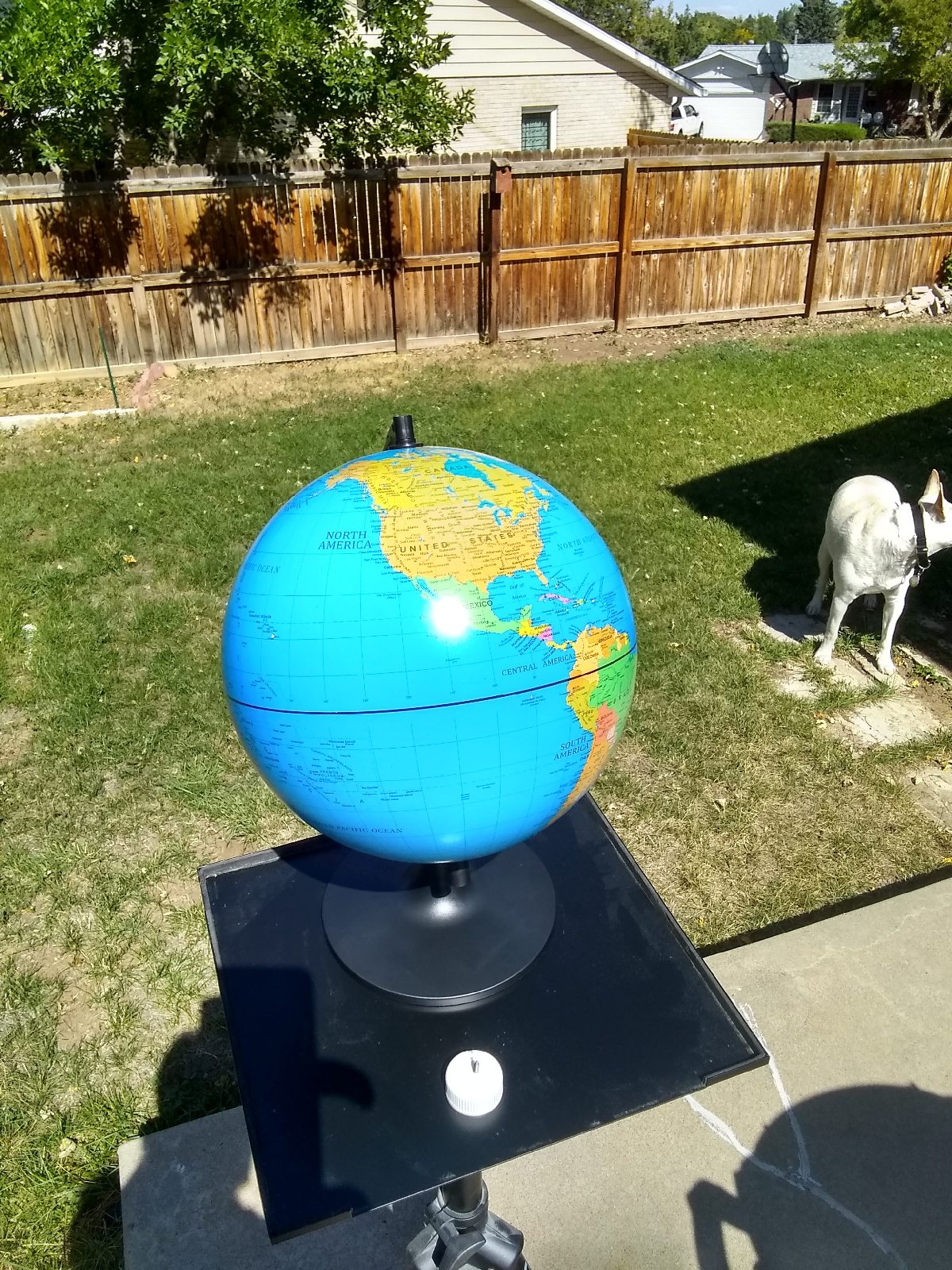
We're on a rock whirling around the sun amid other rocks and space debris. It's a nice rock with water and plants and restaurants, but keep in mind that we're surrounded by vacuum and cold and, and space debris.
If you're sitting in your living room looking out your window, you can easily see the motion of that kid bicycling down the street, but what if you're in your car driving down the street. It's not so easy seeing your own motion
We can see other planets and track their motions. Maybe we shouldn't be too incredulous about our ancestors that thought the Earth was the center of the universe and everything else whirled around Earth.
In a way, they were right. The whole Einsteinian revolution began with the idea that, in an inertial frame of reference it really doesn't matter whose point of view you take.
Hmmm...I'd better explain that "inertial frame of reference" thing. It's really important to modern physics. In an inertial frame of reference, everything is moving at a constant velocity. Different things might be moving at different velocities, but they're not speeding up, slowing down, or changing direction. It's "inertial" because the attribute of inertia is what causes matter to resist changes in velocity.
But Earth isn't in an inertial frame of reference, is it? It's in a circular orbit so it's constantly changing direction
Well, yes, but it's orbit is huge and, if you look at one segment of it, the orbit looks like a straight line, so it's in an approximately inertial frame of reference locally.
So are we moving around the sun or is everything moving around us. Have you ever been in a vehicle and suddenly had the weird feeling that you and your vehicle was standing still and everything else was moving? You were having an Einsteinian moment.
So how do we choose? That's easy, we choose the most convenient option. Really! Yes! That's what physicists do. And it has proven very inconvenient to see everything as moving around us because if that were the case, Mars can be seen to spin its merry way around the sun, except when it decides to occasionally reverse course and go the opposite direction for a while before turning around and continuing it's journey in the right direction. Mars is a rock. It doesn't "decide".
If we're going around the sun like all the other planets, then we catch up with Mars, pass it and then watch it trail us. That makes a lot more sense.
But it's easy to watch Mars and see what it does, but how can we see what we're doing since it would be really hard for us to look back at us, what with all that vacuum, and cold, and lack of good restaurants.
Well, we have two options. We can watch what other planets are doing and assume that our planet works pretty much the same way, or we can watch what other planets' motions look like and figure out what our motion must be to make their motion look like that.
It's like a big puzzle, but all the pieces are there. We know, for instance, that the sun is in the same place in our sky about every 24 hours. Sunrise yesterday was at 6:49 am. Today it was at 6:48 am. Well, 23 hours, 59 minutes.
So we know that the Earth spins on its axis once every 23 hours and 59 minutes give or take a few seconds.
We also know that the sun takes 31,557,600 seconds (365.25 days of 86,400 seconds per day) for the sun to come back to the same place in the sky. That's how long it takes for the Earth to orbit around the sun.
Wait a minute (or about 60 seconds). How do we know that? Well, it's how we define a second, or how we used to define a second. Now we define a second as "the duration of 9,192,631,770 periods of the radiation corresponding to the transition between the two hyperfine levels of the ground state of the caesium-133 atom" according to Le Systeme international d'unites. Don't worry about it right now. I'm planning a whole blog or two on time later.
But how do I know when the sun is at the same place in the sky? Well, my analemma, of course! Here it is
Do you see the figure 8?
Let me see if I can help.
I hate drawing on it. It took me a whole year to make it. It looks a little ragged but we moved in the middle of the year and I had to reorient it at the new place but I had the north-south bearing and level values, so it was close. If you want a clean one, a lot of big world globes have analemmas printed on them somewhere in the Pacific Ocean (the only place with enough room). Check your local library or geography classroom
What I did was build a wooden block to sit astride our back fence. To the top, I tacked a sheet of paper and, in the middle, I drove a nail. On the first and thirtieth of each month (and a few other days), at 1:00 PM, I marked where the end of the shadow of the nail was. The pattern that formed is called an analemma.
Our analemma looks different than an analemma in Alabama, where I used to live. I was surprised, when I moved to Denver from Selma, Alabama how much more the path of the sun each day lay down toward the southern horizon. We're only 506 miles north of Selma.
The figure 8 pattern tells us an important thing about the Earth. It's not on the level. What I mean is that the axis of rotation is not straight up and down in respect to the sun. We're tilted.
That's what causes the seasons. The sun's light hits us at a different slant at different parts of the globe. That spreads the heating sunlight out more in some places and concentrates it at others.
The only part of the globe where the sun is ever directly overhead is at the equator, and then only twice a year, solar noon on the equinoxes. As you travel further and further north, the sun "lays down further and further to the south. Notice that my analemma never crossed the nail and it's always on the north side. Above the Arctic Circle, there are times when the sun never sets. It just rides around the horizon. The Arctic Circle isn't fixed but it's currently a little north of 66° latitude.
The same kind of thing happens in the southern hemisphere except the path of the sun slants to the north. That means that, if you build a sundial, you have to take where you are on the globe into account. The analemma was once a very important tool for that reason. The width of the loops of the analemma provides the equation of time that allows a sundial maker to fine-tune their sundials so that they give accurate time.
You can also see the Earth's tilt at night. The path of the sun follows a straight band across the sky called the "ecliptic". It defined a flat platter extending out from the sun. All the visible planets, including us, and the moon "roll" around the platter like marbles on a dinner plate.
It's tight. Everything stays within about 8° above or below the ecliptic you can see it at night because that's where the band of constellations called "the zodiac" are.
Go out and find those constellations. If you're not familiar with them, download the Stellarium app. It shows where they are in your sky. You'll see that, although they follow the celestial equator in the night sky (the day sky, too, they're just not bright enough to be seen with the sun), you won't see them around the horizon. They'll be in a band tilting up into the sky unless it's the equinox and you're at the equator.
I could calculate the tilt from my analemma if I could have managed to keep it level and strictly oriented all year. Maybe you could manage that.
By the way, the Wikipedia has a cool article on the analemma with time elapsed photographs of the sun in the sky tracing an analemma and explanations of how it has been used as an astronomer's tool.
We can know a lot about Earth's rotation from direct observation of the sky. What about our orbit around the sun? Well, we already know how long it takes us to get around the sun. What about the shape of the orbit and it's radius?
That'll be in the next blog so stay tuned.
You can learn a lot about us by looking at the sky. The fact that there even is an "us" has a lot to do with where we are in the solar system and in our Milky Way Galaxy. If you haven't already installed Stellarium on your phone, go ahead. It's free. And go out and explore the sky.