Showing posts with label Earth. Show all posts

Monday, November 9, 2020

A universal sundial

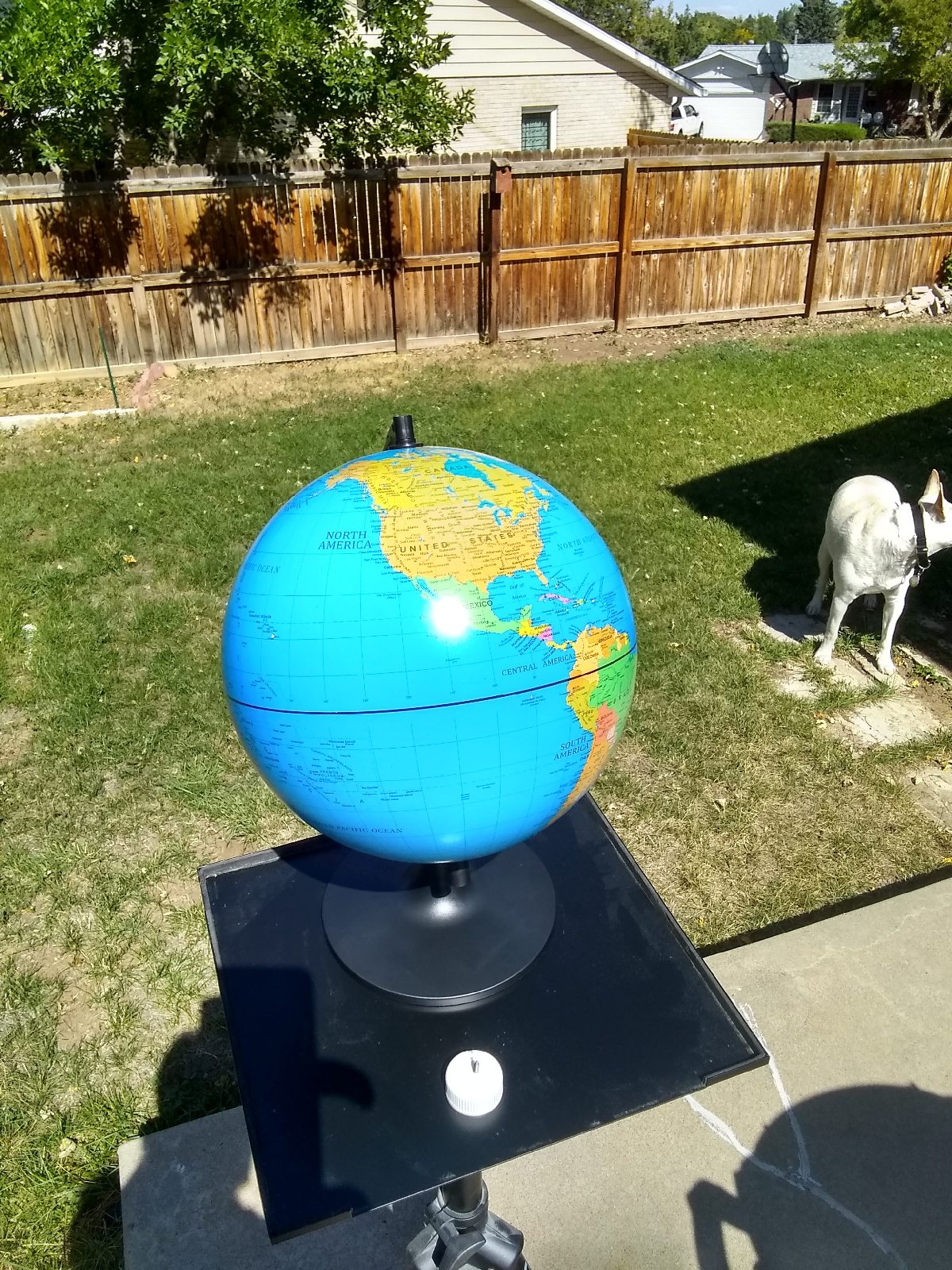
A world globe can be used as a sundial that can tell you the time of day anywhere on Earth, time of sunrise and sunset, how the seasons work, and many other things. All you have to do is orient it in the same direction relative to the sun as the Earth. That way, it models Earth in space. Here's how you do it.

You will need a surface that can be tilted (and, possibly a clamp for the base of the globe to keep it from tilting over. Alternately, there are globes that can be tilted in respect to the base.) You will also need a mini-gnomon. A gnomon is just a vertical rod that will cast a shadow in the sun. It has to be small enough to position on the globe's surface. I used a plastic bottle cap and drove a screw through the center from underneath. (The screw should be as near a right angle to the surface of the cap as you can make it. You can test it with a carpenter's angle or even the sides of a sheet of paper.) After using a carpenter's level, or a phone app level to level the surface you will place the globe on, place the cap on the surface and mark the edge at the point north of the screw. Use a magnetic compass or a phone app but don't forget to look up the correction for true north from where you live and add or subtract it from your compass bearing. (Do an Internet search for "magnetic declination".)

With the line between the screw and the edge mark pointing north, make another mark with an erasable marker at the end of the screw's shadow from the sun.


Now, set your globe on the surface with the north pole pointing north (according to your compass with the correction to true north.). Rotate the globe until your position is on top.


Now for the fine tuning. Place the mini-gnomon pointing north directly over your position on the globe. If the sun's shadow on the globe and the sun's shadow on the Earth are oriented the same, they will both be oriented the same in space in respect to the sun, so tilt and rotate your globe until the tip of the screw's shadow touches the mark you made earlier at the shadow's tip. Your globe is now aligned.


What time is it? One way to tell is to watch your mini-gnomon to see when it's shadow is shortest - that's solar noon. During daylight savings, the local time will be an hour behind solar noon.

You can find where on the globe that it's solar noon by moving the mini-gnomon around to find the place where it's shadow is shortest. That will be a line of longitude. Knowing that every 15 degrees of longitude is an hour will allow you to calculate the time anywhere on Earth (at least, while the sun is out.)

You may have heard that the sun is directly overhead on the equator at noon each day. Try it out.

When it's solar noon where you are, place the mini-gnomon directly over your position and slide it straight down your line of longitude to the equator. Does the screw cast a shadow? Not if it's one of the two annual equinoxes. On any other day, the sun will be exactly overhead somewhere north or south of the equator.


You can easily see where sunset and sunrise is by finding the day-night divider line on your globe.


At my current time, here, sunset is slowly creeping off Africa into the Atlantic.

There is a lot you can do with the universal sundial. Can you use a thermometer to measure differences in temperature on the surface of your globe according to the angle the sun is shining on it? That's what causes the seasons.

Once you have a globe oriented, you can use a clamp or clay or some other way to freeze it in position and make a cover to keep it out of the weather. Then you can use it all year.

Monday, May 18, 2020

Earth's specs

Somewhen in the 200s BC, a Greek named Eratosthenes measured the circumference of the Earth. He worked and lived in Alexandria, Egypt and knew of a place in Syrene, Egypt where, on the summer solstice, the image of the sun could be seen in a deep well, meaning that the sun was directly overhead. That placed Syrene on the equator. 

Eratosthenes assumed the Earth to be a sphere. If that were true, he reasoned that, if he stuck a rod in the ground vertically, it's line could be extended straight to the Earth's center to form an angle with a similar line from Syrene and that angle could easily be calculated. All he had to do was measure the angle formed of the line from the tip of the sun's shadow to the tip of the rod with the ground, subtract that from the 90° angle of the vertical rod with the ground, and he would have it...and "it" would also be Alexandria's latitude. It worked out to be about 7°.

By that time, everybody knew that the Earth was round and that the angular measure of any circle was 360°, and Eratosthenes knew that Alexandria was 5000 stadia from Syrene, he could figure out the circumference of a great circle on the Earth and, therefore, the Earth. His result was 250,000 stadia, or 39,385 kilometers, which is 1.4% off from the accurate circumference, 39,941 kilometers. Not too shabby!

So, on my recent hike to The Bluffs, I decided to do a modernized version of Eratosthenes' calculation.

The summer solstice was still a ways in the future so, not trusting nature to provide me with a good shot of the sun on demand, I measured the latitude and the distance between Arapahoe and Ridgegate Stations on the RTC southern light rail lines. I used Veiyra Software's Physics Toolbox Pro for the measurements. Here are the readouts.

Arapahoe Station

Ridgegate Station.

The distance, measured as the crow flies using Google Maps, is 5.6 miles or 9 kilometers.

"As the crow flies" is another way of saying "along a great circle on the globe," so I now have a way of converting degrees along the circumference of the Earth to kilometers and vice versa. By the way, I have it from a reputable source, namely, a crow, that crows do not always fly in straight lines.

The two stations are at almost the same longitude, so I can ignore that. The difference in latitude is .08 degrees.

But what about the stick in the ground? Well, that's another thing. It's called a gnomon and was a primary tool of ancient astronomers. It simply measured the angle of inclination of an astronomical object. Today we have astrolabes (basically a protractor with a plumb bob and a pointer) and the more advanced theodolite used by surveyors. I have a theodolite on my phone, the Dioptra app by Workshop512.

Since I really had all the information I needed, and I didn't know how far I was from the equator, I just wanted to do a modern version of Eratosthenes' trick to find my latitude by the sun. True to course, it was so cloudy on the summer equinox that I couldn't even tell which quadrant of the sky the sun was in, but I slapped a welder filter on my phone and took this shot from Dioptra the next day.


The angle of inclination was 51.1°, which was close to the actual measure on the equinox taken from the Time and Date website:


Solar noon was at 1:07.

Angle of inclination was 50.5°, which placed my latitude at 90°-50.5°=39.5° . Looking at the Toolbox measurements above, I'm off by less than a tenth of a degree. The Dioptra measurement, which is also GPS is 39.58, so it's close.

But back to the real thing. The difference in measured latitude was 0.08° which is 4 minutes and 48 seconds (There are 60 minutes in a degree and 60 seconds in a minute). If 0.08 degrees is the same as 9 kilometers, 1 degree is 112.5 kilometers.

Okay, breath held, the moment of truth….112.5 kilometers times 360 degrees is 40,500 kilometers. The actual value is 39,941 kilometers. I was off by 1.01% Wow! I just impressed myself!

Of course, along with all the measurement error and such, the Earth is only approximately a sphere. The radius at the equator is larger than the radiuses at the poles.

We know the circumference of the Earth. The approximate volume is easy. The volume of a sphere is π\6 times the diameter cubed. The diameter is the circumference divided by π. Working backward, the diameter is 12,714 kilometers. So the volume is right at 10 to the 12th power cubic kilometers.

Okay, mass...mass is a bear. You measure mass with a balance and standard mass (remember the blog about mass and weight?) But Earth does have a mass. How in Sam Hill would you figure it out?

Well, obviously, you can't use a balance so any measurement has to be indirect. The first measurement to within 1% was made in 1798 by Henry Cavendish as a spin off of his accurate measurement of the gravitational constant. He used a torsion balance to do that and I can't even approach that kind of precision at home, so I'll just tell you how he did it. 

Isaac Newton figured out that the force of attraction (gravity) between any  two masses is directly proportional to the difference between their masses, and inversely proportional to the square of the distance between them. But to come up with an actual measurement, a proportionality constant was needed. He called it the Universal Gravitational Constant and never found it's value.

About 70 years later, Cavendish did it. Imagine a long, vertical, thin, flexible rod. At the bottom end is another rod forming an inverted T. At the end of that rod are two balanced heavy masses. His masses were  .73 kilograms each. He could set the bottom rod spinning back and forth and measure a slight force inhibiting the motion by comparing the frequency of oscillation with and without the force. The force, of course, would be another large mass close to one of the chunks of lead on the torsion balance. He knew the masses he was working with, the separation between them, and Newton's formula, so he was ready to calculate the Universal Gravitational Constant.

It was 6.67408 x 10^-11 m^3kg^-1s^-2 .

Believe it or not, that's what we need to calculate the mass of the Earth. Using Newton's formula we need the acceleration due to gravity (we found that approximately fooling around with the smartphone's accelerometer), multiplied by the radius of the Earth squared (we know that), divided by the Gravitational Constant.

So let's do it. Square the Earth first. The diameter is 12714 km so the radius is 6357 km. We need that in meters so 6357 x 10^3 meters. Square that to get 4.04 x 10^13 meters squared. The acceleration due to gravity is 9.18 meters per second square so the numerator is 3.71 x 10^14. Now we divide that by our Gravitational Constant, 6.67408 x 10^-11 m^3kg^-1s^-2  to get 5.56 x 10^24 kg (the accurate figure is 5.972 x 10^24 kg).

Actually, Cavendish didn't report the mass of the Earth. He stopped one step short by publishing the density of Earth which was 5.45 grams per cubic centimeter. He probably figured that, from there, it was easy to multiply that times the volume of Earth so, eh, let someone else do the easy part. 

If we look around and figure out what proportion of Earth is made of light rocks, heavy rocks, water, air... and come up with an average density we would say that it's around (and people before Cavendish had done just that) 2.7 grams per cubic centimeter, so where does all that mass come from?

Well, obviously, there's more underneath our feet than meets the eye. In fact, the deepest we've ever been is 12,262 meters and, although that's pretty deep, it barely scratches the surface. Still, the researchers expected temperatures around 212 degrees Fahrenheit and what they got was 356 degrees. It's hot down there.

But two things convince us that the core of the Earth is iron-rich molten metal. One is the surprising density of Earth. The other is something you don't see a lot of in the solar system...magnetism.

Earth is a magnet. The sun and gas giants like Jupiter and Neptune have strong magnetic fields. Mercury has a weak field. Some of the moons (but not ours) seem to be magnetic, but most of the smaller planets are magnetically inert.

We've used compasses that rely on the Earth's magnetic field for a long time. It wasn't until 1600 that William Gilbert proposed that Earth is a magnet. In fact, Earth is not a permanent magnet. It's an electromagnet.

Moving electrons (current) generates magnetic fields and our rotating molten metal outer core is one humongous magnetic field generator.

Our planet is special. We are just the right size. If we were too big, gravity would squash us. Too small and we wouldn't have enough gravity to hold onto our atmosphere. We get just enough sunlight for a healthy biosphere. We have plenty of that rare commodity - water. A nice balance of plants and animals conditions our air. And we have an effective magnetic shield that shunts dangerous solar radiations around the planet and out into space.

When I bought my current phone, I made sure it had a magnetometer in addition to the other regular sensors. Phones with GPS receivers will provide fairly accurate compass readings, but a magnetometer is more accurate and you can use it to measure both magnetic fields and electrical currents.

My Android has a AK09918 triaxial magnetometer. Since it's triaxial, it measures field strength in three directions (like the accelerometers). There are two common kinds of magnetometers in smartphones: magnetoresistive and Hall Effect. The AKM is a Hall Effect sensor that uses a flat conductive plate. A magnetic field causes electrons to deviate from their path and polarizes the plate. That can be sensed as a potential difference across the plate.

About a week ago, I hiked down a mile of  Little Dry Creek trail and used the Physics Toolbox Pro to record magnetic fields. I walked almost due west so I was cutting across the magnetic field lines.

The strength of a magnetic field is measured in teslas (in this case, in microteslas). A tesla is equal to a weber per square meter, and a weber is a kilogram per square second. If you understand induction (it makes transformers work), webers involve how much voltage you can crank out with a magnetic field. So with microteslas, don't expect geomagnetic electric generating stations any time soon.

I recorded the magnetic field in three directions at a rate of one measurement per second. Since I had the phone in my shirt pocket, the x direction was right-left, y was up-down, and z was forward-backward. I then saved the several thousands readings in a csv (comma separated values) file that I could pick up with DANSYS, my statistical spreadsheet.

Here's a graph of the tracings.

The tracings are pretty fuzzy, indicating a lot of noise. The inside of a smartphone has lots of electrical components crowded together and heat from those and the outside. Noise is to be expected and when you're measuring on the order of micro-anything, you can expect noise to blur the lines. 

All the lines have big spikes but the z component has the most. That is my forward and backward direction and I was walking in an urban environment, so power lines, underground cables…. yeah. So that's not the Earth's magnetic field, right? 

Many scientists call this the anthropocene epoch because the biggest influence on the Earth's environment, for the first time, is a single species - humanity. Every stray magnetic field alters Earth's magnetic field locally. Have you ever tried to get a compass to work in a house? You're likely to find it somewhat off the magnetic north.

But, we can sense some trends. There is a noticeable difference between the start of my recording and the latter part. That's because I started at my home and walked a ways more or less north before turning west on the trail.

The green line gives us the total field strength. It's measuring around 50 to 75 microteslas. The normal background magnetic field strength runs around 25 to 65 microteslas, so we're well within that range (once we get away from the houses.) The local residue from residences doesn't seem to spread out very far. The trail is generally about 200 to 300 feet (as measured by Google Maps) from the nearest houses.

Geophysics is the study of the physical attributes of our planet. After the barriers between East and West came down in 1957, scientists took the opportunity to focus on Earth and instituted the International Geophysical Year. You can learn a lot more with a team than you can alone. Perhaps you can join with some interested neighbors and have a Geophysical Year of your own!

Tuesday, March 3, 2020

Earth in space 2

So, we know how long it takes Earth to rotate, that it's tilted in respect to the ecliptic, and the time it takes to travel around the sun. So how far is it from the sun?

Uhrmph...uh. Anybody got a meter stick?

Well, with some high powered telescopes and a lot of patience, we could measure the apparent distance between two stars and half a year later, on the opposite side of the sun, measure the same distance and see how much it's changed. 

Stars don't move in the sky in respect to us - not to any measurable extent, that's why they're called "fixed stars" - so any apparent motion would be due to what's called "parallax error". If you want to see parallax in action, get close to the wall on one side of an analog wall clock (the kind with hands) and read the time, then go to the other side against the wall. You'll get two different readings because you're viewing the hands of the clock from two different angles.

You can use the parallax method if you can measure very tiny angles, but the whole idea of this blog is to get by with little expense and portable equipment.

What to do?

Let's use math!

But first, the background. Back in the early 16th century, Nicholas Copernicus realized that astronomy would make much more sense if the sun were at the center of things instead of the Earth. Tycho Brahe didn't hold with Mr. Copernicus' new fangled ideas but he did have an eye for precision and cranked out a massive library of observations of the visible planets.

Johannes Kepler (born 1571), the hero of our story, did hold with Copernicus' new fangled ideas and needed his teacher, Tycho Brahe's data to prove it, but Brahe wouldn't give...until, on his deathbed, he bequeathed his library to Kepler. 

Kepler started working tirelessly on the data. It was hard for him to keep a job, and he moved from place to place. What he wanted was very pointedly something the powerful church of the time did not want, a heliocentric universe. After his benefactor, King Rudolph of Bohemia, abdicated his throne to his brother Matthias, things began to fall apart for the Kepler family, but Johannes continued working.

His way of understanding Earth in space was to, first, work out the motion of Mars from Brahe's observations. With his results, he applied them to the other visible planets to see if they worked the same way. When it was obvious that all the visible planets complied with his three laws (we talked about those in "Orbits"), he applied them to Earth. The third law is telling. It tells, in fact, how far the Earth orbits from the sun (at least, at its furthest point, and since the Earth's orbit is almost (not quite, but almost) circular, we'll go with that).

Kepler's third law says that the square of the orbital period (the time it takes a planet to orbit the sun) is proportional to the cube of the distance we want. The proportionality constant, it turns out, is equal to the sum of mass between the two bodies (the sun and the planet) multiplied by Newton's universal gravitational constant divided by 4 times pi squared (we had to wait for Newton to figure out the details). All together, the formula, 200 years in the making, is…

r is the distance we're looking for. T is the time it takes for us to travel around the sun, 365.25 days or 31,557,600 seconds. I convert to seconds because the almost-constant a, in SI units is 2.97x10⁻¹⁹ s2/m2. That's a rather messy looking value but remember that constants like that are mainly there to make your answer come out in the right units. I said that it's "almost constant" because it's actually a calculated value that includes the sum of the sun's mass and the mass of the object orbiting the sun. But objects in the solar system are so much smaller than the sun that their mass is negligible. The point is that the ratio of a planet's period of orbit squared to the maximum distance from the sun cubed is almost exactly the same for all the visible planets.

When I do the math, it puts us 149,675,423,264 meters or 93,003,996 miles from the sun at our maximum distance. The Wikipedia says an average of about 92 million miles and, since the Earth's elliptical orbit is almost circular, that's pretty close.

It's sorta exciting when calculations like this come out right. I used my statistical spreadsheet, DANSYS, to do the calculations but you could have done it with any spreadsheet, or even a calculator.

So, I'll see you next time and write about Florida (Station, that is) when we've moved a little further around the sun

Tuesday, February 25, 2020

Earth in space

We're on a rock whirling around the sun amid other rocks and space debris. It's a nice rock with water and plants and restaurants, but keep in mind that we're surrounded by vacuum and cold and, and space debris.

If you're sitting in your living room looking out your window, you can easily see the motion of that kid bicycling down the street, but what if you're in your car driving down the street. It's not so easy seeing your own motion 

We can see other planets and track their motions. Maybe we shouldn't be too incredulous about our ancestors that thought the Earth was the center of the universe and everything else whirled around Earth.

In a way, they were right. The whole Einsteinian revolution began with the idea that, in an inertial frame of reference it really doesn't matter whose point of view you take.

Hmmm...I'd better explain that "inertial frame of reference" thing. It's really important to modern physics. In an inertial frame of reference, everything is moving at a constant velocity. Different things might be moving at different velocities, but they're not speeding up, slowing down, or changing direction. It's "inertial" because the attribute of inertia is what causes matter to resist changes in velocity.

But Earth isn't in an inertial frame of reference, is it? It's in a circular orbit so it's constantly changing direction 

Well, yes, but it's orbit is huge and, if you look at one segment of it, the orbit looks like a straight line, so it's in an approximately inertial frame of reference locally.


So are we moving around the sun or is everything moving around us. Have you ever been in a vehicle and suddenly had the weird feeling that you and your vehicle was standing still and everything else was moving? You were having an Einsteinian moment.

So how do we choose? That's easy, we choose the most convenient option. Really! Yes! That's what physicists do. And it has proven very inconvenient to see everything as moving around us because if that were the case, Mars can be seen to spin its merry way around the sun, except when it decides to occasionally reverse course and go the opposite direction for a while before turning around and continuing it's journey in the right direction. Mars is a rock. It doesn't "decide".

If we're going around the sun like all the other planets, then we catch up with Mars, pass it and then watch it trail us. That makes a lot more sense.

But it's easy to watch Mars and see what it does, but how can we see what we're doing since it would be really hard for us to look back at us, what with all that vacuum, and cold, and lack of good restaurants.

Well, we have two options. We can watch what other planets are doing and assume that our planet works pretty much the same way, or we can watch what other planets' motions look like and figure out what our motion must be to make their motion look like that.

It's like a big puzzle, but all the pieces are there. We know, for instance, that the sun is in the same place in our sky about every 24 hours. Sunrise yesterday was at 6:49 am. Today it was at 6:48 am. Well, 23 hours, 59 minutes.

So we know that the Earth spins on its axis once every 23 hours and 59 minutes give or take a few seconds.

We also know that the sun takes 31,557,600 seconds (365.25 days of 86,400 seconds per day) for the sun to come back to the same place in the sky. That's how long it takes for the Earth to orbit around the sun.

Wait a minute (or about 60 seconds). How do we know that? Well, it's how we define a second, or how we used to define a second. Now we define a second as "the duration of 9,192,631,770 periods of the radiation corresponding to the transition between the two hyperfine levels of the ground state of the caesium-133 atom" according to Le Systeme international d'unites. Don't worry about it right now. I'm planning a whole blog or two on time later.

But how do I know when the sun is at the same place in the sky? Well, my analemma, of course! Here it is 


Do you see the figure 8?

Let me see if I can help.


I hate drawing on it. It took me a whole year to make it. It looks a little ragged but we moved in the middle of the year and I had to reorient it at the new place but I had the north-south bearing and level values, so it was close. If you want a clean one, a lot of big world globes have analemmas printed on them somewhere in the Pacific Ocean (the only place with enough room). Check your local library or geography classroom 

What I did was build a wooden block to sit astride our back fence. To the top, I tacked a sheet of paper and, in the middle, I drove a nail. On the first and thirtieth of each month (and a few other days), at 1:00 PM, I marked where the end of the shadow of the nail was. The pattern that formed is called an analemma. 

Our analemma looks different than an analemma in Alabama, where I used to live. I was surprised, when I moved to Denver from Selma, Alabama how much more the path of the sun each day lay down toward the southern horizon. We're only 506 miles north of Selma.

The figure 8 pattern tells us an important thing about the Earth. It's not on the level. What I mean is that the axis of rotation is not straight up and down in respect to the sun. We're tilted.

That's what causes the seasons. The sun's light hits us at a different slant at different parts of the globe. That spreads the heating sunlight out more in some places and concentrates it at others.

The only part of the globe where the sun is ever directly overhead is at the equator, and then only twice a year, solar noon on the equinoxes. As you travel further and further north, the sun "lays down further and further to the south. Notice that my analemma never crossed the nail and it's always on the north side. Above the Arctic Circle, there are times when the sun never sets. It just rides around the horizon. The Arctic Circle isn't fixed but it's currently a little north of 66° latitude.

The same kind of thing happens in the southern hemisphere except the path of the sun slants to the north. That means that, if you build a sundial, you have to take where you are on the globe into account. The analemma was once a very important tool for that reason. The width of the loops of the analemma provides the equation of time that allows a sundial maker to fine-tune their sundials so that they give accurate time.

You can also see the Earth's tilt at night. The path of the sun follows a straight band across the sky called the "ecliptic". It defined a flat platter extending out from the sun. All the visible planets, including us, and the moon "roll" around the platter like marbles on a dinner plate. 

It's tight. Everything stays within about 8° above or below the ecliptic  you can see it at night because that's where the band of constellations called "the zodiac" are.

Go out and find those constellations. If you're not familiar with them, download the Stellarium app. It shows where they are in your sky. You'll see that, although they follow the celestial equator in the night sky (the day sky, too, they're just not bright enough to be seen with the sun), you won't see them around the horizon. They'll be in a band tilting up into the sky unless it's the equinox and you're at the equator.

I could calculate the tilt from my analemma if I could have managed to keep it level and strictly oriented all year. Maybe you could manage that.

By the way, the Wikipedia has a cool article on the analemma with time elapsed photographs of the sun in the sky tracing an analemma and explanations of how it has been used as an astronomer's tool.

We can know a lot about Earth's rotation from direct observation of the sky. What about our orbit around the sun? Well, we already know how long it takes us to get around the sun. What about the shape of the orbit and it's radius?

That'll be in the next blog so stay tuned.

You can learn a lot about us by looking at the sky. The fact that there even is an "us" has a lot to do with where we are in the solar system and in our Milky Way Galaxy. If you haven't already installed Stellarium on your phone, go ahead. It's free. And go out and explore the sky.