Showing posts with label transportation. Show all posts

Monday, April 17, 2023

Clear Creek Station to Pecos Junction Station

A nice thing about train rides to hikes in Denver is that the stations are often situated to provide good vistas of where you're going.

The snowcap is Mount Blue Sky (formerly Mount Evans). The double peaked mountain in the foreground just to the right of the power pole is Mount Morrison. Red Rocks Park and Amphitheater is at the base of Mount Morrison. The view is from the train as it is pulling into Broadway Station.

 
On this trip, I'm going thataway. The low mountain in the foreground is Green Mountain. It's one of the foothills between the Rockies and the Colorado Piedmont, a pile of the stuff washed out of the Rocky Mountains and the Ancestral Rockies. Behind the Home Depot are the Table Mountains. That's the direction I'm going. No clouds, it should be a clear day for a short hike.


Olde Town Arvada is convenient on this route, so, being the milkshake fanatic that I am, I make a stop on the G Line before each hike to get a snack. In my wandering, I spotted this Catholic church, the Shrine of St. Anne's. The cornerstone was dedicated in 1920, making it a product of the "wild west". 

Saint Anne was the mother of Mary, who was the mother of Jesus.

After Olde Town, I reboarded the train and headed for Clear Creek Station. 
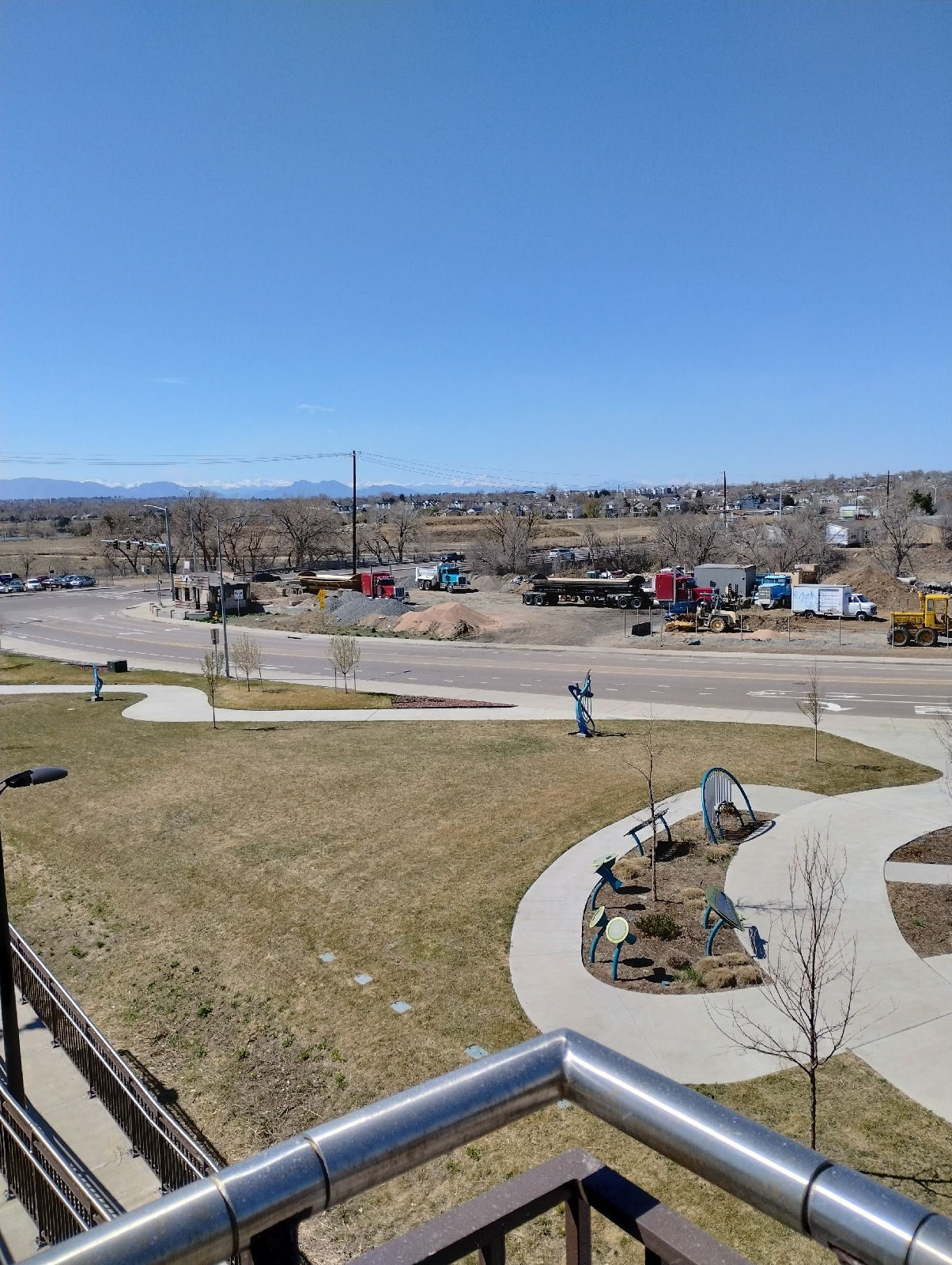
Clear Creek and Clear Creek Trail is just down the hill. 

This leg of the G Line hikes is basically a walk around the perimeter of Martin-Marietta's asphalt plant, a little over two miles. 
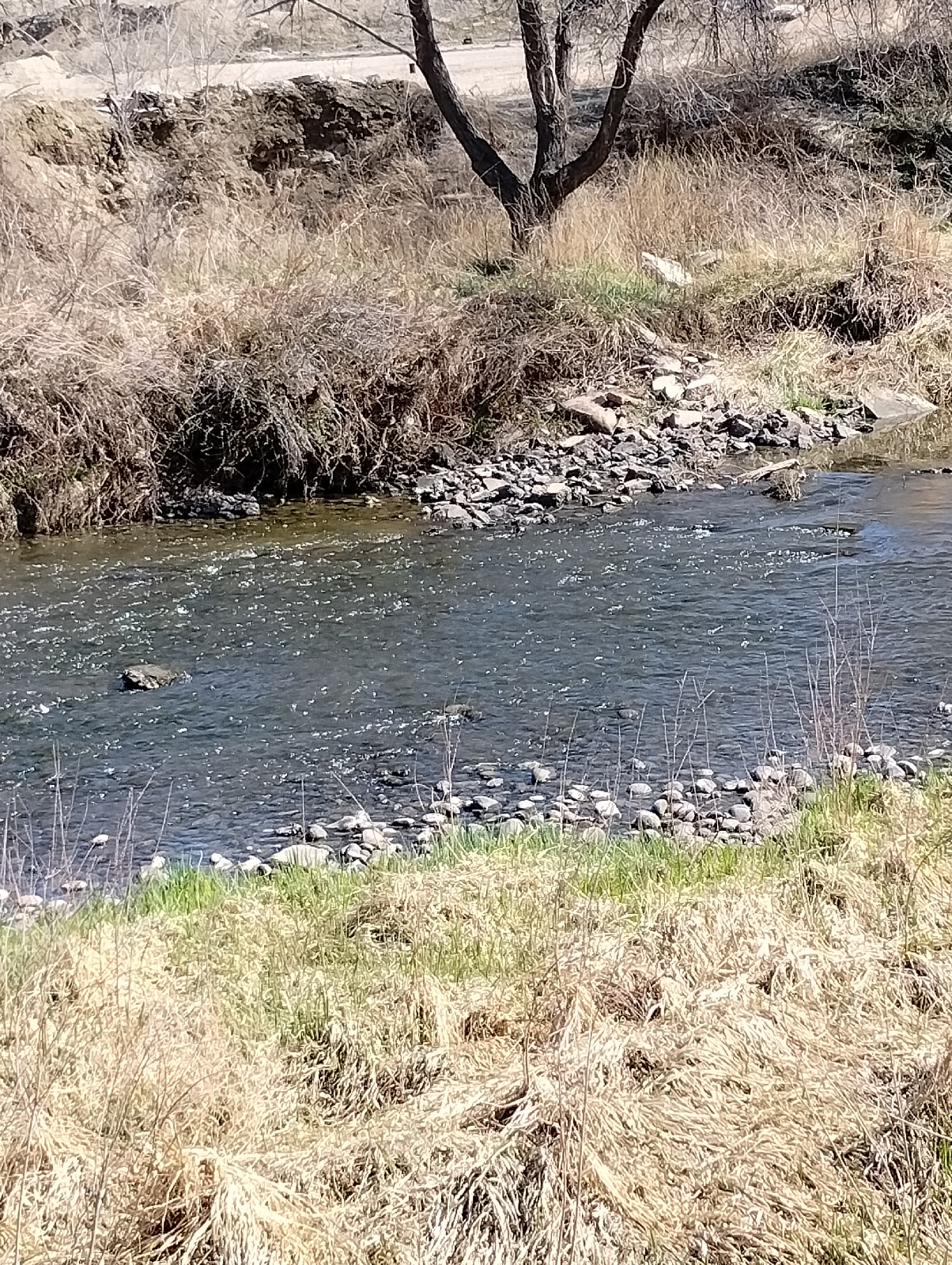
I had planned to take a sample of the sand from the Creek bed to look at, but it turned out to be black mud, so I changed my mind.

 The huge piles of asphalt were too near. I have to credit Martin-Marrietta, though, the area didn't stink of asphalt so they must be taking some concern for the environment.

I'm sure you're familiar with asphalt. It's what they pave roads with. Asphalt, or bitumen, is a sticky, semisolid material that is either derived from petroleum (the heavy part left after the oil is refined) or is drawn directly from the ground. Bitumen mixed with clay, the material actually used to pave roads, is also called "asphalt". I don't know where this stuff in these pictures is from but the Pierre shales that surround the Denver Basin contain a lot of petroleum and there are many wells to the north and east.
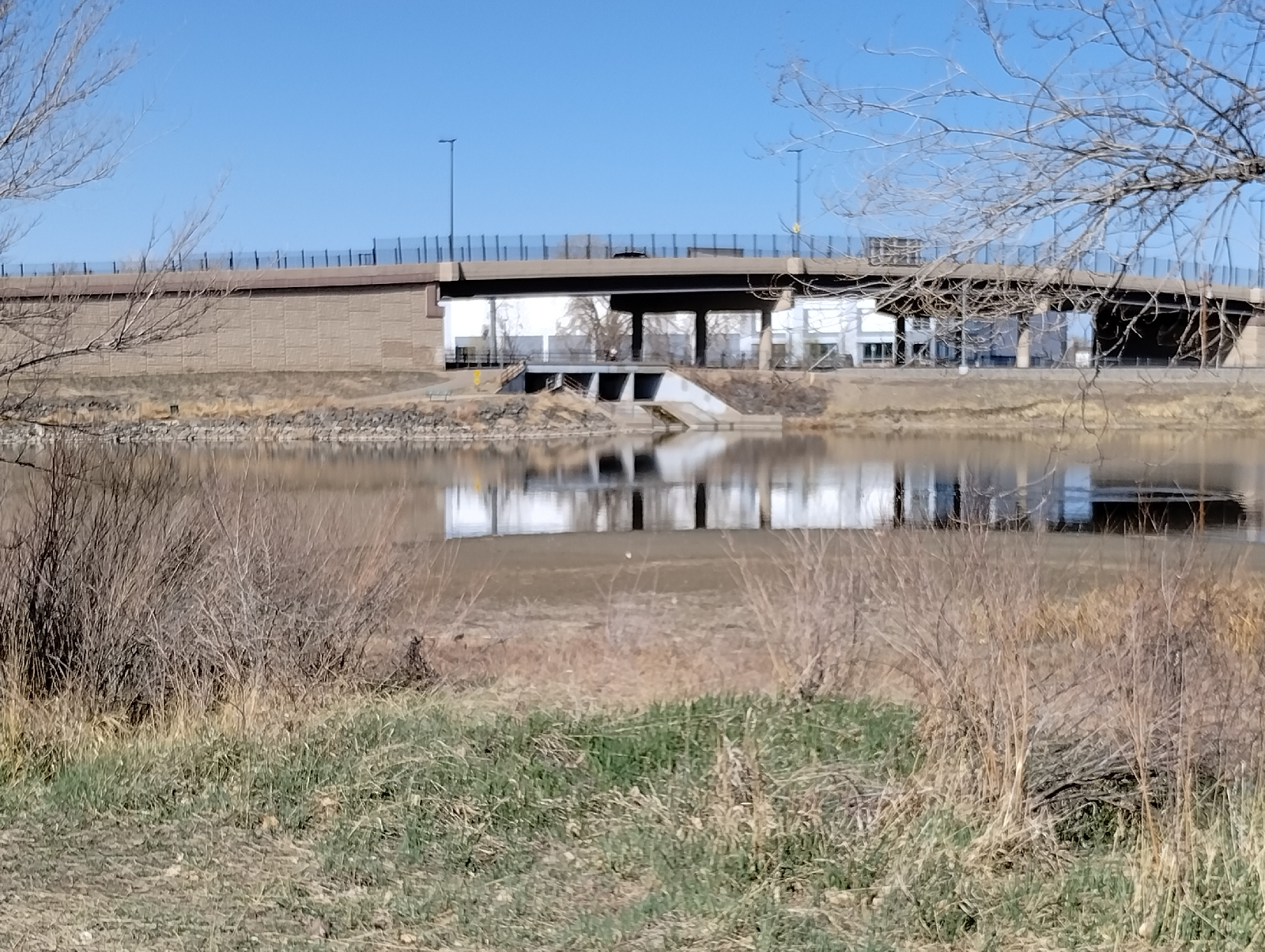
Another confluence...this is where Little Dry Creek joins Clear Creek. The actual confluence has been altered by an artificial pond. There are several such ponds between Arvada and Denver and they seem to be popular with anglers. I met several on this trip.

This Little Dry Creek isn't the same one that runs through my neighborhood but I have visited it before at the Westminster Station (Friday, June 21, 2019, Terminus: Westminster).
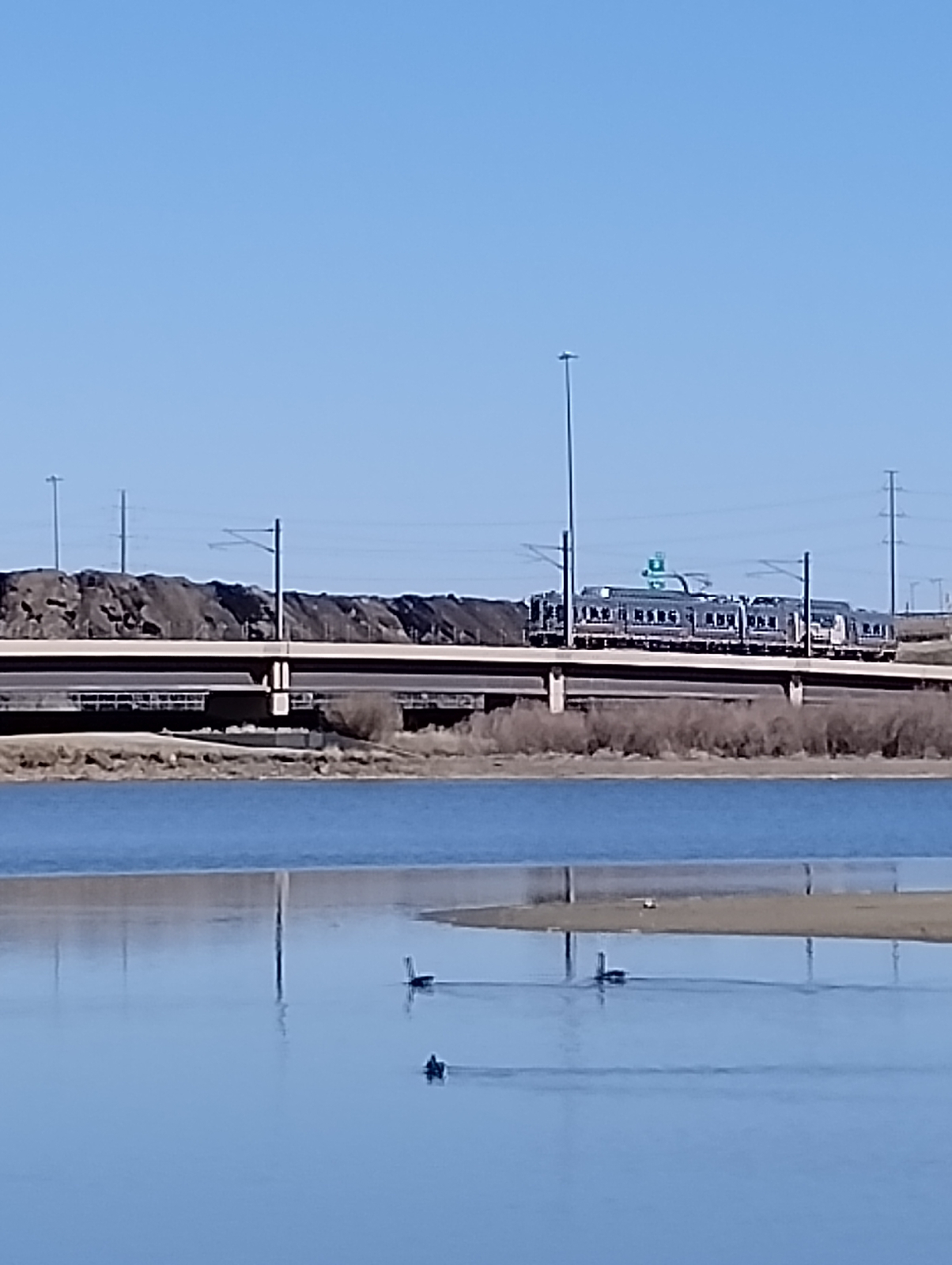
This isn't the horse I rode in on. It's traveling the B Line from Westminster Station to Pecos Junction. I'll hike that one after I finish the G Line.

Again, I have to commend Martin-Marrietta. The installation is very near Little Dry Creek Lake (pictured above) and the lake is popular with anglers and water fowl alike.

Clear Creek is a respectable stream here. I'll be separating from it after this hike because it heads north east away from the G Line, which takes a 90° turn south on it's approach to downtown and Union Station. I'll be following Pecos south to 38th Avenue,then east to Fox Street. That'll get me to Fox Station, and the following hike along Fox Street will take me to the end of the G Line at Union Station.

All of these station-to-station hikes have been above a geologic depression in the Earth's crust called the "Denver Basin". It's a geologic basin instead of a topologic basin because it doesn't show on the surface (or on topological maps). It's far underground buried beneath the Dawson, Arapahoe, and Denver formations.

As the Rocky Mountains began rising up, water was already tearing them down and the erosion products were washing out across the plains. Although it's sorta hard to picture it, over the millions of years between then and now, the rocks of the Earth's crust can bend and flow and squeeze like putty and it did here. As the Colorado Plateau rose, as in counterpoint, the land to the east buckled downward, and as debris piled up, the crust sank under the weight until a great bowl full of dirt, mud, gravel, and boulders formed and then they built Denver right on top. It's a long way down to hard rock...as far as 3900 meters (13000 feet).

If you enlarge the blue diamonds in the pictures above, you can see that Martin-Marrietta is proud of their commendations. NAPA is the National Asphalt Pavement Association and to quote their website the commendation is to "help asphalt mix producers and paving companies improve operations and safety as well as recognize employees and partners for a quality work." So I guess the Pecos Junction plant has something to be proud of.

Again, most of these stations provide good views of the mountains. Up to now, my only exposure to Pecos Junction Station is from the train and the platform is tucked away beneath highway overpasses. It's an important station in that it provides a switching site between the G and B Lines but it's not very scenic being situated in an industrial area 

The parking area is up top with a long, covered pedestrian walkway leading to elevators and stairs down to the platform (always gotta be one last obstacle at the end of a hike!)

The mural on the platform is a piece by Bimmer Torres called "Roots Crossing". It illustrates a primary issue in the area... transportation.

And there I was set to utilitize that very thing and go back home.

I have mixed emotions about industry but I can't readily dismiss it. Our modern world depends on it. What are the industries in your area? How do they fit into your world?

Thursday, September 13, 2018


--- Alameda to Broadway ---

I had a side trip to make to the library, so I took a bus from Colorado and Amherst to Colorado Center Station. That gave me the opportunity of talking to a long time residence of Denver who could remember when South Denver was semi-rural. He lamented the changes. For instance, he remembered when the area where I-25 and the light rail currently runs west from Denver University to Broadway, used to be called "The Narrows". I can see why from the topography. I can't find a major stream in the area, but there does seem to be a depression in the valley wall there.

Colorado Center is a large group of shops and office buildings on Colorado Boulevard and I-25. Here's a shot from the station.

                                                               [Colorado Center]

Colorado Center Station almost turns into a subway here, but it's still open to the sky. Many of Denvers light rail stations are near restaurants and other points of interest and have elevators to make them more accessible.


                                                     [Colorado Center Station]

But my destination, this time was Alameda Station. It has a view of one of the examples of Denver's love of the arts. There are many murals around town and this one is popular.  It was being painted while I was training for a job at a place further down Alameda, and I could watch some of the work.


                                                           [Alameda mural]

Alameda Station is one of the four hubs  (the others being Broadway, Osage Street, and Auraria West) where most of the light rail lines meet. It also has the White Whale Room where I stopped for a cup of handcrafted (it was that good) chai. The man behind the counter was friendly so I had to ask him about the name. There couldn't be a whale within 2000 miles of Denver.

He said that he suggested that it meant that they were obsessed with coffee and cocktails (their raison d'etre - did you catch the literary refernce, there?) but he admitted that it referred to the trains that ran just outside. They do look sorta like white whales.

                                                                [Alameda Station]

                                                             [The White Whale Room]

After a well received rest, I wandered down toward Alameda Avenue past apartments called "The Denizen". I took notice because that's what I call Vincent when he's being rambunctous.

                                                                    [The Denizen]

Another thing caught my eye - a large building on Alameda that reminded me of a Spanish mission. I had to check it out. I found that it was a place called the "Byers School".


                                                              [The Byers School]

The Byers School was an small elementary school that was closed in the 1970s and was left vacant until, in 1982, it was renovated and turned into condomeniums. Still and impressive building, though.

Along Alameda, on the way down to the South Platte is this mural. I didn't notice the camper at the time. I would have stopped and talked to him. I cut him out so as to not risk identification.


                                                               [Mural on Alameda]

This is not a terribly pretty stretch of the South Platte - mostly shop and industrial areas, but there are some interesting points.

                                                          [South Platte at Alameda Ave.]

I noticed this denizen under an underpass on the Platte River Trail. I have no idea what it is but it was interesting, so I took its picture.


                                                                  [The something]

Johnson Habitat Park is a dump-turned-recreational-park between Alameda and Broadway. I wouldn't swim there but it's not nearly as dirty as, say, Bear Creek. In fact, it is a vegetative swale - a plot of land planted so as to filter runoff water before entering the river. There are several educational plaques and exhibits along the trail such as the following explaining the park and giving some information about the river itself. The Colorado state tree. the blue spruce, and the state grass, the blue grama, are displayed there.


                                                                  [Johnson Habitat Park]

This whole area of the Greenway, between Evans and Alameda is obviously intended to be instructive and is a nice hike for the budding naturalist.

Back at Mississippi Avenue, I stopped in at the Breakfast King for a bite. This place is like an old fashion city cafe with a huge menu  (remember Alice?). The waitresses all deserve their tips - really nice people. The food is tastey - especially the breakfast food.

Thoroughly worn out and hot (summer isn't quite ready to give up, yet.), I took the H Line back to University and boarded a bus for home.

Murals are legitimate works of art and often have a lot to say about local culture. Does your area have any murals on display? What do they say about your home?

Often parks are planted to reflect local habitats. How about the parks in your area?


Sunday, July 15, 2018


                                                             [Eugene Field library]

Friday, the 13th (my day!), the Eugene Field branch of the Denver Public Library hosted presentations by Bike Denver and the Colorado Department of Transportation about the future of transportation in Colorado. I'm not a bicyclist so the Bike Denver presentation was just interesting. If you would like more information they have a website at www.bikedenver.com and the provide many services to encourage people to use the bike trails more including lessons and people who volunteer to help folks get use to the area.

The bus trip down University Boulevard gave me the opportunity to visit an area that I have been through several times but have not been able to spend any time at. The Bonny Brae Ice Cream Shop is a local landmark and I've been wanting to check it out. It's understandably popular, and did I mention that I'm crazy about milkshakes?

The CDOT had a lot of information to share. A big item was that they are trying to find ways to manage traffic congestion without widening roads and they are investigating some serious technology to do it. Of considerable interest to me was that the CDOT has their own transportation system that has buses that run to Grand Junction, Colorado Springs, and Fort Collins (it's called "Bustang") and they're looking at expanding the bus lines to other areas. That gives me a lot more travel opportunities.

Does your local library offer presentations of information of local interest?

What are the transportation opportunities like in your area? Sometimes there are services that you have to look for but investigation is fun.


Tuesday, April 17, 2018


--- Mineral to Littleton ---

My first light rail trek took me from Mineral Station at the extreme south end of the C and D lines on the Denver light rail system to Littleton Station, the next stop to the north.

My two "home stations", the ones closest to home, are the University Station, at Denver University, and Englewood Station, which is a couple of miles downhill. I can get on a bus in front of my house and ride to either, which I have begun doing because I find that I haven't recovered completely from my health problems of 2017, and I have begun focusing more on the hikes and less on testing my endurance. In this case, I walked a couple of blocks down the street and boarded a bus that would take me to Englewood Station.

This central hub is interesting in it's own right, being an exhibition site for the Denver Open Air Arts Museum and being located next to the Englewood Civic Center. Shopping centers and restaurants are close by. It also offers a breathtaking view of the Front Range including Mount Evans, Mount Morrison and Waterton Canyon far to the southwest. The light rail parallels the freight rails so, while I wait for my train, I can watch the big trains go by and admire the boxcar graffiti.


                                                       Pictures at Englewood Station

People don't usually talk on trains. I have found that to be a tautology across the country. But, if you encounter a group of effervescent young people, you can often enter the conversation. I was once listening to a group near Denver University, whose talk drifted to the mud around Denver and I inserted that most of it was volcanic, which bought me into a lively discussion of local geology.

This time, it was before noon and the train was lightly populated. I had gotten up early to find it snowing hard, but within the hour, the snow stopped and the sun came out and I was out of my sweater before I got to the train.

Oxford Station - Littleton Station - Mineral Station

The light rail carries sleek, white "space age" trains (except when they are sporting rainbow advertisements). When I was a kid, trains still looked like the freight trains shown below and things that looked like these light rail electric trains were still futuristic and scify. And Denver takes some pains to make the stations aesthetically pleasing. The bridge below passes from Mineral Station over the Sante Fe/CanAm highway to the big park and ride lot, a Seven-Eleven convenience store, and Mary Carter Greenway, my destination.


                                                                 Mineral Station

After a snack at the convenience store, I hit the trail. South Platte Park at this point has displays concerning the disastrous flood of 1965. I head north into the Carson Nature Center. It looks pretty much like other parts of the Mary Carter Greenway, which it is a part of. The biggest difference is that the people that administer the trail offers nature tours of the area - but not today - I'm just walking. The trail follows the South Platte River. It doesn't look very ferocious today.

                                                                   South Platte River

This is a favorite area for water fowl and there are many ducks on the river, including some little reddish brown ducks that I had not seen before and that would not let me get close enough for a good picture. This wasn't a technical hike, so I didn't have my telephoto equipment.

Birds in the Denver area are little jerks. They wait until I get my finger on the shutter release button and they fly.

In the Carson Nature Center, I did see the first nice colony of bryophytes that I've seen since I moved to the Denver area. I will have to go back when I start looking at plants - with my close-up lenses.

Cooley Lake and the other ponds of South Platte Park were reclaimed from an old mining project.

                                                               Cooley Lake

There are many water features, there as much for erosion control as for aesthetics, along the South Platte.

                                                             Rock water feature

Around the Hudson Gardens area is a bridge across the river, a small grove garden commemorating influential community members, and a couple of small parks at streams that flow into the river.

                                                                  Hudson gardens area

Hudson Gardens isn't much to look at yet. It's too cold to get the flowers out and the coffee shop that faces the rail wasn't open when I went by. In the winter, the gardens function more as an event center, featuring a surprising number of big name music groups. The gardens are open to the public, free of admission.

I was hoping to make it to Lucille's Cajun Bistro before they closed but missed it by a few minutes. The smell of biscuits was enticing, but I will have to wait.

Littleton is a picturesque little town. Downtown is laid out in a grid with the streets lined with trees and small shops. There are a few modernistic buildings but, over all, it reminds me of the small town America of my childhood.

                                                                       Littleton

The train depot is a coffee shop. I had just eaten when I stopped in, thinking that it was a souvenir shop so I didn't buy anything, but it smelled great, so the next time, I will have to try out the coffee and pastries.

                                                                       Train depot

The actual light rail station is below ground level behind the depot.


                                                                    Littleton Station

Denver likes murals and this one adorns the wall that runs along the train stop. It is a "primitive" representation of the town. Not intended as a term of disrespect, the mural reminds me of work by people like Henri Rousseau, Paul Gauguin, and the early Grandma Moses. This is quite different from the more modern styles at, say, Oxford station , just one stop to the north, or the outdoor art of Englewood Station. Oxford station also has tiles that display the works of school children - drawings about transportation.

A brief train ride, a longer wait for a bus and bus ride, and a short hike then brought me home again. It was quite warm for a day that started with snow.

If you've never taken a train ride, you should try it out. Do people behave differently on a train than on the street or in a bus? Do you feel differently about the people around you on a train?

If you travel on a train regularly, say, as a commuter to work, pay attention to the art and architecture along the railway. Are there common themes or styles?