Showing posts with label architecture. Show all posts

Monday, June 5, 2023

Pecos Junction to Fox Station

Pecos Junction Station

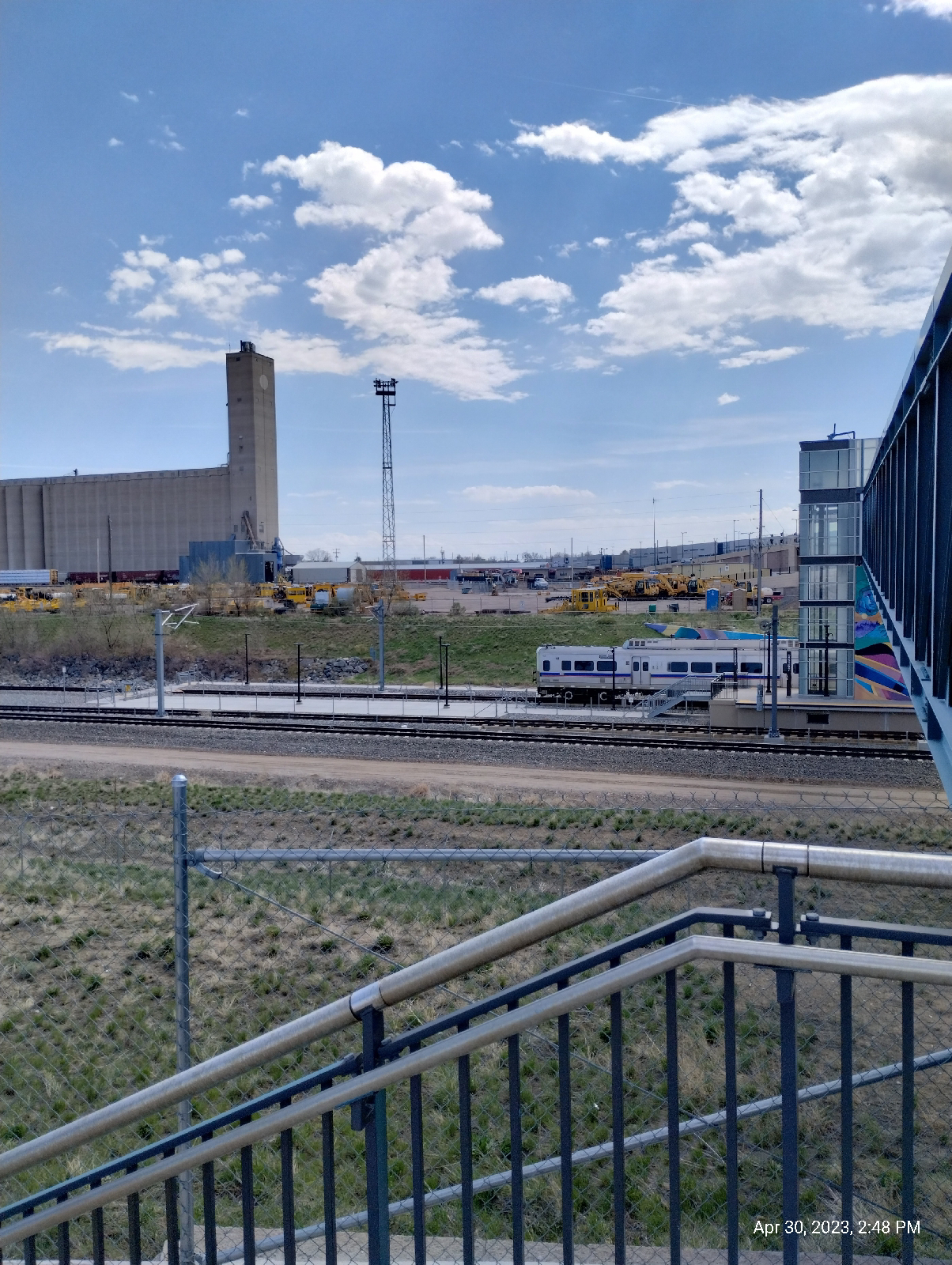
The penultimate G Line hike was a stroll down Pecos Street. It began at the RTD Pecos Junction Station. There's the Commerce City grain elevator #2 in the background.

The term "grain elevator" used to confuse me. They look like rows of silos...which they are. It turns out that a grain elevator can be the conveyor that transfers grain up from ground level to the top of a grain bin, or it can refer to the whole facility.

I was getting close to Denver, so the scenery was getting very urban...industries and residential neighborhoods. The train passes through train yards and the sprawling areas of stacks of metal and fabrications. I would get to see the more civilized fronts of the industrial complexes.


Pecos Street takes a long bridge over the railyards, providing some nice views of the mountains and the plains...and the railyards. The fences that run along the side are decorated with local children's art.

The Denver skyline is also right there.

I have no idea what this building is (or was). Other than the address, I couldn't find any information about it. It just struck me as an attractive example of single office building from the later half of the twentieth century.

It also shows the prevalence of finished basements in the Denver area. Where I come from in Alabama (and the past) a basement had a dirt floor and maybe a pit, and the hot water heater and furnace was down there. Here, people live in their basements and there should be a radon detector down there.

This may be the most interesting city park I've ever seen. Named Chaffee Park, it's a concrete median in a junction between busy city streets. Crosswalks enter and exit. It is nicely designed, though.

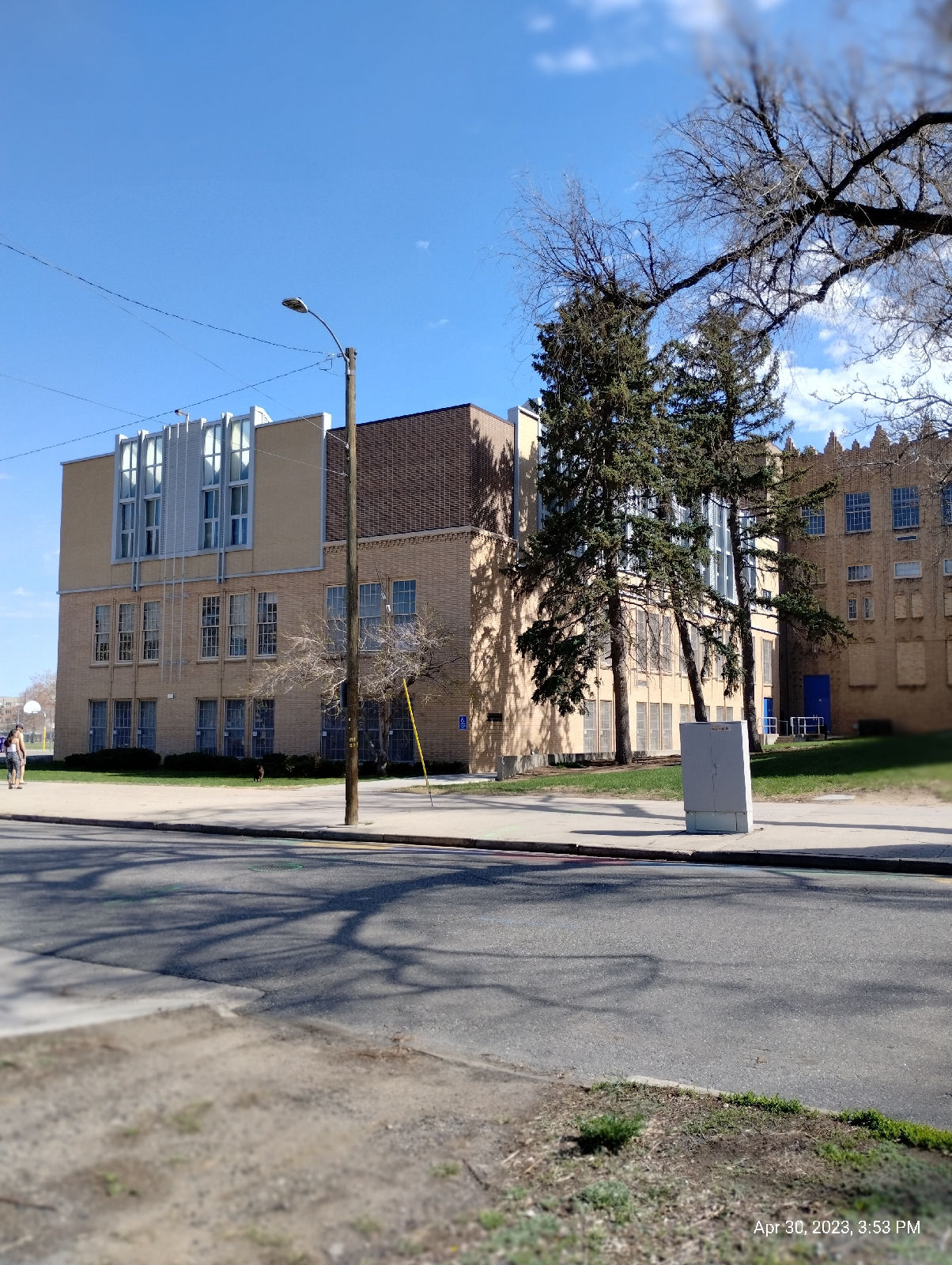
41st and Fox Station is in the Sunnyside neighborhood, once called "Little Italy". The Horace-Mann school building was built in 1931 to double as a community center. It now houses the Trevista, a prekindergarten to grade five school. It displays a highly ornate art deco style that was popular in the first half of the twentieth century. Obviously, there have been more modern additions.

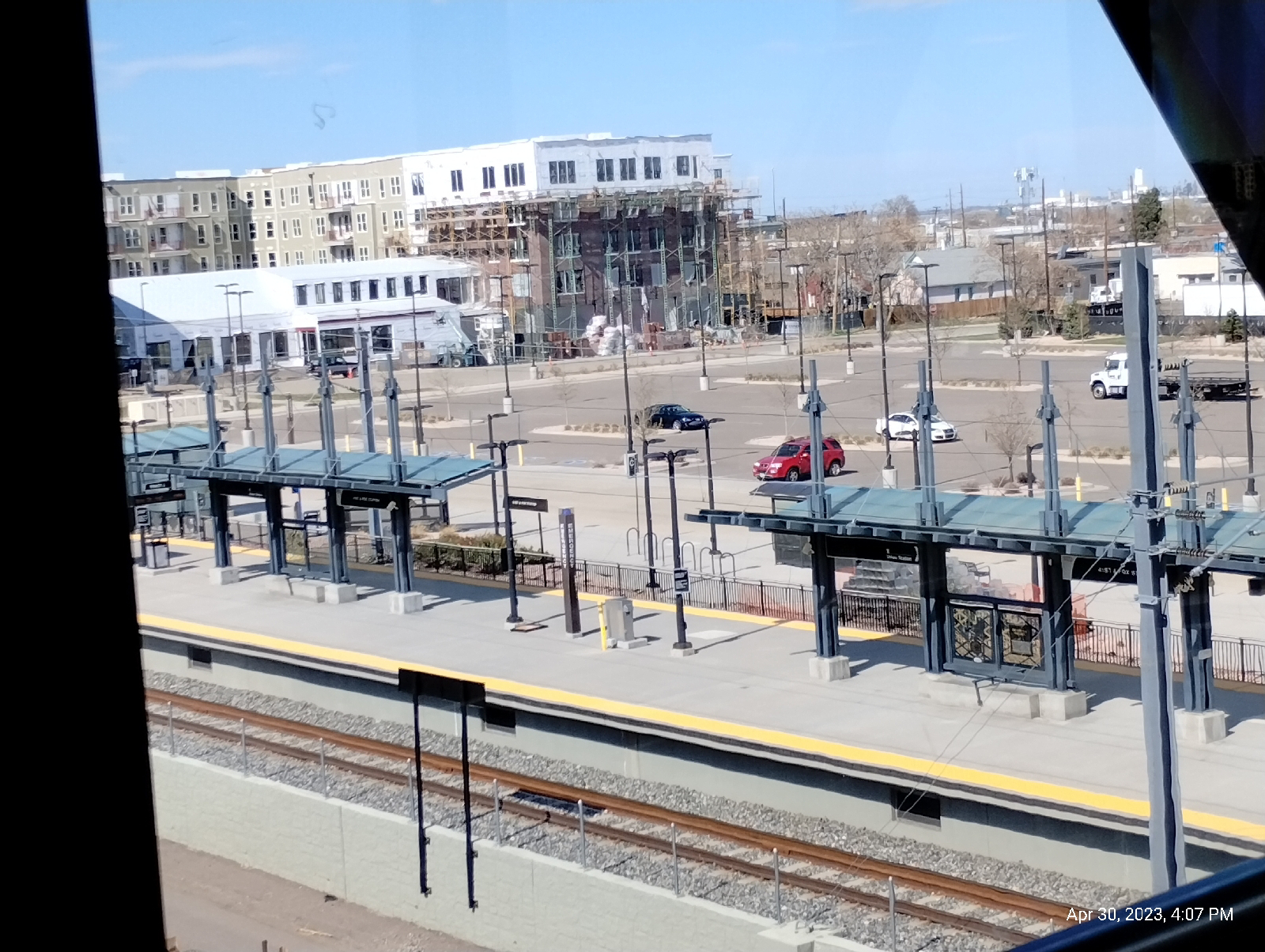
Fox Station has another of those long pedestrian walkways that are common along the RTD light rail.

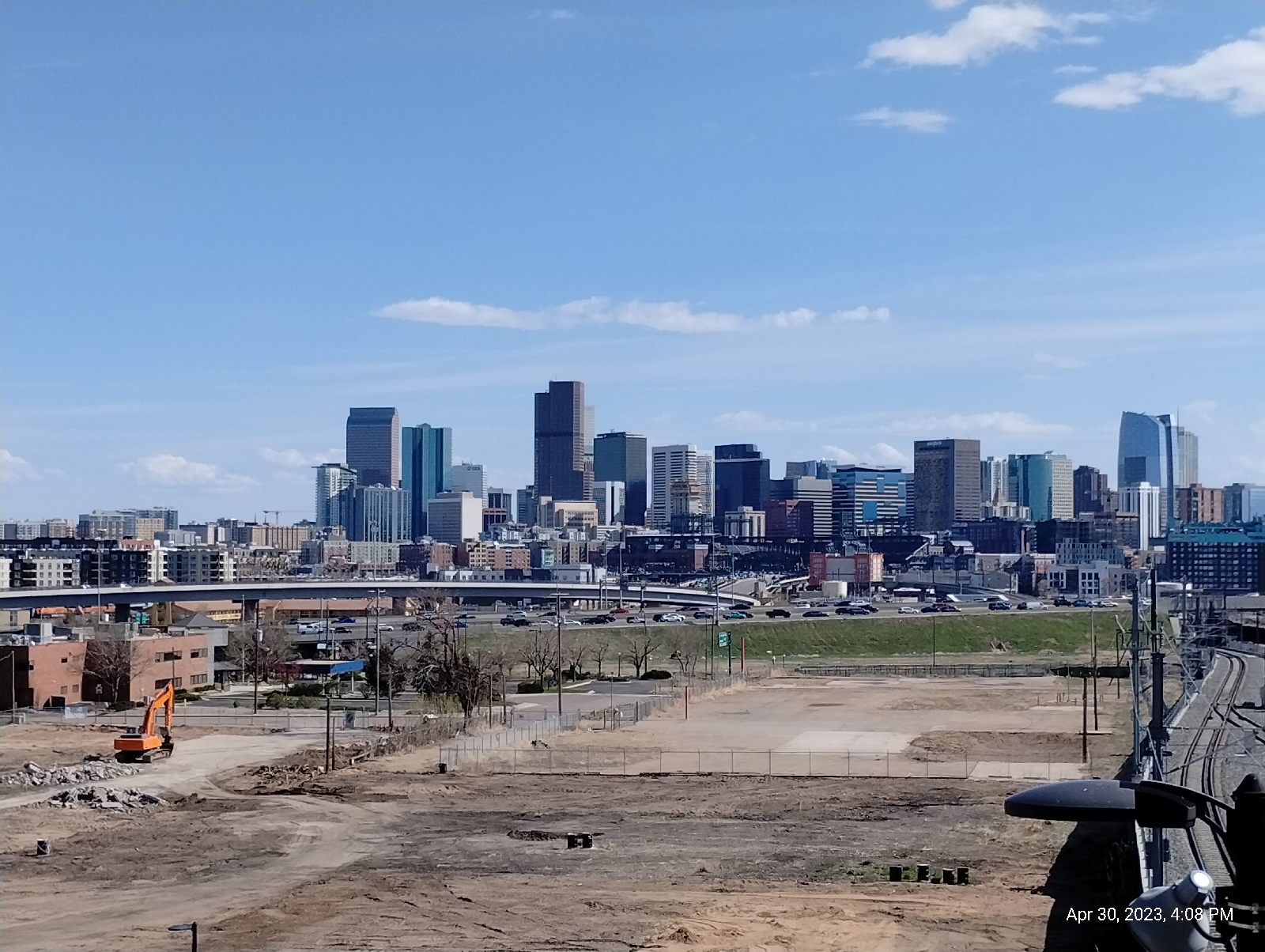
Fox Station, being the last on the G Line before downtown Denver provides good views of the Denver skyline and...uh, the railyards.

Denver is divided into neighborhoods for governmental reasons but each neighborhood also tends to have it's own appearance and culture. Are there areas of your town that feel different? Can you tell why?

Sunday, March 15, 2020

Meanwhile...

I hope you don't think that the only things I do are what I report in my blog two or three times a month. Most of my activity is family and community business. I have a Carolina dog that keeps me busy at home and along with washing dishes and cooking occasionally, I make frequent trips to local grocery stores and there is the weekly trip to the old neighborhood where I am still the assistant librarian at the church I used to attend.

But I'm supposed to walk at least 20 minutes every day to keep my heart going. Almost literally, "if I stop, I stop." Luckily, even my local walks are interesting. Some of the neighbors like to talk and most of them have friendly dogs (Denver is dog territory). The scenery is even spectacular in the neighborhoods.

A while back, I walked over to the other side of Arapahoe to check out Fiddler's Green. It's at the north rim of the valley formed by Little Dry Creek. It's the southern border of the patch of tall buildings in South Denver called "The Denver Tech Center". I go there every week to the Arapahoe at Village Center light rail station, but I had not checked out the surrounding area. 

The big draw is Fiddler's Green Amphitheater, a major venue for stage shows in the area. But it isn't much to look at unless you're going in and that requires a ticket.

On the other hand, there is much more packed into the area. The other day, I noticed a bronze statue of an elephant near the rail station. It was so uncharacteristic that I couldn't quite figure out what it was from a distance. It's a reminder that there's so much up the hill (probably anywhere) that you always miss things, so you have to keep going back.

Adjacent to the amphitheater is Marjorie Park with it's collection of fanciful statues, including many from the Alice stories of Lewis Carroll. There was construction going on when I visited so I could only get a few shots through the gates.


The park was originally named Samson Park after the pet Yorkie of the Museum of Outdoor Arts founders John and Marjorie Madden. The name was changed in 2015. I'll have to return after they finish construction.

Luckily, nearby Tuscany Plaza was accessible with it's collection of statues.


There is outdoor art all over the place in the Village Center/Fiddler's Green area. On the way back from the train station, I got a picture of the bear outside Plaza Tower One, the prominent 22 story building at Village Center.


In fact, you could wander around the entire Tech Center for days looking at art and architecture. 

And, of course, the views of the Rockies in this area are stunning. It's easy to get so used to them here that you forget how breathtaking they are.

The little park running through Walnut Hills is a corridor for wildlife. I spotted this big redtail hawk a couple of days ago. If you have problems seeing it, it's because they are well camouflaged in their leafy surroundings.


Speaking of wildlife, last week, a friend and I hiked up Waterton Canyon to Strontia Dam. Groups of male bighorn sheep were lounging around. I guess the females are lambing. There were plenty of birds and we saw a herd of deer on the other side of the river. 


Not a great shot but incentive to go back sometimes with my telephoto lens. There is a big difference between optical and electronic enlargement.

The Corona virus is interesting from a sociological standpoint. It's a repeat of so many epidemics that I've been through over 66 years of life but this time it's close to mass hysteria. The electronic media has opened up the world to many exciting possibilities, but it has also become a tool for manipulating huge numbers of people who have adapted quite well to it and are very open to manipulation.

It is keeping me inside more to avoid all the mad dashing around and store emptying.

Stay safe and be a neighbor for those that are more vulnerable and we'll get through it all.

Monday, June 10, 2019


--- Highline Canal: Spring ---

The Highline Canal Trail is like a highway for pedestrians.

That sounds too much like a metaphor. Let me drop the "like". The Highline Canal Trail is a highway for pedestrians. If you're hiking or biking and you want to get from A to B, then the Highline might be your friend, along with the many other urban trails that intersect it.

Pedestrianism has it's advantages and disadvantages. It's not for the lazy. It's usually slow (barring heavy traffic on the roads)) and takes considerably more effort than driving. It's not going to take you any great distance unless you're going to get into backpacking in a big way.

On the other hand, it's cheap and doesn't rely on fossil fuels. And you get a bonus. All that exercise your doctor prescribes? It's built in.

Exercise. This 17 mile stretch of the Highline pretty much convinced me that I'm getting too old for the 30 mile day hikes I used to do. 20 seems to be my new limit....at least when temperatures rise above 70 degrees.

I joined the Highline Canal Trail near Dry Creek Road in Littleton. There are several access points in the area.


                                                     [Approach to the Highline Canal]

In following the "highline" contour of the area, the canal has to navigate many roads and natural streams by passing over or under. Here is one of the aqueducts over Dry Creek. It's definitely not a Roman aqueduct but it has it's charm in a Currier and Ives way.

                                                                  [Aqueduct]

As an early 20th century work of engineering, it's certainly interesting.

The canal and it's accompanying trail meanders through a wide variety of scenery, including urban shopping areas.

                                                                         [Littleton]

And just to show that I actually did begin near milepost 20, here's milepost 21.

                                                                      [Milepost 21]

Although I was hoping spring wildflowers would be out for the hike (and there was some as I will show), the predominant color was green.

                                                                   [Along the trail]

One of the many walkers I met early on the trail described the trail as "bone dry". As this photo shows, that isn't exactly right. Denver Water allows water to flow along the canal occasionally, but even when it's not flowing, snow melt and rain will produce ponds along the way.

                                                             [Pond on the canal]

There are quite a few vistas of the Rockies along the canal, such as this view of snow capped Mount Evans.

                                                                    [Mount Evans]

One wildflower I encountered was this small white ground cover. I couldn't quite narrow it down but the five petalled flowers and lacy leaves reminded me of an anemone. A good site for wildflower identification in Colorado is Wildflowers of Colorado (http://www.wildflowersofcolorado.com/index.html), which let's you search by flower color and provides lots of photos.

                                                                  [Anemone?]

At one point, the canal crosses Lee Gulch and it's a little difficult to figure out which trail is the Highline Canal and which is the Lee Gulch Trail. Actually, it's not that difficult since the Highline Canal Trail follows the canal....always.

                                                               [Cascade on Lee Gulch]

There are places where the canal really is "bone dry" and you can see the stream bed and how the canal is constructed. Through most of it's length, the Highline flows across natural earth.

                                                                      [Dry bed]

Where there is water, the many foot bridges across the canal provide picturesque scenery.

                                                                        [Footbridge]

I left the trail where it crossed University (the first time) and walked up to Cherry Hills Marketplace for lunch at the Original Pancake House. The food was good and reconnection with the trail was easy. I just followed Orchard Road back down to where it intersected the Highline Canal.

In places honeysuckle splashed that banks of the canal with white, pink, and rose.

                                                                   [Honeysuckle]

These are different honeysuckle than the ones I'm familiar with down South. Those are vines....these are bushes.

I'm especially fond of succulents and cactuses. Their blossoms tend to be extremely varied, intricate, and colorful. Euphorbia is one of the common varieties in this area. It's also called "spurge" There are many species but this green flowered kind is the only kind I've seen locally.

                                                                     [Euphorbia]

These little guys are called Cowboy's Delight or Copper Mallow. They're tiny but the orange blossoms sorta grab you.

                                                           [Copper Mallow plant]

The orange color on this tree trunk is pretty but it is probably a disease called Cytospora Canker.

                                                               [Orange tree trunk]

And this is only the third snake I've seen since I moved to Colorado, all garter snakes (I miss snakes).

                                                                     [Garter snake]

I've hiked the last 7 miles of this stretch of the Highline before. You can see the backyards of some very large homes here. The structures in Cherry Hills Village tend toward the impressive, ornate and large.

By the time I got to Hampden, my feet were blistered, I was tired, and  it was verging on heat-prostration-weather for me, so, after walking down to University, I was ready to hop a bus for the last half mile.

Poetically, spring is the time that nature revives from it's long winter sleep. Actually, nature never sleeps, it's just harder to see what's going on in the winter. But spring is a great time for people who are interested in birds, other wildlife, or flowers. What's happening outside in your area?


Friday, February 15, 2019


--- Terminus: California Street ---

A circuit around California and Stroud Streets from 15th Street to 19th Street in Downtown Denver forms the terminus of several of the light rails  - F, H, D, and L. A hike around the circuit is short but there's a lot there. I wasn't that interested in food or shopping but there is plenty of that.

I left the train at the Convention Center/Theater District Station and walked around to the Convention Center entrance. I've shown the big blue Bear ("I See What You Mean") in a past blog. Here he is looking into the Convention Center lobby.


                                                                  [Big Blue Bear]

The Convention Center is near the south end of 16th Street Mall, the southern end of old Denver, and the Civic Center Park. Denver is really a fairly small city. I would not attempt a hike across downtown Atlanta in a day but it would be easy  to start at the Convention Center, walk down 16th Street Mall and see the capital and other government buildings at Civic Center Park, return to California Street to complete the circuit around Stout back to 16th Street, and then take the 16th Street Mall Flyer bus to Union Center, look round there and Commons Park, then walk back down to the Conference Center in a day. For those that like city life, that would be a good day trip.

                                                     [Denver from the Conference Center]

The Conference Center/Theater District complex is cyclopean. The Conference Center itself is modernist sculpture of glass and steel. Characteristic of Denver, the interior is adorned with art.


                                                      [Conference Center and wall art]

There was a garden show opening in a couple of hours, but I didn't want to wait around so I started up California Street.


                                                    [California Street and the light rail]

The Colorado Information Center is just down the street on the right (north side of the street). They have a gift shop where you can buy, among other things, replicas of the blue bear (not quite as big as the original) for less than $30 - two sizes, even. The staff is friendly and informative.

The buildings along the circuit are a mixture of old and new. The old tends toward ornate.

                                       [Rose colored building with decorative pilasters and plaques]

Older buildings in Denver often affect a Greek Classical style. If a wall doesn't need columns, columns are suggested anyway with the use of ornate pilasters.

An interesting assemblage of buildings, the Holy Ghost Catholic Church literally rests under a cantilever projection of a skyscraper. Beautiful as a combination of new glass and old stone, there is also a humor here. I say "old" but the church building was dedicated in 1924 with less than a third of is original plan completed. The present building displays the largest collection of colocreme travertine in the United States, over 300 tons of decorative stone.


                                                     [Holy Ghost Catholic Church]

The Federal Custom House at California and 19th Street has an impressive portal. There's a lot of brass in Denver.


                                                          [Federal Custom House]

This is where I turned down 19th Street to follow the light rail over to Stout Street. At 19th and Stout is a collection of buildings, old and new, that house the Federal 10th Circuit Court. The new building to the east is an ornamented block of concrete.

                                              [New Byron White United States Courthouse]

These buildings were names for Byron Raymond White (1917 - 2002) the first Coloradan to serve on the United States Supreme Court.

Across 19th Street is the old building, a classical style building of the same Yule marble that adorns the state Capitol, the Lincoln Memorial, and the Tomb of the Unknown Soldier. Consistent with Denver's love of monumental architecture, the front of the courthouse has a porch with 16 (count 'em) columns. The side walls don't need columns, so they have pilasters to be consistent.

The inside is similarly spectacular with barrel vault ceilings in the lobby and Federal District Courtroom and richly paneled ceilings in other rooms. Being a federal courthouse photography isn't allowed, but you can visit and be wowed. They also have an informative brochure in the lobby.


                                               [Old Byron White United States Courthouse]

The west side of the courthouse is adorned by these two bighorn sheep. The sheep were the work of Denver sculptor, Gladys Caldwell Fisher. Their official names are "Rocky Mountain Sheep" and "White Ram".

                                                                  [Courthouse sheep]

Across 18th Street from the Byron White Courthouse is the Ghost Building. You can look at the outside but you can't go in - it's very posted.

                                                                [Ghost Building]

It was named after Allen M. Ghost, who was a real estate tycoon. The 1700 stone blocks were moved to the current location in 1985.

Almost back at the Convention Center, I spied another purple building, this one the La Boheme Gentlemans' Cabaret. Again featuring ornate pilasters, it is, as they say, a strip club. I see on the Internet that they consistently get good reviews.

                                                                  [La Boheme]

After the train ride back to University Station, I walked across campus to home, stopping along the way to take a few pictures of the construction being done on the west side of the Driscoll Building. This is scheduled to be finished next fall.


                                                             [Driscoll construction]

Some cities favor a monumental style, others like small town American aesthetic. How would you describe downtown in your city? Have many of the buildings been relocated? A lot of Selma, Alabama, where I used to live, was originally in Cahaba, Alabama but was moved upriver because of flooding.