Showing posts with label Centennial. Show all posts

Wednesday, August 30, 2023

Where did all these people come from? Walnut Hills in the Anthropocene

Hominids, human-like apes, appeared on the Earth about 15 to 20 million years ago in what was, by this time, Africa pretty much as the continent appears today. This model has them evolving, along with other great apes, from gibbons. By 300,000 years ago, they had formed into anatomically modern humans, relatively hairless, typically upright walking bipeds. The switch from hunter-gatherer societies to sedentary lifestyles, what we call "civilization", happened around 30,000 years ago in southwest Asia. About 6000 years ago, city-states developed, primarily in the river valleys of Asia and Africa, and with cities came writing, recorded history, and various technical disciplines like mathematics.

Did homo sapiens (scientific name for humans) appear in different places on Earth. Hints reappear from time to time that they might have but, fossils being what they are-rare and elusive- evidence is not conclusive.

From all that we know, humans are a very new addition to the Americas. Humans were established in North and South America by 12,000 to 14,000 years ago and may have crossed the Bering land bridge from Asia to the area now occupied by Alaska as early as 26,000 to 19,000 years ago during the last glacial maximum. Again, fossils are rare and hard to interpret because they have to be preserved by very special processes. Hunter gatherer societies did not leave abundant traces like later, more sedentary colonies. When humanity began constructing permanent dwellings and tools, human history shifted from paleontology to archaeology. Instead of looking for bones, we began reading the artifacts left behind.

Lamb Springs, south of Lake Chatfield, has produced the remains of mammoths killed by humans dated at 14,140 to 12,140 years ago, so they were in the area before that time. The earliest natives seemed to stick to the plains but later humans were established in both the plains and the mountains. 

By 1700 AD, both the Ute and Apache tribes were settled in this area. The Ute were primarily in the mountains while the Apache were mainly a plains tribe. The. Comanche entered the area in the early 1700s and banded with the Ute to drive the Apache south of the Arkansas River, then, in the 1820s, the Arapahoe and Cheyenne moved in and pushed the Comanche south.

The first settlers of European ancestry in the area were gold prospectors from Georgia. In fact, the early settlement that became Denver was named Auraria after the Georgia town of the same name. Gold prospectors entered the area on the way to California after the Sutter's Mill strike and found some gold in the South Platte River and it's tributaries. Towns like Montana City and Petersburg sprang up but the gold wasn't as forthcoming as the prospectors expected. Still, people settled in to farm the land in places like Arvada and what is now West Denver.

If you spend much time in Denver, you'll eventually encounter the name "Little Raven". That was the name of a Southern Arapahoe chief who established peaceful relations with the first European settlers to enter the area.

The Pike's Peak gold rush commenced in 1859 bringing thousands of settlers into the Colorado territory. In 1862, engineer Richard Sullivan Little brought his wife Angeline and built the Rough and Ready flour mill, establishing the town of Littleton in 1867, which was incorporated in 1890. Both Littleton and Little Dry Creek are named after the Little family.

Centennial is a recent addition of Arapahoe County. It was established February 7, 2001.  Walnut Hills was incorporated much earlier in 1965.

Big history is the history of everything. We are the outcome of everything that has gone before us. Carl Sagan said that, "we're made of star stuff," and he meant that literally. Everything is.

Everything has a big history... your town, yourself. I had a genetic trace done several years ago. My ancestors originated in Africa (like every other hominids on Earth) and left with a handful of others, probably during a time of drought). It's rather miraculous that they survived to exit the continent. Their descendants traversed the passes of the Caucasian mountains and entered Europe about 45,000 years ago, likely following migrations of large game animals like bison. My ancestors obviously included Neanderthal...most hominids today are sapiens hybrids. 


During the last of the last ice age, about 20,000 years ago, my people were in the Balkans, as soon as they could, migrating north. We were in southern France about 15,000 years ago, following the retreat of glaciers, finally settling in the region around the Rhine River.

We were dispersed when the Burgundians took over the region during the One Hundred Year war(s) and returned to our homeland after Germanic regions were returned to earlier inhabitants. We were originally Sahns, but took the name VanZandt from the Burgundians who left the Xanten area.

We were present in upstate New York during the Revolutionary War and later migrated to the Midwest, Oklahoma and Texas, and from there to North Carolina and Georgia, where my mother and father was born.

I came (briefly) from southern Florida before my family returned to our homeland in south Georgia, but my father followed jobs to central Georgia and Alabama. Leaving our home in the mill village of Valley, Alabama, I entered the university at Auburn, Alabama and, after twenty years of college and working through college, I began my career in Selma, Alabama as a vocational rehabilitation specialist. Now I have retired to the Denver, Colorado area, and that is my big history.

What's yours?

Sunday, March 15, 2020

Meanwhile...

I hope you don't think that the only things I do are what I report in my blog two or three times a month. Most of my activity is family and community business. I have a Carolina dog that keeps me busy at home and along with washing dishes and cooking occasionally, I make frequent trips to local grocery stores and there is the weekly trip to the old neighborhood where I am still the assistant librarian at the church I used to attend.

But I'm supposed to walk at least 20 minutes every day to keep my heart going. Almost literally, "if I stop, I stop." Luckily, even my local walks are interesting. Some of the neighbors like to talk and most of them have friendly dogs (Denver is dog territory). The scenery is even spectacular in the neighborhoods.

A while back, I walked over to the other side of Arapahoe to check out Fiddler's Green. It's at the north rim of the valley formed by Little Dry Creek. It's the southern border of the patch of tall buildings in South Denver called "The Denver Tech Center". I go there every week to the Arapahoe at Village Center light rail station, but I had not checked out the surrounding area. 

The big draw is Fiddler's Green Amphitheater, a major venue for stage shows in the area. But it isn't much to look at unless you're going in and that requires a ticket.

On the other hand, there is much more packed into the area. The other day, I noticed a bronze statue of an elephant near the rail station. It was so uncharacteristic that I couldn't quite figure out what it was from a distance. It's a reminder that there's so much up the hill (probably anywhere) that you always miss things, so you have to keep going back.

Adjacent to the amphitheater is Marjorie Park with it's collection of fanciful statues, including many from the Alice stories of Lewis Carroll. There was construction going on when I visited so I could only get a few shots through the gates.


The park was originally named Samson Park after the pet Yorkie of the Museum of Outdoor Arts founders John and Marjorie Madden. The name was changed in 2015. I'll have to return after they finish construction.

Luckily, nearby Tuscany Plaza was accessible with it's collection of statues.


There is outdoor art all over the place in the Village Center/Fiddler's Green area. On the way back from the train station, I got a picture of the bear outside Plaza Tower One, the prominent 22 story building at Village Center.


In fact, you could wander around the entire Tech Center for days looking at art and architecture. 

And, of course, the views of the Rockies in this area are stunning. It's easy to get so used to them here that you forget how breathtaking they are.

The little park running through Walnut Hills is a corridor for wildlife. I spotted this big redtail hawk a couple of days ago. If you have problems seeing it, it's because they are well camouflaged in their leafy surroundings.


Speaking of wildlife, last week, a friend and I hiked up Waterton Canyon to Strontia Dam. Groups of male bighorn sheep were lounging around. I guess the females are lambing. There were plenty of birds and we saw a herd of deer on the other side of the river. 


Not a great shot but incentive to go back sometimes with my telephoto lens. There is a big difference between optical and electronic enlargement.

The Corona virus is interesting from a sociological standpoint. It's a repeat of so many epidemics that I've been through over 66 years of life but this time it's close to mass hysteria. The electronic media has opened up the world to many exciting possibilities, but it has also become a tool for manipulating huge numbers of people who have adapted quite well to it and are very open to manipulation.

It is keeping me inside more to avoid all the mad dashing around and store emptying.

Stay safe and be a neighbor for those that are more vulnerable and we'll get through it all.

Thursday, October 31, 2019

New location, first excursion

This one was about dental work...very interesting but probably not for everyone, but it did give me an opportunity to check out some of the neighborhood. 

The roads here are a spaghetti mess so they're taking some time for me to learn, but that does mean that there's little though traffic and not much opportunity to get up speed driving. It really is a quiet little neighborhood. Unlike an HOA, it looks like people live around here. It's not junky but people work on their cars in the yard and the lawns are not homogeneous and manicured. I think I'll like these people.

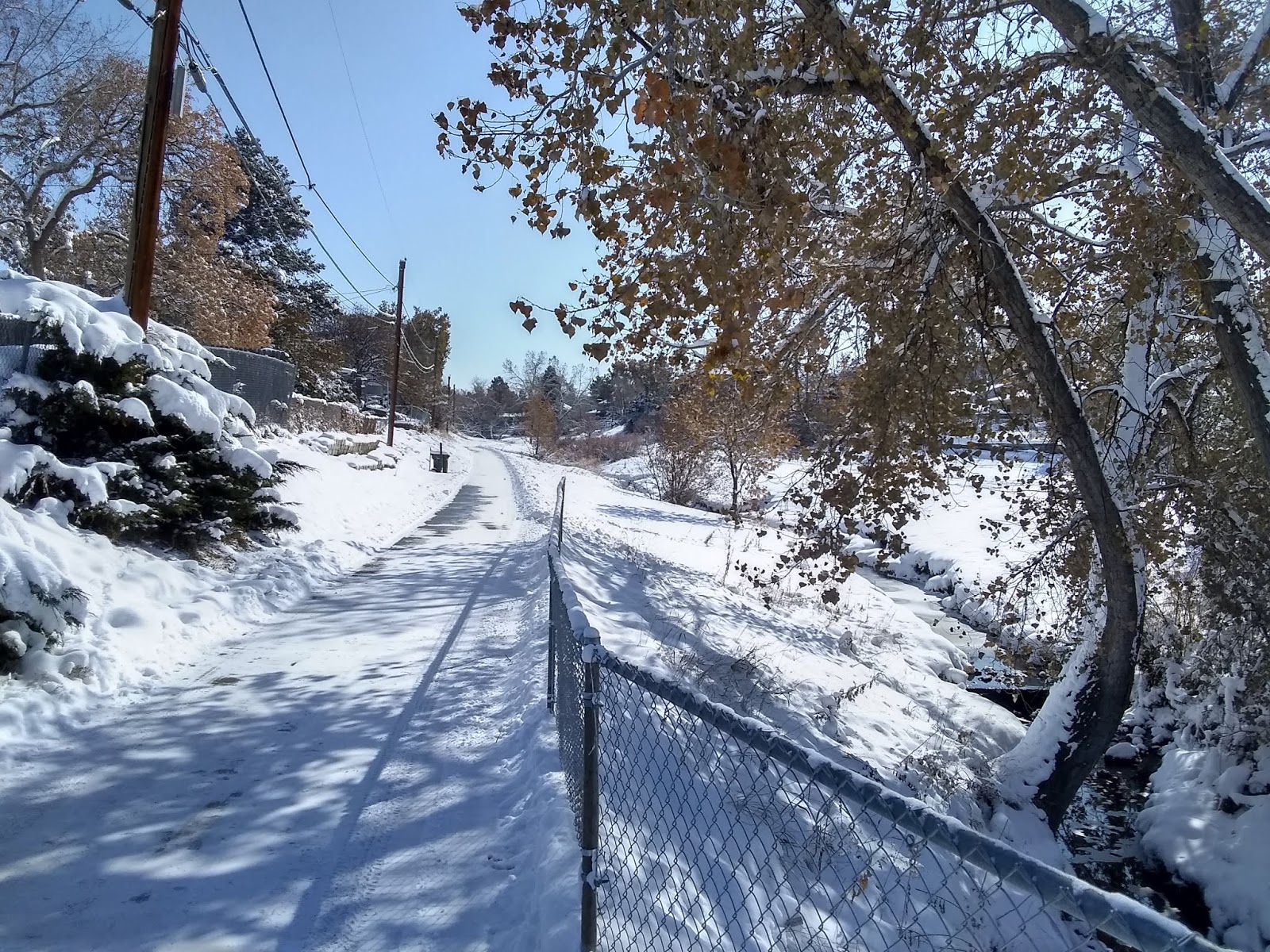
A short walk from our house, on the street we have been using to get home, is a park that has Little Dry Creek (which I have never seen dry, and is named after the Little that Littleton is named after, not because it is necessarily smaller than Dry Creek) flowing through it. It provides a convenient corridor to the major road that forms the eastern boundary of the neighborhood. 


[Walnut Hill Park]

Part of the South Suburban Parks and Recreation trail system, this trail links up with an extensive network of walking, biking, and connector trails. The trails in the Denver area are intended to be an alternative to vehicular traffic.

This is the second snow of Autumn 2019 and the combination of snow, traffic, and mountains is pretty much iconic for Denver.


[Shots around Centennial]

I caught the RTD light rail from the Dry Creek Station, about a mile and a half walk from my house, but on the return trip I checked out the Arapahoe Station which seems closer. I'm sure I'll have photos of that in later articles.

[Dry Creek Station]

I'll be recuperating from our move for the rest of the week but will start my morning doctor-prescribed walks next week with excursions around the corners of our neighborhood. Hopefully I'll find interesting things to post.

Relocations are irritating and exhausting but, for the adventurer, they mean new environments and opportunities for chance to take you into new territories. If you just have to relocate, take advantage of your new surroundings. New is good.

Sunday, October 13, 2019

Another moving experience

Six years and three moves. It's striking how different, different parts of the Denver area are. We are moving to Centennial now and we will definitely be in the plains. There's still a little rise from the South Platte River but the geography is no longer river valley.

While I adapt to the new location, my blogs will be largely about that but I'm still looking forward to switching gears to astronomy and physics next year. I wonder how light pollution will be in the new neighborhood. 

I've also shifted my October excursions to November. I still plan to take a train out to the airport for the weird Denver tour. And, unless something else interferes, I'll hike Boulder Creek with a friend. I still plan to finish up the Highline Canal Trail, but I've pretty much lost my opportunity for an Autumn hike.

Anyway, I hope you stick with me through some big changes in the future months as I finish up 2019, mathematics, and language with the caveat that the past never really goes away.

Are you one of those folks (like me) who hate moving? Take advantage of it! A move is a great time to take stock of your situation, organize your life, and make all those big changes you've wanted to make but have been putting off.