Thursday, November 7, 2019

Physics: The Fundamental Science

I'm not a physicist, but I will be impersonating one on this blog for the next year or two  Actually, I love science demonstrations and have since I was a kid with my science kits.

Why is physics fundamental and in what way?

Well let's think about the prairie dogs out in the Bear Creek Greenway. They would be (and are currently) of interest to biologists. But, being animals, they have to eat to survive and they get most of their energy from carbohydrates, much like humans. The processes they use to extract that energy has to do with the interactions between molecules and atoms. Now, we're in the realm of chemistry, but the interactions between chemical substances care governed by charges, so, now we're solidly in the realm of physics.

The furry little things move around (a lot!) and their bones and muscles work by the same principles as any other machines - again, physics.

The Table Mountains in Golden are geologically interesting remnants of ancient volcanoes. They have deposits of basalt to prove it. Basalt is like granite but hardened so quickly that  large crystals could not form. The way substances change phase are physical phenomenon, and the processes that uncovered those ancient volcanoes are also physical forces.

The point is that all the sciences, at some level become the purview of physics. The ways we measure things are governed by physical processes. If you pour a liquid into a graduated cylinder, you will see that the surface is curved and accurate measurement requires that you take that curvature into consideration. The forces that curve the surface of the liquid are physical. The smartphone I use to measure things on the trail and make photographs relies on electronics to function.

Physics is at the bottom of all the sciences.

There are several "flavors" of physics that have developed over the years. The more intuitive, everyday version is Newtonian mechanics. Most folks have a pretty good grasp of the regular push and pull of things although some of the details may be surprising, but Newton died with a serious question on his mind. He knew how gravity worked, but he didn't know what it was, and his idea that light was particles was not completely right. By the time James Clerk Maxwell came along, it was well established that light had a wave nature and he gathered all the parts of electromagnetic theory together. 

A lot of people think that Einstein's theories of relativity replaced classical physics, the combined physics of Newton and Maxwell, but again, that's not quite true, in fact, Einstein started with the proposition that classical physics had to be true for every observer in every (inertial) frame of reference. From this seemingly innocent proposition, things began to get weird. As an object gets faster, both its size and time contracts (time runs differently for objects moving at different speeds), and the speed of light in a vacuum is the upper limit of speed in our Universe. But the theories of relativity have been soundly verified.

During Einstein's life, physicists came to the surprising conclusion that in the subatomic world, things did not move smoothly but in discrete steps, things could jump from one place to another without existing anywhere between, and we could not simultaneously know the position and velocity of an electron. Some things are, in fact, indeterminate.  The atomic world was weirder than we had ever imagined. Quantum physics shocked everyone, including Einstein.

So what does the future hold? It seems to be deeper down the rabbit hole. The future of physics is sure to be an adventure.

But, for awhile, let's go back to the comfortable world of Newton and explore how our everyday physics works and, yes, it still works.

Classical physics starts with observation and that means measurements. If you've been following my blog, you've seen me measure trail distances and altitude, barometric pressure, weight vs. mass, and temperature vs. heat. The thing is... there's only three fundamental measurements…..three things you can measure directly. For instance, you measure temperature either by measuring the change in length of a substance that changes size when they heat up or cool down, or you can measure voltage differences across a material which changes its resistance in relation to its temperature. Temperature is the average internal energy in a mass and you would have to measure the energy of all the particles in the mass to measure the temperature and, even if you could go that route, the unit of energy is a joule which is the force of one newton acting through a distance of one meter. A newton is the force of one gram accelerated at one meter per second, per second. In other words, temperature and energy are composite measurements, measurements made up of other measurements.

The three fundamental measurements that make up all the others are position, time, and amount (count). That's all. Distance is the difference between two positions and time duration is the difference between two times. I'll be talking about mass later. It's actually an amount, but all three of the fundamental measurements are weirder than you might think.

In the meantime, check out my creations.

I use constructions from construction kits as structures for demonstrations and experiments. I have an Erector set and a Lego set and I order separate parts as I need them. Here are two contraptions I built. 

[Escapement mechanism]

[Gear train]

Every.mechanical clock has one. Clocks are driven by motors, mechanical or electric, which are usually continuous. The old grandfather clock had a weight that slowly unwound a chain on a spool. Later clocks and watches used a wound spring. The problem with both was that they moved smoothly. Clocks have to tock, chopping time up into seconds, minutes, and hours. That is the job of the escapement mechanism. In old clocks, that was usually driven by a pendulum, which can be a very precise time keeper (I'll be looking at pendulums later). Later, escapements used a rebound effect to keep going.

This one uses a swinging weight that slaps a post to interrupt the motion...not very useful for clocks but very visual. The gear train shown above scales down the speed of the unwinding rubber band and transfers the motion to the swinging weight. Watch it go!

[Escapement video]

A company called "Klutz" publishes book-based action kits (project books with kit parts) including Lego compatible construction kits. The escapement mechanism parts and plans were in their Crazy Action Contraptions kit.

I also built a cart out of my Erector set. I'll be using it later when I explore motion in the playground. It has a phone clamp that lets me send my smartphone along for a ride and the Science Journal app can record the trip.

[Phone cart]

The thing about construction kits is that their parts are standardized. All the holes and interlocking dots are the same distance apart. All the parts fit all the other parts. In fact, Lego makes their specifications available to other companies, like Klutz, so there is a wealth of parts out there to do just about whatever you want.

By the way, keep workshop pegboards and circuit plugboards in mind, too. They usually fit into this standardization philosophy. If one system doesn't fit another, a little finagling will usually do the trick. A few holes drilled in some Lego bricks will nicely connect Erector to Lego. (Hint: use washers when using screws in soft plastic parts.) Back a circuit plugboard with Lego bricks using double sided tape and your electronic project integrates into your Lego set.

Check out some construction kits. In addition to science adventures, they make great, creative hobbies. Many regions even have clubs for construction enthusiasts, especially Legos.



Sunday, November 3, 2019

Tales of passion and loss

Well, maybe not quite so dramatic, but certainly aggravating.

My intention was to create a series of educational home videos to accompany my upcoming explorations of the hard sciences and I did produce about 10 hours of video...before my computer died.

The files aren't actually lost...not really. They're in the hard disk, but I would have to wait until I get a new computer that can read the hard disk or find someone that doesn't mind me installing my old hard disk into their computer and transfer all the files onto my external drive and that's a whole 'nother can of worms. I'm not into biology yet so the worms are out for the time being. I'm 66 years old and too old to be wasting that kind of time so….

Tack and yaw (whutever that means)

There are actually some great video series already out there and I will recommend a few. Then, I will integrate the demonstrations I planned to do into my excursions. I'll start (as usual) by telling you about my setup, the references and tools I will be using. Then, I will find a local playground and….well, play, and I will record my motions using my smartphones to show you how classical mechanics works in the real world. Then, I'll bring it into the lab (my bedroom) to open it up and show you what's under the hood. And there will be short videos.

As for the series, if you have the money or can check it out at your local library, The Teaching Company has an excellent introduction to physics presented by Richard Wolfson called Physics and Our Universe: How it All Works. It is a 60 lesson series that is light on math but deep on understanding. Dr. Wolfson believes in demonstrations.

One of the stellar personalities from the physics classroom was Walter Lewin (of "physics works!" fame). His classes were deep and his demonstrations were fascinating. You can still find them on YouTube (https://www.google.com/url?sa=t&source=web&rct=j&url=https://m.youtube.com/channel/UCiEHVhv0SBMpP75JbzJShqw&ved=2ahUKEwiK2L3wgcrlAhVHrZ4KHUtABCkQjjgwFHoECAgQAQ&usg=AOvVaw09SeYA_wzqGTJhlVHpa8Ry

A little more "introductory" but very well done are the videos from the California Institute of Technology, The Mechanical Universe … And Beyond. A blend of classroom lectures, science demonstrations, and historical documentary, this series is available for download from the Internet Archives (https://archive.org/search.php?query=mechanical%20universe&and[]=mediatype%3A%22movies%22

And, of course, check out the offerings at the MIT Opencourseware website (https://ocw.mit.edu/index.htm). Physics and astronomy are waiting for you, hopefully sans the drama, loss, and agony of de feet, next year, here on Adventuring: The Bear Creek Commentaries. 

Thursday, October 31, 2019

New location, first excursion

This one was about dental work...very interesting but probably not for everyone, but it did give me an opportunity to check out some of the neighborhood. 

The roads here are a spaghetti mess so they're taking some time for me to learn, but that does mean that there's little though traffic and not much opportunity to get up speed driving. It really is a quiet little neighborhood. Unlike an HOA, it looks like people live around here. It's not junky but people work on their cars in the yard and the lawns are not homogeneous and manicured. I think I'll like these people.

A short walk from our house, on the street we have been using to get home, is a park that has Little Dry Creek (which I have never seen dry, and is named after the Little that Littleton is named after, not because it is necessarily smaller than Dry Creek) flowing through it. It provides a convenient corridor to the major road that forms the eastern boundary of the neighborhood. 


[Walnut Hill Park]

Part of the South Suburban Parks and Recreation trail system, this trail links up with an extensive network of walking, biking, and connector trails. The trails in the Denver area are intended to be an alternative to vehicular traffic.

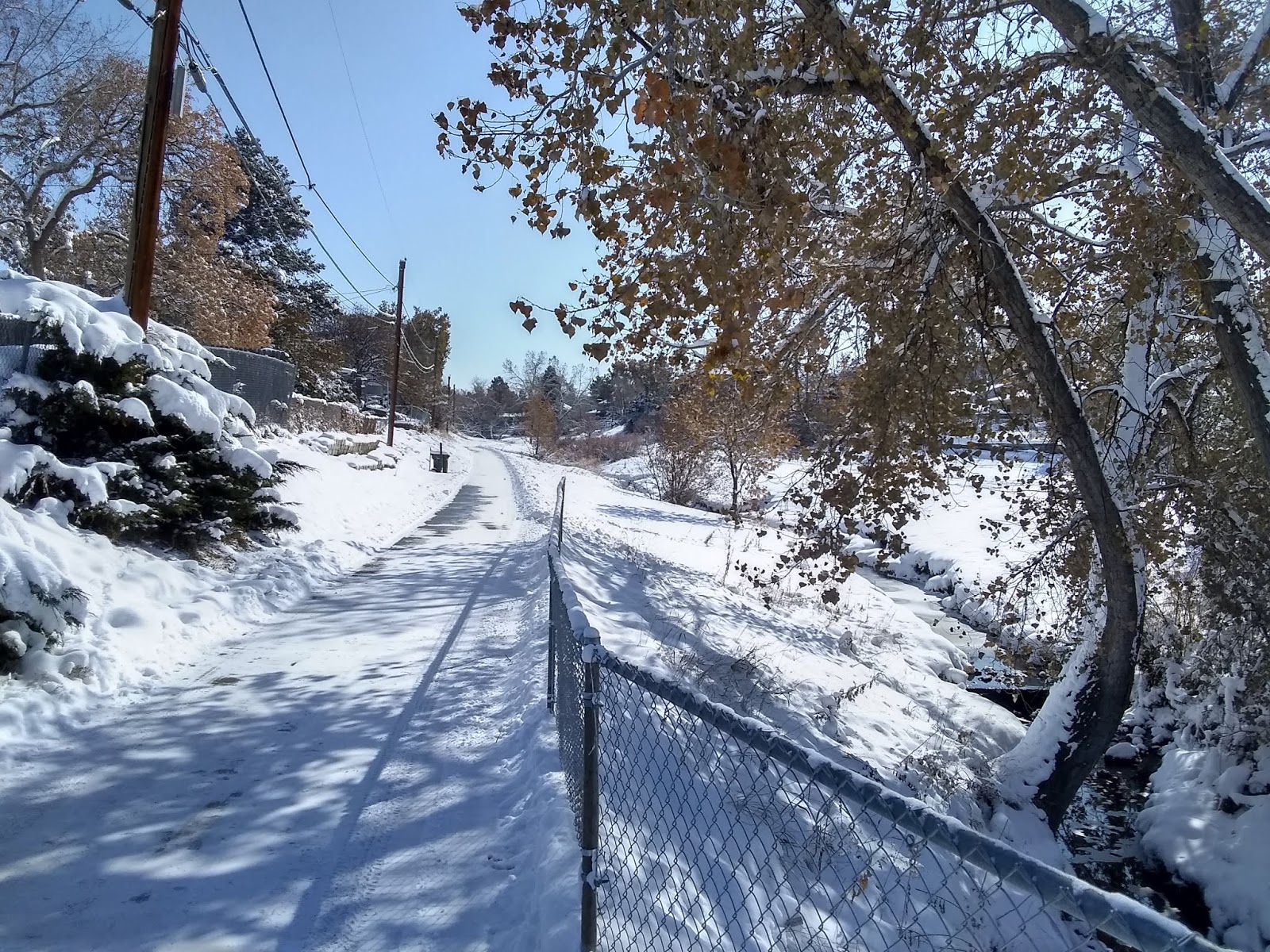
This is the second snow of Autumn 2019 and the combination of snow, traffic, and mountains is pretty much iconic for Denver.


[Shots around Centennial]

I caught the RTD light rail from the Dry Creek Station, about a mile and a half walk from my house, but on the return trip I checked out the Arapahoe Station which seems closer. I'm sure I'll have photos of that in later articles.

[Dry Creek Station]

I'll be recuperating from our move for the rest of the week but will start my morning doctor-prescribed walks next week with excursions around the corners of our neighborhood. Hopefully I'll find interesting things to post.

Relocations are irritating and exhausting but, for the adventurer, they mean new environments and opportunities for chance to take you into new territories. If you just have to relocate, take advantage of your new surroundings. New is good.

Sunday, October 27, 2019

The Chamberlin Observatory


[Chamberlin Observatory]

Before our recent move, there was an astronomical observatory right down the street from me. Why would there be an observatory in the middle of hazy, light polluted Denver?

Well, when it was built in the late 1800s, it was a good ways outside of Denver, A residence was built nearby so the head astronomer, Herbert H. Howe, would not have to travel to and from Denver to do his work. The observatory was named for a patron of the observatory, Humphrey Baker Chamberlin. For more in-depth reading about the observatory and the Denver Astronomical Society that maintains it, check out their website at


My friend, Mysh, had two tickets to the Observatory's monthly open house (not expensive but they have to limit attendance because the building isn't that big and parking is scarce.) She offered to take me along and it was a timely offer since I will be looking at astronomy and physics next year in my adventures. The trip would make a nice segue.


[The refractor]

The main telescope is a Clark-Saegmuller 20 inch refractor. The telescope itself was built by Alvan Clark & Sons and the mount was built by George Nicholas Saegmuller, thus "Clark-Saegmuller". The objective lens is 20 inches in diameter. The eyepiece in use when we visited gave a magnification of 120 times but greater magnifications are possible. 

Refractor scopes have been around for a long time but they were mostly used for spotting on land and sea until Galileo improved the optics for astronomical use. Since then, many designs have been developed. Still, telescopes use lenses and/or mirrors to focus the image of distant objects and gather the tiny amount of light that reaches the Earth. More recently, antennas have gathered other kinds of electromagnetic waves from space, and satellite based telescopes have escaped the distorting effects of Earth's atmosphere to bring incredibly clear images of deep space objects.

The staff presents a lecture on current astronomical topics before giving a tour of the telescope. This time, the topic was planet-like objects that have been found near Pluto and beyond. The amazing thing is that much of the work has been done from Earth-based telescopes on Mauna Loa in Hawaii. 

There are other interesting artifacts on exhibit in the observatory, such as several old pendulum clocks.


[Pendulum clock]

What does clocks have to do with astronomy. We'll be getting into that in the early part of 2020, but part of the answer is that the tracking mechanisms for telescopes, antique and modern, amateur and professional, are clocks.

The tracking mechanism for the Chamberlin telescope is obviously old but has been well maintained.

The astronomers sighted four objects for us. Saturn is a standard. It's spectacular and easy to find. The blue and gold binaries of Albireo was another pair of cosmic jewels. They also showed s quaternary star system. The fourth object was unexpected. They tried to find it early in the demonstration but couldn't. Later in the evening, one of the astronomers was scanning the sky with binoculars and announced that he thought he had founded it, then he sighted it in with the large refractor and treated my friend and I (everyone else had left earlier) to a hazy, but breathtaking view of the Ring Nebula of Lyra, the remains of an exploded star. 

Speaking of optics, there are two ways to get photographs in low light - add more light (with a flash), or expose the image for longer than usual. The later method is preferred for astronomy - it's hard to illuminate a distant planet or star. The pictures above were made with my Snail Camera app, which allows an extended shutter time. This usually requires a tripod to reduce moving the camera while the image is forming but for large Earth-based objects like the observatory building and telescope, a steady hand might be enough.

In the following months, I will be focusing on (pun intended) inexpensive, portable astronomy with binoculars, spotting scopes, and telephoto lenses designed for use with smartphones, but there are ways for the adventuring, lifelong learner to observe distant sky objects. Planetariums and observatories are viable options (they usually like to show off for the public), but images made by large observatories and satellite-based telescopes are available online for study by the amateur astronomer.

Sunday, October 13, 2019

A step back

For those who have found my data analysis package, DANSYS, useful (and have probably also found that some of it doesn't work), I have taken the opportunity presented by the recent turmoil in my life to take a step back and go through all the functions and subroutines. I fixed several bugs and added error handling. Now, if you try to feed a function with data it doesn't allow, it won't crash and open the program editor. It will just sit there staring at you so you can check your input. I have also cleaned up some of my sloppy documentation in case you want to get into the IDE (that's where you actually develop the programs) and do some modifications.

I have the excuse that beta testing would have found these errors much sooner and I haven't had access to beta testers. For those who aren't familiar with the terminology, beta testing is when some people actually use a program that's under development and, when they find problems, or just want to recommend some improvements, they shoot a note to the programmer. I am, by the way, open to suggestions through comments to this blog.

In future months, I will be refurbishing DANSYSX, the user guides, and the LabBooks. I hope you like the changes. For those that haven't looked DANSYS over and want to, you can find it right here:

http://www.theriantimeline.com/excursions/labbooks

Indiana Jones was an archeologist so you can bet that he was into statistics. I've used statistics in some of my studies in these blogs. Data analysis is one of my favorite pastimes. My DANSYS user guides are not just manuals on how to use DANSYS. They also cover the statistics themselves. Check them out and see why I (and Indiana Jones) likes statistics!

Another moving experience

Six years and three moves. It's striking how different, different parts of the Denver area are. We are moving to Centennial now and we will definitely be in the plains. There's still a little rise from the South Platte River but the geography is no longer river valley.

While I adapt to the new location, my blogs will be largely about that but I'm still looking forward to switching gears to astronomy and physics next year. I wonder how light pollution will be in the new neighborhood. 

I've also shifted my October excursions to November. I still plan to take a train out to the airport for the weird Denver tour. And, unless something else interferes, I'll hike Boulder Creek with a friend. I still plan to finish up the Highline Canal Trail, but I've pretty much lost my opportunity for an Autumn hike.

Anyway, I hope you stick with me through some big changes in the future months as I finish up 2019, mathematics, and language with the caveat that the past never really goes away.

Are you one of those folks (like me) who hate moving? Take advantage of it! A move is a great time to take stock of your situation, organize your life, and make all those big changes you've wanted to make but have been putting off.

Tuesday, October 1, 2019

I once worked on a pipeline barge as a welder helper. I was in pretty good shape and I stayed that way by exercising regularly. I would do push-ups - standard and inverted (with my feet up on the wall). On land, push-ups are one thing - on the Gulf of Mexico, they're something else. Pushing up as the barge rode down the slope of a wave, I would almost lift off the floor, but if I wasn't ready when the barge was lifted by the next wave, I could find my face in a collision with the floor.

Something was changing as the barge bobbed around in the water. Was it my weight? Was it my mass? Does it make a difference?

I have an assortment of tools for measuring weight and mass. Here's a picture of some of it.


[Tools]

There are some weight (or mass) sets in the center. (I apologize but the vocabulary of weight and mass is incurably tangled.) To the left are some tools to measure weight - I'll call those "scales", although the word is also used for things that measure mass. To the right are tools to measure mass - I'll call those "balances" although that word is also used to refer to weight measuring devices.

You might say I have a problem, here. Let's look at the three groups separately.

[Weights]

There are standards of both weight and mass and I have lots of little pieces of metal and other materials that have been created to conform to those standards. For instance, the open black box in the center contains very precise (I had to buy it for lab work when I was in pharmacy school) pieces of metal with gram masses and ounce weights.

The cubes below it are called "density samples" because, despite the fact that they're the same size, they have very different masses. Density is defined as mass per unit volume.

There's also a stack of brass masses on a hook that are just right for hanging.

[Scales]

You've likely seen many scales. The things you use to measure the weight of produce at a grocery store are scales. You also weigh yourself on scales - bathroom scales.

Usually, a scale measures how hard an object pulls on a spring (like the set of spring scales on the lower right, or the Jolly Balance (which is actually a scale), the yellow plastic thing in the upper right corner - it also measures density. Alternately, a scale might measure how hard an object pushes down on an electronic component, like the digital bathroom scales in the picture.

[Balances]

On the other hand, a balance literally balances two objects. If they balance evenly, they are pulling down with equal force. Many science kits include inexpensive balances.

The blue velvet lined box in the picture contains a brass assayer's balance like the ones used long ago to "weigh" gold nuggets. There is also a pocket postal scale (which is actually a balance) and a tiny, three beam balance. It works like the "scales" your doctor uses to weigh you. In that case, the doctor balances you against the slider weights on the bars that are about eye height in front of you. A system of levers magnify the weights of the sliders and the machine calculates your weight when you're balanced. 

Scales measure weight and balances measure mass.

I carried some equipment to the Ross-University Hills branch of the Denver Public Library and rode their elevator to see what would happen when I measured the weight and mass of objects.

[Riding an elevator with a scale]

First, I used a portable electronic scale to weigh a mass. Yeah, I know it's a 20 gram mass that the scale says is 30 grams - I didn't zero the scale, but you can tell that the indicated weight (actually weight translated into grams - more about that below) changes as the elevator goes up and then returns to the first floor.

[Riding an elevator with a balance]

On the other hand, the balance stays balanced. You can tell because the vertical point stays vertical. Why did the weight change but the mass did not?

Mass is simply the amount of matter in an object and that doesn't change as long as the object is intact. The mass of an object is measured by comparing it to another object of known mass.

Weight is actually the force that an object directs straight down vertically. Newton's second law of mechanics, and the one most central to everything, defined force as mass times acceleration, so I need to go over a few technicalities.

When a thing changes position, it moves at a particular speed. In a car, speed is usually measured by a speedometer in miles per hour (at least in America. Everywhere else, it's kilometers per hour.) Speed is measured in distance per time, or distance divided by time.

Physicist do not usually work with speed. They prefer to work with velocity. Velocity is speed in a specified direction. It's called a vector quantity because you have to give more than one measure to fully specify it.

When you're driving a car, you don't maintain a constant speed. Acceleration is how fast you're speeding up or slowing down. Acceleration is measured as speed per time. That means it is measured as the distance traveled per unit time per unit time, or distance per unit time squared. In physics, the most common measure is meters per second squared.

Now we come to force. When I say that force is mass times acceleration, think in terms of pushing an object so that it speeds up faster and faster at a constant rate. Force makes things go faster or slows them down. A common measure of force is the newton which is the amount of push required to accelerate a one kilogram object one meter per second squared.

And weight, being a force, is often measured in newtons (notice that, when "Newton" is a name, it's capitalized, but when it's a unit of force, it's written in lower case.). Weight is mass times acceleration. What acceleration? The acceleration of gravity. That's why the weight of a body can change. The acceleration that gravity imposed on a body in freefall is 9.764 meters per seconds squared...at sea level on the Earth and, although it is different at different places on the Earth's surface, the variance is usually too small to worry about. (Geologists actually do worry about it because large deposits of metal ore will present a slightly different gravitational pull than other rocks and they use of a very sensitive instrument called. "gravitometer" to measure the pull.) As you move out away from the Earth, though, it's pull becomes weaker and your weight also decreases.

The moon is smaller than the Earth and, therefore, has less gravitational pull. Acceleration due to it's gravity is only 1.625 meters per second squared on the moon. I weigh 185 pounds on Earth. On the moon, I would only weigh 185 times 1.625/9.774, or 30.8 pounds.

I recorded my phone's accelerometer on the elevator using Google's Science Journal. It looked like this.


[Elevator ride]

Another digression...it can be confusing which direction is which on a phone. Just remember the graphs you drew in algebra. The x axis went left to right, the y axis went up and down and if you were working with three dimensions, the z axis was into and out of the page. It's the same for the phone. Holding the phone flat in front of me, the direction of the elevator's motion was along the z axis. All of the accelerometers produced jagged lines, but look at the scales. The x and y accelerometers showed accelerations around zero and one m/s2. The z accelerometer measured around 9.5 m/s2. That should look familiar - it's the acceleration due to gravity.

When the elevator starts up, weights in the elevator opposes it's motion with an equal but opposite force, (that's Newton's third law). So, add the elevator's acceleration to that due to gravity. Since the accelerometer measures up to twelve m/s2, the elevator must be accelerating at about two and a half meters per second squared until it reached a constant speed, and the tracing smoothed out. At the top, the elevator slows down at about 1.5 meters per second squared and objects lighten up. As the elevator starts back down, objects in it lose weight again, to regain it at the bottom.

That's actually how the phone's accelerometers work. They are tiny (You might have heard of nanotechnology. Cell phone accelerometers are nanotech.) combs that have tiny weights at the end of their times. As the weights accelerate, they move with the acceleration and sensors pick up the motion.

It's not entirely bogus that my electronic scales claim to measure grams (mass). It actually measures weight but, on Earth, weight is mass times a constant 9.764 acceleration due to gravity so the electronics just have to divide the weight by 9.774 to get the mass….but not on the moon.

Riding in a car, notice how you lean as it slows down, speeds up, or turns a corner. That's forces at work. If you have an elevator handy, you might try riding it with a bathroom scales and see how your weight changes and remember...your mass stays the same.

Friday, September 27, 2019

Points east

I recently posted a blog about the University neighborhood in Denver. Since then, I've walked over to my local library, the Ross-University Hills branch of the Denver Public Library for a physics demonstration (that will be the next blog here). That walk carried me through the Wellshire neighborhood. Since I frequently visit the library and the shops over on Colorado Boulevard, this is a regular walk for me.

Wellshire is a residential area bordered by University Blvd on the west, Yale on the north, Colorado Blvd on the west, and Hampden Drive on the south. In addition to several churches and a few shops on the west side of Colorado, the large Wellshire Golf Course lies along Hampden and the Highline Canal runs through it.

The South Platte River cuts a hundred foot deep valley into the plains here and Wellshire is the beginning of the plains extending from University neighborhood east until they hit the shallower valley of Cherry Creek, about eight miles east of the river. From there, it's pretty much plains to the Mississippi River.

My walks usually take me along Bates Avenue and Amherst to Colorado, but the trip on Dartmouth, though more demanding, is beautiful and affords some nice views of the mountains.

[Bates in Wellshire neighborhood]

[Busy Colorado Blvd]

The library is in the University Hills neighborhood, east of Wellshire. The building is a modern, two story construction. I arranged to use their elevator to perform a physics demonstration. Most of the rooms used for activities are upstairs. The catwalk like stairs are interesting. They are suspended at one end by cables.

[Library stairs]


Libraries are often built with aesthetic values in mind and usually offer much more than books. Check out your local library and pay particular attention to it's architecture, history, grounds, and exhibitions

Thursday, September 26, 2019

Walks


I have recently decided to comply more closely with my physician's dictate to "walk 20 minutes a day.". In the past I have been rather slack in my adherence. Some hikes are several hours. My walks to the grocery might be twenty minutes if the trips both there and back are considered.

Now, since my computer no longer constrains me in the mornings, I am free to take this computer ,(my cell phone) and stroll up to the University campus, or to one of the several parks in the area.

Walking in the same area every day lets me more consistently observe the cyclicity of the changes of my surroundings. This morning I noticed a thistle growing up through a dense shrub and how it changed it's habit to it's situation as it sought the sun light.

Yesterday was the first day of Autumn and today a welcomed, cool breeze Is blowing. Soon there will be snow. Both I and Vincent eagerly awaits it.

Since I walk in the same areas every morning, I'm able to divide my attention and listen to my books as I walk. I'm pretty good at multiplexing and things still catch my attention. I am currently listening to a Librivox recording of James Boswell's Journey to the Hebrides. It's a pleasant account of an eighteenth century gentleman's journey to his homeland with his friend, Dr. Samuel Johnson, the author of England's first dictionary.

I sit on a rock wall surrounding the University of Denver's water gardens as students walk past to their current destinations.


The water gardens have fish


The interior of Mary Reed Hall with it's arches and vaulted ceilings


 This spray of water in the sun caught my eye


Do you have a regular walking routine. Do you just walk or do you augment your time with quality rich activities?

Monday, September 23, 2019

Spanish - a final report

I've enjoyed studying Spanish and plan to continue...just because it's fun, but I suspect that I missed the train on conversational Spanish. It's normal for people to lose the ability to learn new languages easily as they get older, especially if it's not a regular part of their lives but it seems that I have another problem. I've always had auditory processing disorder (APD https://en.wikipedia.org/wiki/Auditory_processing_disorder) which makes it hard to process speech, but my jobs in the past have kept me involved with others and their speech. Now that I'm retired, there's less exposure and, with age, my learning disabilities are getting worse.

On the other hand, I can read most of the Spanish signs and labels around town. My ability to read Spanish has improved dramatically. With a little help from the translator in my Kafui Utils Smart Kit app (which I wholeheartedly recommend), I can read Spanish novels like Cien anos de solidad by Gabriel Garcia Marquez (which I also recommend).

The video, Destinos, is educational, entertaining, and pretty and I have a way to go to finish it but it has my attention, so I will.

Are there communities in your town that speak a different language? See if you can learn it. Often, native speakers will be excited to help you with the conversational part, you just have to learn the phrases, "Speak more slowly," and "I don't understand," in their language.