Everything recycles on the Earth. Air, water, rock are are all conditioned, modified, processed, and returned to the surface fresh and ready for reuse. My vote for the "lifeblood of the planet" would be water. It's hard to imagine a planet without water with any life above simple, single cell beings. Water perculates underground to create caves and deposit metal ores in fissures. Water not only washes the ground as rain, but rain aerates streams with life giving oxygen. It's weird properties causes it to float as it freezes, giving fish and other creatures beneath it protection against the outside world.
Water vapor is a greenhouse gas that helps Earth regulate it's temperature. If you live in a temperate climate, you might notice that cloudless winter nights can be brutal. Clouds generally moderate cold nights by holding daytime heat nearer the ground.
The primary component of Little Dry Creek is water. It's may be a very familiar substance, but it's also very strange. As I mentioned above, unlike most substances, it's solid form is less dense than it's liquid form so that ice floats on water. It's a weak acid and base. A liter of water will ionize to contain 0.0000001 liters of hydrogen ions (making it slightly acid) and 0.0000001 hydronium ions (making it slightly basic). The water (dihydrogen oxide) molecule is polar, the electron hungry oxygen atom pulls the hydrogen atoms electrons away making the two hydrogens positively charged while the oxygen is negatively charged. These charges rip ionic substances apart making water the "universal solvent". Water is good at moving other substances around.
Little Dry Creek is fed by runoff and the Dawson aquifer. As water falls on the ground and pavement around Centennial, Colorado it has to go somewhere. The two main "drainages ditches" are Little Dry Creek and Willow Creek. It can also deep into the porous sandstone of the Dawson, Arapahoe, and Denver formations in the Denver Basin and pour out at the many springs in the area. One is just east of Yosemite Street.
The water from the aquifer is well filtered and fairly clean but runoff from the surrounding area carries substances into the stream. Being interested in whether agricultural products were being washed into the creek in the Walnut Hills area, I wanted to test for nitrogenous materials in the water. An aquarium test kit checks for pH (acidity), ammonium, nitrate, and nitrite - perfect for my interests.
I was also interested in the dissolved metal content and decided to perform a chromatographic analysis.
I sampled the creek at three points: as it emerges from the spring, just east of Uinta Street, and at the small cascade east of Spruce Street. I also measured the air and water temperatures.
Using Google Sheets, a spreadsheet that stores the documents I created online in secure memory set aside for me by Google, I recorded the results of the analyses.
The air temperature was right around what would be considered room temperature or a little cooler but the water was frigid, just a few degrees about freezing. Not unexpectedly, it was cold as it emerges from the aquifer (3.5°) and it warmed up to 6.6° about a half a mile away after it had picked up some runoff. But it was actually colder a little further down. This was where it picked up the intermittent stream from Fiddler's Green, which ran a good bit of it's course underground.
The table above gives parts per million amounts of various substances in Little Dry Creek water at (from top to bottom) sites 1, 2, and 3. The bottom row is our home tap water.
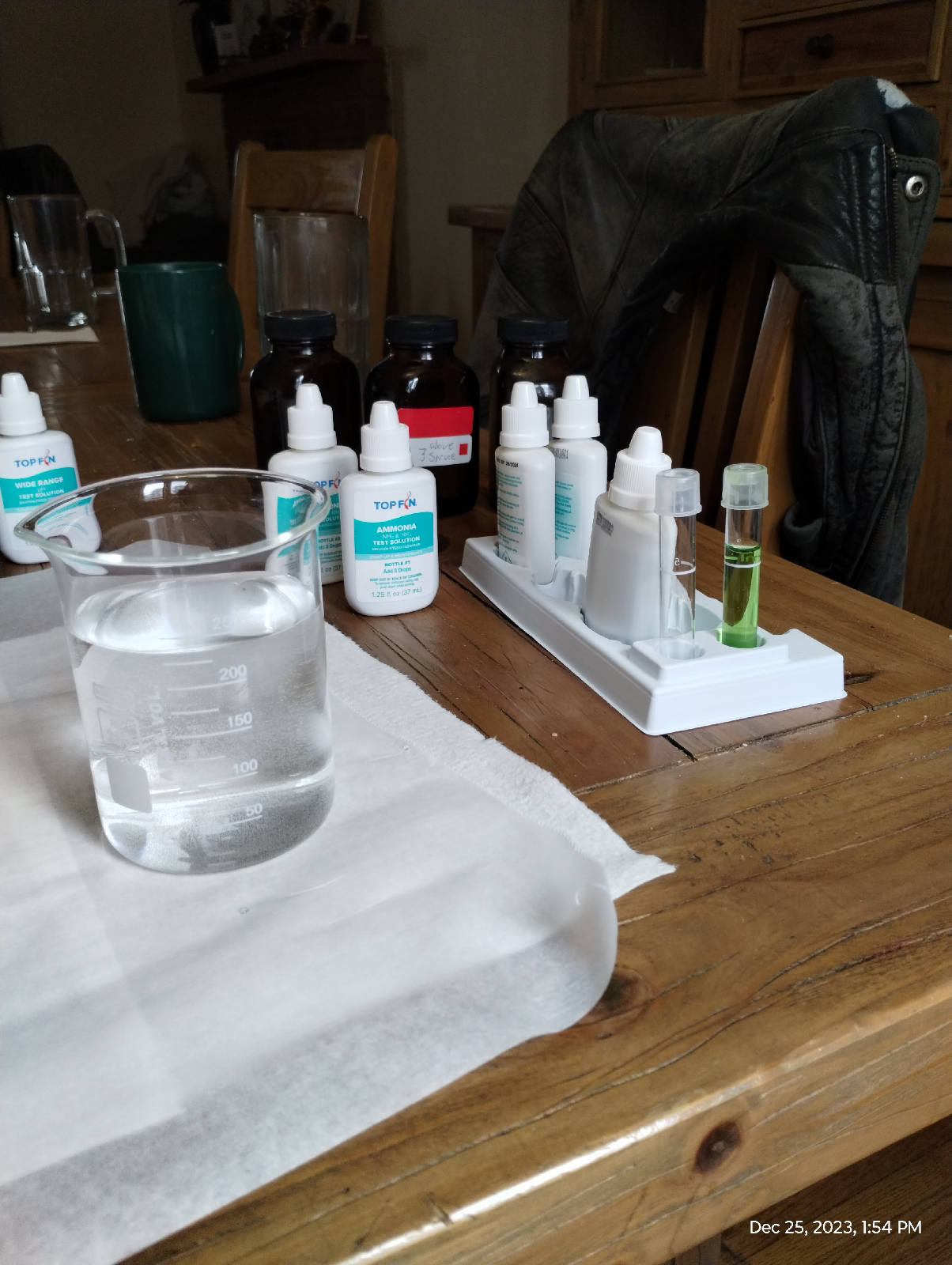
What initially drew my interest to chemistry were two things - fire and color. On the color side we're analytical indicators, solutions that changes color in the presence of certain materials. The picture at the top of this blog shows the pH test for water from site 1 (the spring). (Ain't it perty?)
There are indicators for a lot of substances. Early on, indicators were primarily used only for qualitative analyses. In other words, they could only be used to determine the presence or absence of a substance, not how much there was. But as methods were developed to measure the degree of color change in a solution, quantitative methods also developed to indicate how much of substances were in a solution.
Including high school and college chemistry labs, I would imagine that pH is the most common chemical characteristic tested for. It's an indication of the acidity or alkalinity of a solution.
I used the Top Fin aquarium test kit to test for pH, ammonia content, nitrate, and nitrite. I could not find the actual ingredients used but they look (from the color reactions) pretty much like most of the other kits.
So, what is pH?
Chemists use p functions to express concentrations of substances in solutions, especially substances that exist in tiny amounts in solutions. Specifically, pH describes the concentration of hydrogen ions in solutions of weak acid or dilute strong acids. Concentration is expressed in moles of dissolved substance (solute) per liter of solvent. A mole is 6.02214076×10²³ particles (it's not as complicated as it looks. You add up the atomic masses of all the different atoms in a substance - the atomic mass of sodium is 23 and that of chlorine is 35 so the sum is 58 - and a mole is that number of grams. A mole of sodium chloride - table salt - weighs 58 grams.) So the pH of a solution is the number of moles of hydrogen ions in a liter of solution.
Take water for example. It is both a weak acid and a weak base. It ionizes to form hydrogen ions and hydroxide ions in equal amounts. It's a weak acid because a liter of pure water has only 0.0000001 moles of free hydrogen ions in it. (By contrast, hydrochloric acid is a strong acid because, in a water solution, all the molecules come apart to form hydrogen and chloride ions.) 0.0000001 is an awkward number so chemists use the negative logarithm (to base 10). The logarithm of 0.0000001 is -7, so the negative logarithm is 7.
Water is special since it dissociates into equal numbers of hydrogen and hydroxide ions - half way between acids and bases. Acid-wise, pure water is neutral. Water is both a weak acid and a weak base. A characteristic of mixtures of weak acids and bases is that they resist becoming more acid or basic. If an acid is added to water, the hydroxide ions neutralize some of it to form more water (H + OH = H2O). If a base is added to water, the hydrogen ions will tend to neutralize the extra hydroxide ions. Such a mixture of weak acid and base is called a buffer. So it takes a lot of acidic leaves or carbon dioxide from the air to acidify water to a level that's dangerous for aquatic life. Similarly, it takes a lot of limestone to raise the alkalinity of water to a dangerous degree. Mind you, there are lakes like Ijen in Indonesia, that are so acid that the water will eat the skin right off your body. Highly acid lakes are usually volcanic or has water that has leached a lot of acid from mine tailings.
Anyway, safe water should be nearly neutral. In other words, it should have a pH close to 7.
Judging from the color change for the pH indicator (red fir acid to green for bases), I would guess that the indicator I used is a mixture of bromothymol blue and cresol red. The cresol red is red at pHs around 5 and yellow above 6. Bromothymol blue is colorless below pH 6.5 and turns progressively bluer above 6.5.
Most wide range pH indicators are such mixtures. Anthrocyanines that give flowers and fall leaves red, blue, and purple colors are an exception that goes through color shifts over a wide range of pHs. (see http://adventuringbcc.blogspot.com/2022/02/eat-your-beetsthen-use-juice-to-test-ph.html).
That green color in the picture at the top of this blog means that the water from Little Dry Creek has a pH of around 6.5 and it's consistent throughout Walnut Hills. A pH less than 7 is acid but 6.5 isn't very acid and is well within a safe range for aquatic life. Notice that our tap water is a little basic (7.5). The creek water is a little acid because leaves fall into it and the tannic acid leaches out. Also, carbon dioxide from the air dissolves in water to form weak carbonic acid. Cold water will hold more gas in solution than warm water. Little Dry Creek was very cold, at least when I fell in!
Ammonia is a stable nitrogen and hydrogen compound. A gas at commonly experienced temperature and pressure, it's also frequently given off by cleaning fluids and has a sweetish, biting, rather repulsive odor. (Ammonia water, a solution of ammonia gas in water, is a common cleaning fluid.)
It's common in nature as a byproduct of decay. Any water that has or has had living organisms in it can be expected to have a little ammonia. There's not usually enough to smell. A stream can be loaded if agricultural chemicals like fertilizers or raw sewage is dumped in.
A common test for ammonia uses a phenolic compound to react with ammonia to form an indole compound that is bright blue. The Top Fin test has two solutions. The first contains the phenol compound, sodium salicylate (related to the salicylic acid in willows and other plants, methyl salicylates also known as wintergreen oil, and acetylsalicylic acid or aspirin). The second solution contains sodium hydroxide (which adjusts the pH of the solution), sodium hypochlorite (which chlorinated the product), and sodium nitroferricyanide (which catalyzes the reaction). The combined solutions without the ammonia is yellow but if the indole forms, the yellow color mixes with the blue dye to form a green solution, the more ammonia, the darker green.
The spring water contained 2 parts per million ammonia. The EPA maximum standard for freshwater is 17 milligrams of ammonia per liter of water (that's 17 ppm). The other two sites showed 0.25 ppm ammonia. Interestingly, our drinking water has more dissolved ammonia (0.5 ppm) than the creek. It's not surprising that the "pure" spring water has more ammonia. It's a gas and colder water under pressure can hold more devolved gas than the water in an aquifer. The ammonia is released as it flows in the open stream.
Nitrates and nitrites are also common nitrogenous compounds found both in nature and in industrial processes. They are anions of nitric and nitrous acids (respectively) and their salts. Nitrates are also artificial fertilizers that are readily taken up by plants, especially as the ammonium salt, ammonium nitrate. In lakes and streams, they can lead to overpopulation of algaes. The Top Fin kit has tests for both.
Before I get into the Griess reaction, which is commonly used to test for nitrites, I need to explain "aromatics". When I use that word, most people are going to think "something that smells nice." Chemists think something else. The two meanings do overlap. Many nice smelling (and colorful!) Substances are also aromatic compounds, but there are aromatics (like the number one aromatic, benzene) that most people would say smells unpleasant.
Aromatics have this ring structure somewhere in their molecule.
That's benzene, six carbon atoms (the six gray balls) bonded to six hydrogen atoms (the white balls). Other atoms and collections of atoms can take the place of one or more hydrogen.
The Griess reaction is used to being and two of these rings together.
Start with an aromatic compounds with an amide group replacing one of the hydrogens. In our case, it's probably sulfanilamide.
The nitrogen with two hydrogens at the bottom is the amide group we want to target. A nitrite ion will knock the two hydrogens of the amide group off to form a diazo group (just two nitrogens) and the whole molecule becomes a positively charged ion waiting to react with something....it likes the carbons in an aromatic ring.
In the Griess test, we want an end result that's brightly colored....an azo dye. One common aromatic reactant, and probably the one in the Top Fin kit, is N-(1-naphthyl)ethylenediamine. It's a big word, but the stick diagram is rather pretty.
The carbon just opposite the tail on this molecule.... that's where the diazo group latches on. The result is this dye.
It's purple. The more nitrite is present, the more of the two aromatic compounds get stuck together and the more purple the solution becomes.
What about the water in Little Dry Creek (and in my drinking water)? There was no nitrite in our tap water and the creek had a tiny, but consistent amount at all three sites, 0.1 parts per million, which is about 0.1 milligram in a liter of creek water. The Environmental Protection Agency's maximum contaminant level goal for nitrites in drinking water is 3.3 mg/L.
The nitrate test seems to be the same Griess reaction used for the nitrite test except the nitrates gave to be reduced to nitrite (with concentrated hydrochloric acid and a witches' brew of other substances). It used sulfanilamide but I couldn't find what it was reacted with to give a red color.
The test didn't indicate any nitrate in our drinking water or at the spring but the creek had picked up 5 parts per million of nitrate by site 2 and that concentration continued at least to site 3.
EPA maximum contaminant goal for nitrate is pretty high, 44 mg/L, so the creek is okay for nitrates.