Showing posts with label paleontology. Show all posts

Friday, October 20, 2023

Anatomy of a Mountain Range 3: Where There Be Dragons (or what's left of them)


Just across the road from the north entrance to Red Rocks Park, Alameda Parkway climbs the Dakota hogback. It's blocked off to vehicles except for the tour buses and maintenance vehicles of Dinosaur Ridge. The Friends of Dinosaur Ridge museum especially designed for younger visitors is there, also.

Dinosaur Ridge, a very prolific source of dinosaur fossils, has been designated a National Natural Landmark. There are dinosaur fossils from there and the sister site, Triceratops Trace, in museums all over the U.S. Although the park charges for guided tours, it's free to hike over the hogback and read the interpretive markers. It's a fascinating hike.

Apropos to this blog, Dinosaur Ridge dissects the Dakota hogback. That means I won't be showing you all the sights. You'll have to visit in person for that, but it's well worth the visit. The dinosaurs are waiting.
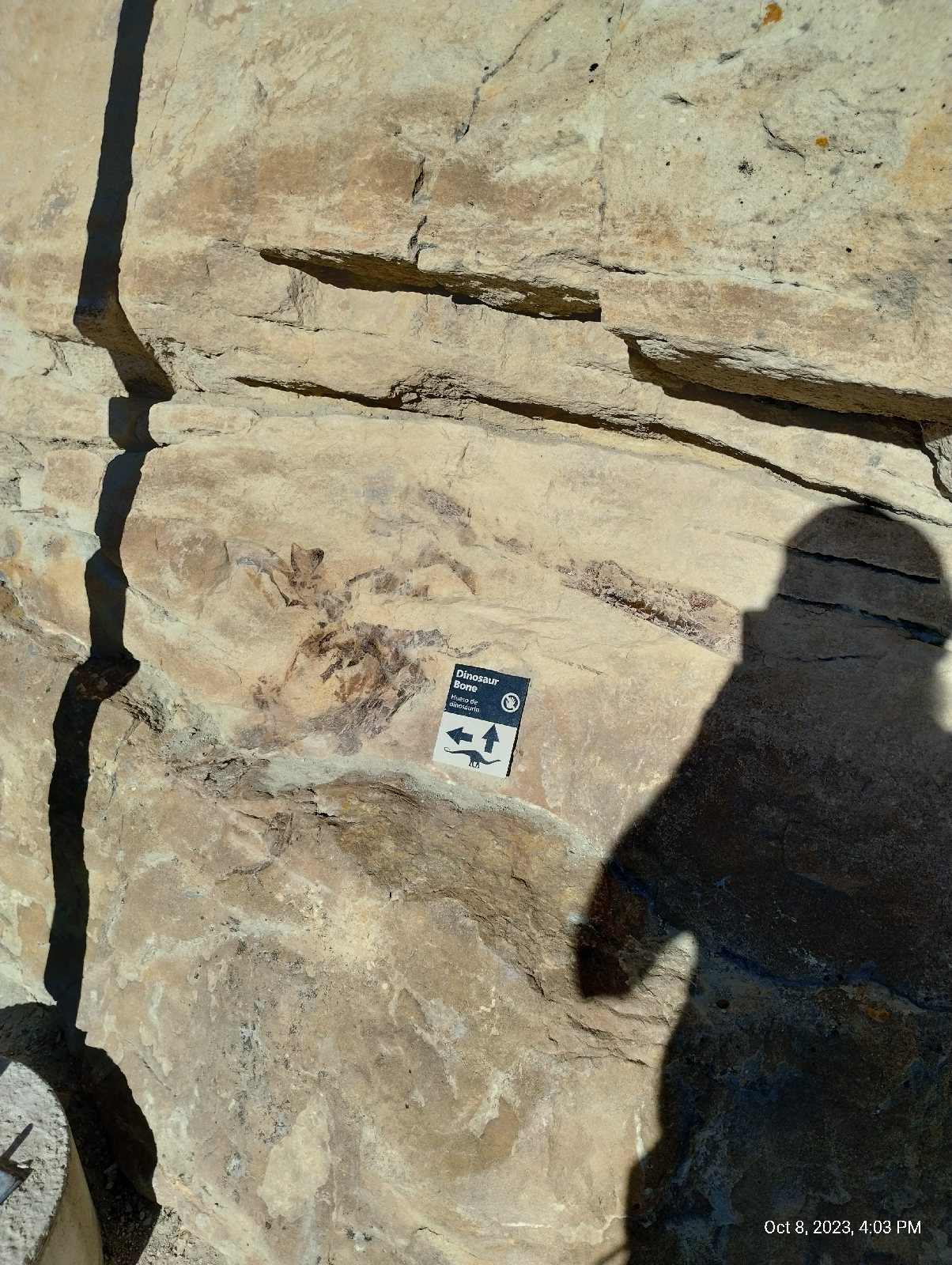
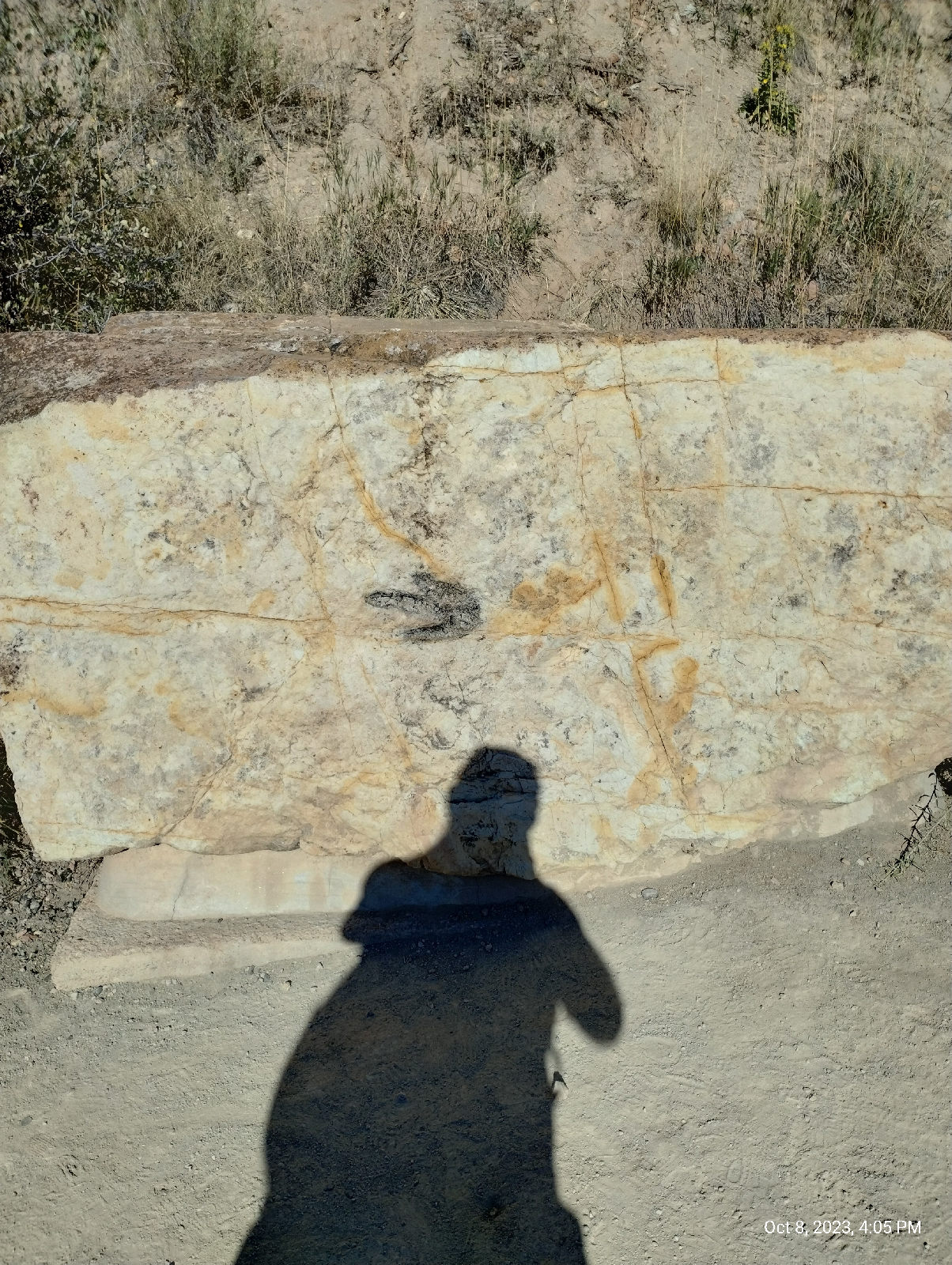
The dinosaur fossils in the sandstone consists of both bones and footprints. The skeleton above is surprisingly intact. The bones underneath are more typical. At this site, the dinosaurs died upstream and the bones were washed downstream in a humble.

The footprints can be crowded and tell paleontologists a lot about dinosaur behavior. Evidently, they were very social creatures.


Dinosaur Ridge is a veritable bone quarry. It was a major site in the infamous bone wars waged by the paleontologists Othniel Charles Marsh and Edward Drinker Cope. You should look it up. It's a prime example of how scientists should not behave.
Remember the Law of Lateral Continuity? Remember the layer of volcanic ash back in Morrison? Here it is again on Dinosaur Ridge. 
The beast that left the claw marks in this rock (it was sand back then) ate dinosaurs. It was a crocodile and it's modern relatives haven't changed a lot! Not all the fossils in Dinosaur Ridge are of huge animals. It was a marine environment so it's not surprising to find shells and worm burrows.
and wave ripples.
The lower layers of the hogback are stone made from compacted mud: mudstone and shale. The size of particles that make up rock is an important hint to deciphering it's geologic history.
Big chunky sediments are deposited by powerful streams close to their source, or, as in the case of the Castle Rock capstone, very powerful torrents far from their source. We know that the Castle Rock conglomerate material originated near what is today Boulder because that's the only place we can find the blue quartzite in it's "mother lode". What a flood that must have been!

The finer the sediment, the more languid the streams or the further away from the sources. They don't call the Mississippi River "the Big Muddy" for nothing. It starts off in the mountains tearing them to shreds as powerful rivers like the Missouri and the Tennessee but by the time it has grown into the huge river that flows into the southern states, it carries a lot of weight in water and has lost most of its boulders and gravel. It's weighed down with mud and silt.

This Benton Shale is made from silt from far away mountains and was deposited in the shallow inland sea. We know that because we find the fossils of marine animals in it. This rock has been dated at around 92 million years.

The Benton shale is near the bottom of the pile and so is the east entrance to Dinosaur Ridge. There is a little paleontology museum there but I was in a hurry to get to Golden before nightfall more from outright fatigue than any worry about hiking at night. Just as Alameda Parkway comes off the hogback, it intersects Roony Road and the last stretch of my hike 

Tuesday, July 31, 2018


--- Sociology in the colleges ---

The social sciences cover a very large conceptual area. Any situation in which more than one person is interacting is social. Even when there is only one person, the way they think about other people is social. So, it's no wonder that I can't just tell you what the universities around here focus on in the social sciences. From what I've said about psychology, philosophy, and religion in the area, you probably aren't to surprised that a lot of it is about social justice.

I didn't travel to Boulder for this one but I did look over the School of Sociology website. I noticed that they do have a focus on criminology, like Denver University. It lists four working groups that come together to discuss topics in sociology and I assume that those give some idea of what's going on there in research - what's in vogue. Those groups are:

Criminology and Criminal Justice Working Group
Culture, Power and Inequality Working Group
Political Economy Working Group
Population and Health Working Group

I did walk down the street to the Denver University and had a nice day of it. A major emphasis there seems to be criminology. For instance, one of the professors, Jared Del Rosso is doing some significant work about the public perception of torture.

The main building for sociology is the Strum Hall. The School of Sociology and Criminology is the largest on campus, consisting of 15 schools and departments.


                                                                  [Sturm Hall]

Sturm Hall also houses the Denver University Museum of Anthropology. The public part of the museum is one small room but museums like this are my favorite. It is a teaching museum. Students interact with items in the less public museum holdings to create installations displaying their academic work. The study is ongoing, the information is current, and the displays deeply consider the items, the people who created them, the students who study them, and the visitor who views them.

When I visited, there was an installation about Korean shadow puppetry. The text on the wall emphasizes the importance of the shadow in the human psyche.

                                                                        [Shadow]

The displayed artifacts were primarily Asian and North American (much was Hopi).

                                                                      [Display]

"Activating the Collections" makes explicit what this museum is about. I'll let the museum, itself, explain.

                                                  [Activating the Collections]

The museum offered a book written by a professor at Denver University. I didn't expect much - I got much more. Sarah Milledge Nelson's Spirit Bird Journey is an engaging, very well written, but odd little story that weaves three threads together. It is a fascinating description of Korean culture that tells of an archeologist's research in Korea, and also tells of her spirit journey as a bird to paleolithic Korea. Part scientific expedition, part shamanic fairy tale, this novel is informed throughout by the author's own archaeological expertise, knowledge of Asian history and culture, and an excellent handling of narrative.

I decided to buy a copy for a friend and found that new paperback versions are hard to find - perhaps out of print. The original publisher was RKLOG Press in Littleton, Colorado but all I could find were used copies, hardbacks, and digital copies.

I also noticed that the author has written other novels and academic books. I will have to check them out.

Leaving the museum, I was treated to a stroll through the water gardens.


                                                                      [Water gardens]

The semicircular plaque looks like a sundial or some kind of astrolabe but it actually points out the mountains that you can see from this point in the gardens. As you can see, in the summer, there are too many trees. Most of the campus is an arboretum.

                                                                   [Mountains]

I have been passing a small wine bar for some time. Hiking, I'm not drawn to wine or espresso, but this time I stopped in and was delighted to be reacquainted with Italian sodas - the perfect drink for a hot summer day. I'm now identifying all the places around town where I can get Italian sodas. La Belle Rosette, on University Drive just south of the campus is now a favorite stop - friendly people with Italian sodas in the summer and specialty espresso drinks in the winter. What more could I ask for?

Are there any teaching museums in your area? They often are on college campuses but, not always. My favorite paleontological museum in the area is the Museum of Natural History in Morrison, which is also a research site. Again, it's a small museum but the staff is on the cutting edge of paleontology and the tours are packed with up-to-date information about fossils in an area where fossils are big.