Monday, April 3, 2023

Olde Town Arvada to Gold Strike Station

Confluence of Clear Creek and Rolston Creek

The very place of the first gold strike in Colorado.

Rolston Creek, Rolston Point (the earlier name of Arvada), Rolston Ridge, Rolston Road, Rolston Crossing, Rolston Station...who is this Rolston guy?

In 1850, Lewis Rolston, a prospector from Georgia stopped by this very place and panned a quarter ounce of gold out of the creek that now bears his name. They left the next morning on their way to California. In 1858, Rolston returned with another group and set up a placer mine at the same site...the first gold strike in Colorado.

Rolston was born in 1804 in South Carolina but later moved to Auraria, Georgia (after which Auraria, Colorado was named and from where many of the settlers of Auraria, Colorado came). He is also sometimes credited with starting the gold rush in Georgia after he collected a shiny rock in what would later be Lumpkin County, Georgia.

He returned east in his later life, served in the Confederate army and probably died in Georgia around 1870.

When the gold played out in Rolston Creek, many of the miners settled down to farm the area.

My trek started, as usual, in Centennial and I boarded the G Line train at Union Station in downtown Denver.

I detrained at Arvada Olde Town and relaxed for a few minutes with a milk shake. The statue at the station, Frank Swanson's Track Bone, refers to the railroad as the backbone of the community. It's carved out of Colorado rose red granite.

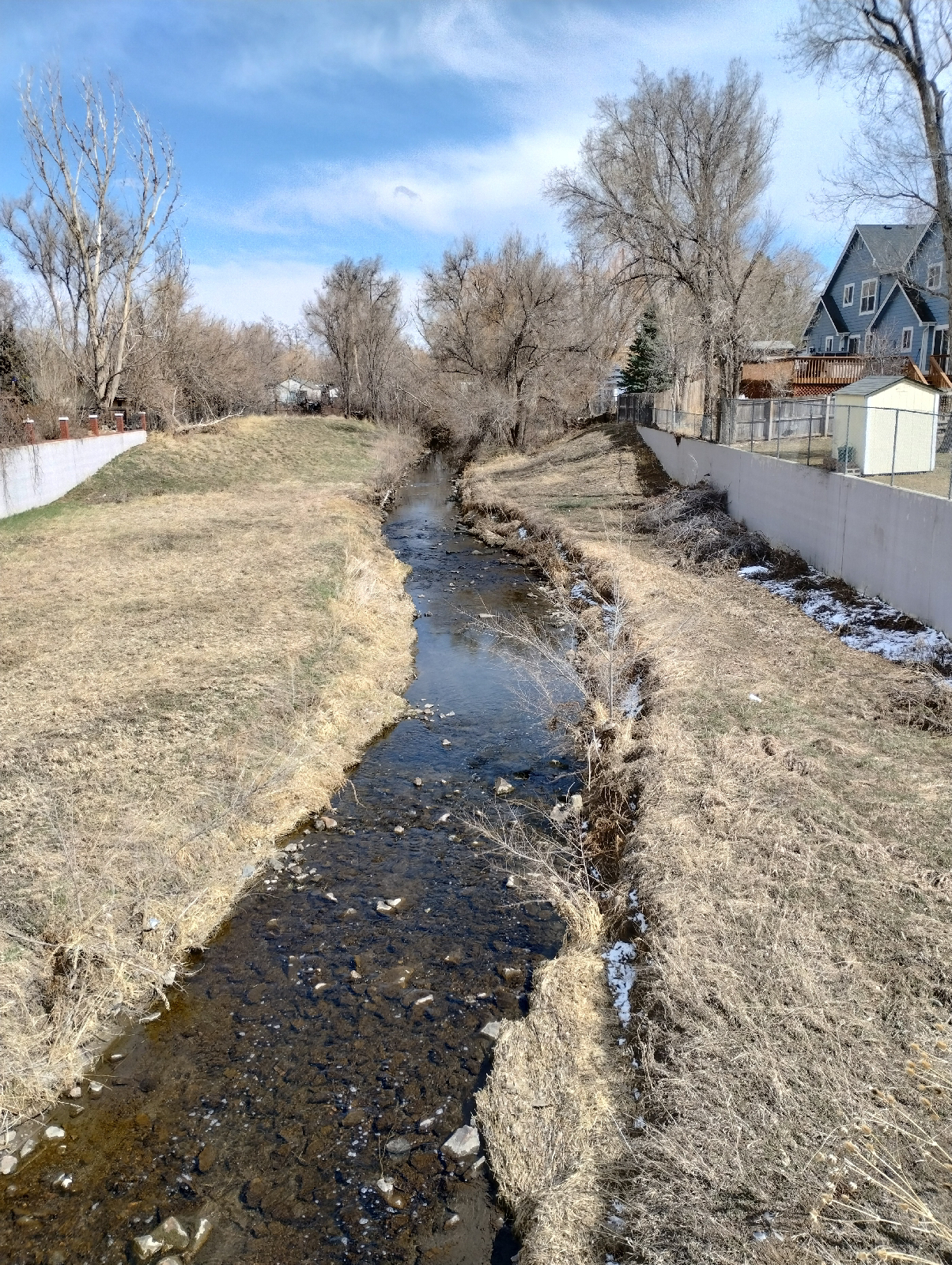
I joined Rolston Creek on the Rolston Creek Trail right in downtown Arvada.
Rolston Creek arises a little to the west in Golden Gate Canyon in northeastern Gilpin County. Rolston Creek Trail begins just north of North Table Mountain near Golden, Colorado and runs about 14 miles to the confluence of Rolston Creek with Clear Creek, where it joins the Clear Creek trail. Since these trails parallel the G Line to Pecos Junction, I'll be making use of them for a while. After that, Clear Creek and the G Line separate. The creek joins the South Platte River in Thornton. I would not want to hike back to Union Station from there 

Clear Creek has enough energy to eat away at it's banks, so there's plenty of meandering. Oxbows aren't common around here. The land isn't quite flat enough for streams to go anywhere they want. But there are a few. One nice example is in the Carson Nature Center in Littleton. There were a couple of places on this hike where it looked like Rolston Creek might make oxbow lakes if left alone. With all the urbanization and industrial parks, there's little chance of that happening.

Oxbow lakes form when a meander is choked with sediment so that it's cut off from the rest of the stream. Check out maps of streams out on the plains and you'll find many examples 


Have I mentioned that Denver likes murals? These murals in Arvada are exhibits from the 2021 Arvada Babe Walls Mural Festival. 

I left the Rolston Creek Trail at the Gold Strike Park, which commemorates the first Colorado gold strike. Along with the interpretive plaque, there are a few pieces of placier equipment on display. I'll get back to this park on my next hike.

Getting from the park to Arvada Gold Strike Station required a little navigation around urban streets but it wasn't too complicated or far and it afforded some nice views of the commuter train...

and the mountains.
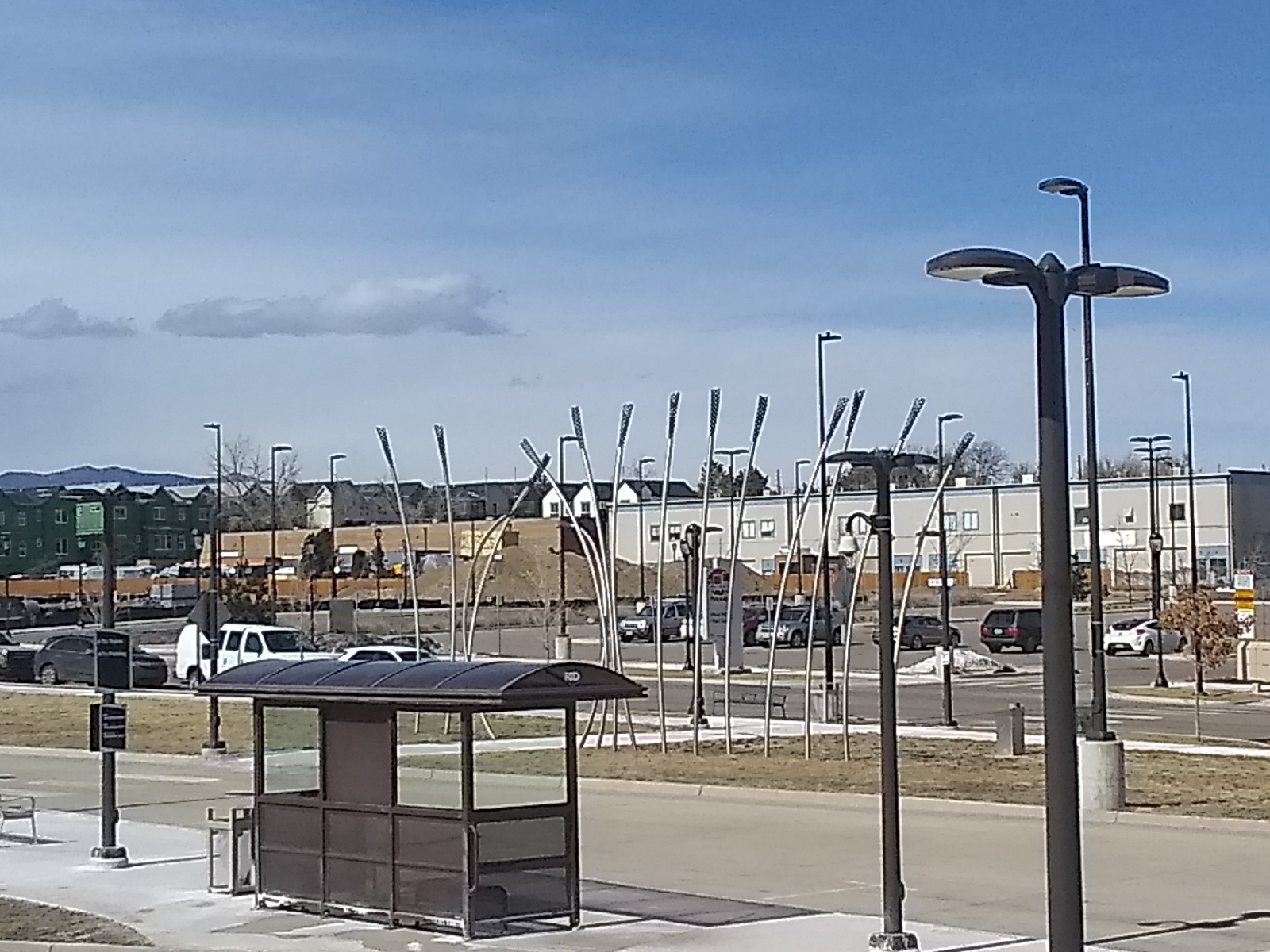
The station itself is pretty typical of these G Line stations.

How do the streams in your area differ in appearance than these in the Denver Metro area? What might account for their differences?

Gold prospecting was a trend in the U.S. in the 1800s. Was there a gold rush in your area? You might be surprised. Gold is fairly rare but is widely distributed. Do your homework and you might even be able to find some in your area.

Saturday, April 1, 2023

Arvada Ridge Station to Olde Town Arvada Station: A walk through the 'hoods

ducks are pairing up now...

and showing off. The fountain at Arapahoe at Village Center was host to these two when I went through on the way to the G Line. It's March and we could still have snow. Some of our deepest accumulations since I've been in the Denver area have been in April. But any break in the cold brings all the birds out .

The art installation at Arvada Ridge station by Norman Lee and Shane Allbritton is called "Chromatic Harvest". It emphasizes the historical importance of agriculture to the area. Like the lenticular "animation" once popular on cereal boxes and trading cards (made possible by a special illustration overlain by a striated lens coating) this image shifts between two scenes as one walks by.

Wheat Ridge, of course, was named for the wheat once grown there (and the northern ridge of Clear Creek Valley where it is situated), and Arvada was once known as the "Celery Capital of the World". There's very little of that to see on the G Line. The art is there, though, on the parking level of the Arvada Ridge station. You can't see it from the platform.

Most of my hike was through residential neighborhoods around Ridge Road. Here's a shot of one of the big commuter trains that serve the area.

A sign that I was nearing the end of my short hike, this water tower marks a "slice of small town America" called "Olde Town Arvada". Technically, a large area of the northwest Denver Metro area is Arvada, Colorado but there area parts of the region that are more recognizable as a town ..here and to the north near Broomfield. Sometimes it's hard to tell if it's Arvada, or Westminster, or maybe Lakewood.

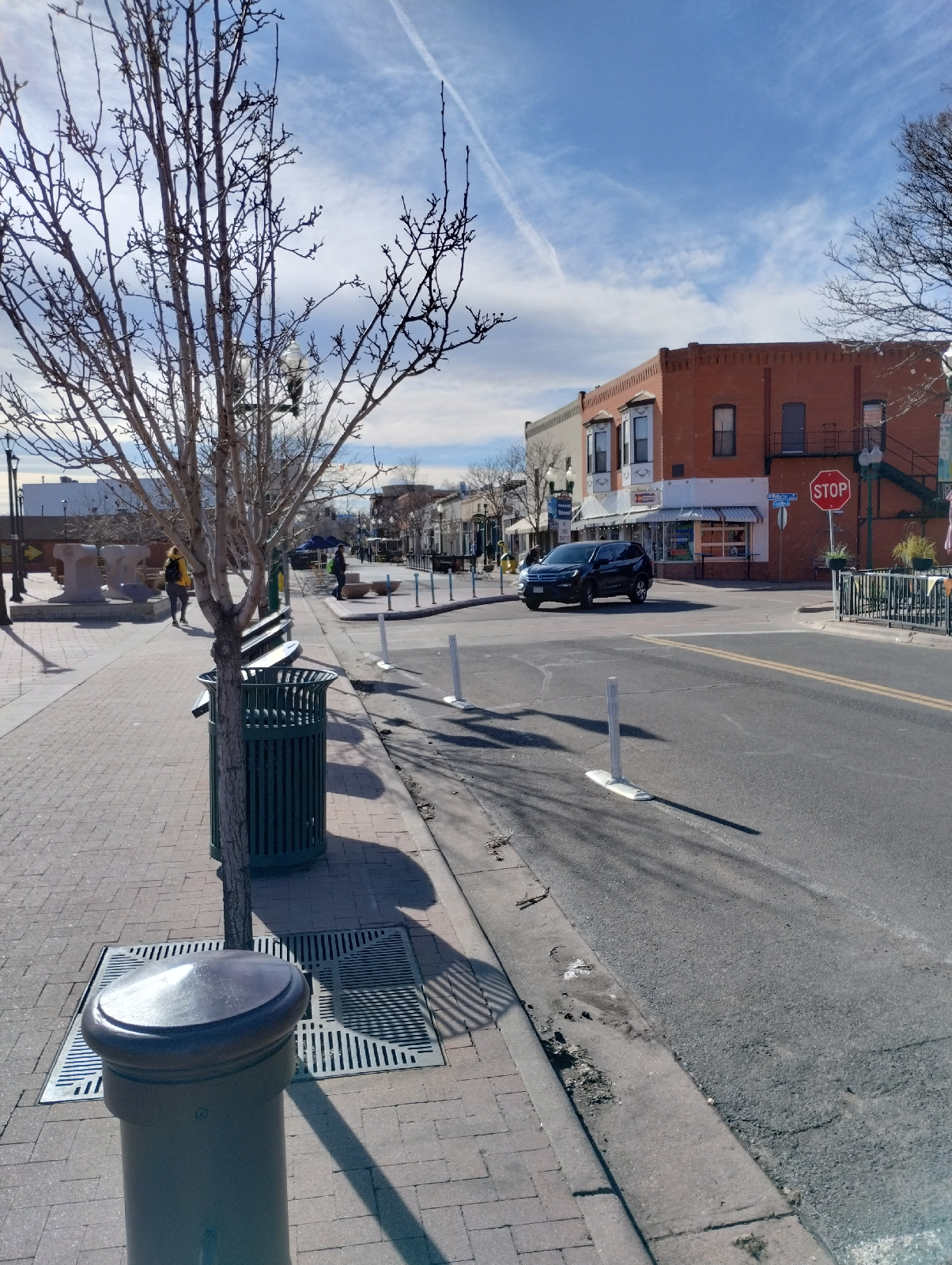
Anyway, Olde Town is the only actual tourist attraction on the G Line. It's intended to capture the atmosphere of "turn of the century" (I assume early 20th Century) Main Street America. With the diverse shops and proximity to the railroad station, it does seem to draw people. I've never been there when there weren't kids playing in the street (The main street is barricaded against traffic) and folks eating outside the restaurants.

To maintain it's purpose as a historical site, there are interpretive plaques placed around that explains the importance of gold, agriculture, and the railroad for the region.

The train station itself looks pretty modern.

There's also the only public restroom I've found on the G Line at the station (except for the restrooms at Union Station.)

I ate a massive roast beef sandwich at Lloyd's and visited Scrumptious for a milk shake (there are a lot(!) of places to eat at Olde Town Arvada) and then waited for the train.

There are very few places on Earth that hasn't been touched by humanity and they all have bragging rights. Arvada holds the distinction for once being the Celery Capital of the World and the site of the first gold strike in Colorado. What is your area proud of and how do they show it?

Place names have meaning to people (if it's only "my home town"). Arvada was originally named Ralston Point for the person who made the first gold strike but was renamed Arvada after Hiram Arvada Haskin, brother-in-law of the settler Mary Wadsworth, wife of Benjamin Wadsworth, first postmaster of the area after which Wadsworth Boulevard was named. The town was renamed to distinguish it from all the other places named after Rolston.  Where did your town (or region) get it's name?

I'll get to look at that site of the first gold strike in Colorado on the next hike and there'll be a lot of Rolston.

Monday, March 27, 2023

Wheat Ridge Station to Arvada Ridge Station: The G Line

G stands for "gold".

RTD's G Line runs near the place where Colorado's first gold strike happened.

I'll get there but first there are two legs of the journey to accomplish. I visited the Wheat Ridge-Ward Station, the western end of the G Line back in July 1, 2919 (http://adventuringbcc.blogspot.com/2019/07/terminus-wheat-ridge-im-not-going-to.htmlhttp://adventuringbcc.blogspot.com/2019/07/terminus-wheat-ridge-im-not-going-to.html). Then, it was just to look around the station. Now, I begin a new series of station-to-station hikes from Wheat Ridge through Arvada to Union Station in Denver. There are six stations.

My point of departure for each of these hikes will be Union Station in downtown Denver. The G Line is one of the northbound rails that board in the train pavilion at the South side of Union Station (the southern rails use the light rail station to the north).

Union Station Train Pavilion

Still electric cable cars, these trains are larger than the light rail trains that run south of Denver. These look like trains, and the passenger areas are cushy and roomy.

These trains are also commuter trains first. Many of the people who work in Denver live in these northern suburbs. Situated on the plains, there isn't a lot out here other than residential areas and industries. The stations are further apart and there are fewer attractions.

Geologically, it's still the Dawson-Denver-Arapahoe formations, the same that make up the land in Centennial, where I live...dirt from the debris washed out of the Rockies and the Ancestral Rockies and volcanic dust blown from the west during the Colorado uplift. It's a lot of dirt and mud, but good for plants. Arvada is the area's main agricultural region.

The main highlight for me at Wheat Ridge is the view of North Table mountain and it's basalt cap.


And the other mountains around Golden.

The Station is the end of the line for the G Line. A little to the west is Ward Road that has a few amenities, like a convenience store.

The art at Wheat Ridge-Ward Station is a piece by Michael Clapper called "Anchored by Place".

For rockhounds, the G Line offers dirt, mud, and landscaping boulders and gravel. I'm not dismissing gravel, such as railroad ballast. I've found some nice materials in gravel, like these feldspars.

But don't mistake them for indigenous minerals. There's no telling where they came from. You can try panning gold from nearby Ralston or Clear Creeks but good luck and remember that these are now urban Creeks and are likely polluted.

The views along this route are urban prairie and consist mostly of residential and industrial areas. On the train out, I noticed a lot of industrial sprawl and kept wondering, "how am I going to get around all this." Well, part of the draw is the puzzle of navigating these urban landscapes. My smartphone map utilities will be my friend.

To adventure!

By the way, do you know how to use the map utilities in your smartphone browsers? For wilderness navigation, understanding the lay of the land and celestial navigation is your best bet, but for urban navigation, minding the streets and city maps will get you where you want to go 

Most smartphones will use GPS to locate your current position and put you on a map. If you need more help finding your way around, the Directions function in the Maps section of your browser should do the trick. Learn how to use them. 

Saturday, March 25, 2023

Geology notes: Valley dynamics and volcanoes


My home study range, Walnut Hills, Centennial, Colorado is situated around two valleys, Little Dry Creek and Willow Creek. They merge a little to the west and finally join the South Platte River in Englewood. Little Dry Creek begins less than a mile to the East at a spring from the Dawson aquifer discussed here:

http://adventuringbcc.blogspot.com/2022/02/expedition-dry-run.html

Like many high desert aquifers, this one isn't very productive and most of the water in these streams are from runoff.

The shape of the valleys is typical, a shallow "V" with a sharp bank at the streams. Particularly, they're typical of streams that cut through relatively soft group. When streams cut through hard rock, they tend to form canyons with high, steep sides.

A small nameless but persistent stream arises from underground (I think this is the first sunlight that touches it) to join Little Dry Creek. If you read the discussion about confluences in the last blog, this arrangement will be familiar. The smaller stream joins downstream at an angle with a delta between.

This is a relatively energetic stream, being on the slope of the much larger and steeper South Platte River Valley. Since people live along the stream, erosion is a concern, so these weir dams are placed along the stream bed to expend some of the energy built up by the water pulled down by gravity.

Energy is the capacity to do work, in the case of the creek, to wear away the ground under it, so it can be thought of as the force it exerts over a period of time, and force is the mass of the moving material (water) times it's acceleration (which increases as it moves downward in response to gravity.) The weir dam just slows the water down momentarily.


Valleys grow outward as well as downward, otherwise all valleys would have vertical walls. The photographs above show the Little Dry Creek Valley growing. It's called "gravity slump".

All the ground around a stream is on a slope and, therefore, gravity is pulling it down. The ground further away from the creek is moving so slowly that you can't see it but there's plenty of time is geology for it all to finally make it's way down to the water to be swept away. Cycles of freezing and thawing, and rain helps to loosen up the soil.

But slump is most evident at the creek bank. Here sheets of dirt sheer off and slide into the stream.

Keep in mind that the confluence of Little Dry Creek and Willow Creek is also moving upstream, eating away at the valley. And this part, where the slope increases...


That used to be further west. At one time the creek flowed over that ridge. There might have been a cascade, or even a waterfall, but it ate away at the ridge moving it back until the steep section is where it is today. 

Water moves faster and erodes more quickly on a steep slope so the slope moves upstream. Waterfalls and cascades move, and as they do, they eat away at the walls of their canyon or valley 

Before the Rockies were there to the west, what is now the Colorado highlands were lowlands. There was a while different set of mountains there before that. We call them the Ancestral Rocky Mountains. They were worn down by erosion and the present day 14,000 foot mountains will one day be worn down to plains as all their bulk is washed down to the ocean.

And, maybe, the continued grinding force of the Pacific plate against North America will push up another Colorado Plateau to be again sculpted into another Rock Mountain range 

There was a short stretch of the RTD light rail in downtown Denver that I had not hiked so my housemate, Fox, and I took a train down to the Denver Convention Center and walked back to the Auraria Station. Part of the trip was to visit a gallery in the Convention Center.

Here, artists Kirk Johnson and Jan Vriesen have created interpretations of how Colorado looked over the last 500 million years. The painting feature places that, today, have names. For instance, about 64 million years ago, a volcano erupted in what is today Golden, Colorado, belching out lava flows which, today, can be seen as North and South Table Mountains. Here's Mr. Vriesen's idea of what the event might have looked like.


Along with the ten paintings, there are interpretive plaques explaining them and one for the whole exhibition.

Not only is this a valuable and informative art exhibit but it's also a useful resource for people interested in exploring the geology of Colorado. All ten sites can be visited today.

When I visit an area, I like to sit somewhere and try to visualize what it has looked like in the recent and distant past. That requires some research beforehand. Many states have online encyclopedias. I know that Alabama has an extensive website that provides lots of information about the State, including history, culture, tourism, and geology. You might want to search for "(your state) encyclopedia " to see if your state does. If not, you can find plenty of information in the Wikipedia online encyclopedia.

Friday, March 24, 2023

The last leg: The W Line

The terminals tend to be the most interesting stations on a line.

The W Line began in the mountains at Golden and ends in downtown Denver at Union Station. Along the way, I've seen ancient lava flows, art, antique toys, and miniature houses, and heard people's stories. 

You won't see any snow in these photos. That's funny since snow is still on the ground a few miles down the track where I live. The Front Range urban corridor, the most populated areas in Colorado just east of the Rockies, varies drastically in weather as you move north or south. Warmer downslope winds called "chinooks" crash down off the higher mountains, often with hurricane force winds, while the mountain passes let colder air through as fronts move out onto the plains. So ten miles can make a huge difference in weather here.

My hike began where I left off the last time, at the modernist event center, the Ball Arena. Although it hosts cultural events like concerts and plays, the big theme here is sports and you can see art dedicated to sports and buy items celebrating many of the local teams.

Not much of a spectator, I look and pass by.

Denver should be a Mecca for people who like bridge architecture. There are bridges everywhere illustrating many styles. These truss bridges over Cherry Creek are foot bridges connecting the Auraria neighborhoods to Denver proper. They don't span much distance so the simple truss structure works well. It works like a board across a creek.

If you built bridges as a kid, you probably remember that your plank was, well...fun? As you walked across, it sagged in the middle and bobbed up and down.

All bridges are a road or trail bed supported by some kind of structure to carry the weight of the "plank" and lead the force of the weight down into the earth. Here, sturdy steel girders form a lattice work that lays across from one bank of Cherry Creek to the other. The road bed rests on a platform of girders like the slats under your mattress. The trapezoids on either side keep it from sagging and bobbing. The trapezoids are reinforced by diagonal girders that form triangles. In a triangle, any joint is braced by the opposite side. A triangle is the most stable plane shape.

Cherry Creek and the South Platte River define major regions of Denver. West Denver is west of the river. The original settlement of Auraria where settlers of European heritage joined Chief Little Raven's tribe of Arapahoe was nestled between the two streams, and Denver proper developed across Cherry Creek. The streams have never been navigable to large river traffic but was the original draw to the area as gold was panned from them and their tributaries. Then they served as open sewers. Although they have been cleaned up considerably, they still carry an invisible load of diverse toxic metals from mining operations upstream and enteric bacteria like Escherichia coli from ongoing sewage contamination. Swim at your own risk.

Nevertheless, water fowl find the streams inviting, and I occasionally see fish there. Denver used to be on the migration routes for many birds but as the climate has warmed, more and more are staying put year round. Also, further south they get shot.

Confluence Park

The South Platte River and Cherry Creek merge in downtown Denver at Confluence Park. This area has been extensively landscaped not only for aesthetic reasons but also to manage erosion. A lot of energy is expended here and the valley shape can change quickly (over geologic time) if allowed.

Confluences are often a good place to look for heavy metals like gold. Industrial placers are troughs fitted with slats or ridges in the beds. Water is sent down under pressure (often by gravity flow). Light particles of dirt, sand, or crushed rock wash on by while the heavier partials are caught behind the slats. In a confluence, the trough is the natural stream bed and the slats are rocks and boulders that slow the flow of the water. The Sand that collects there is enriched with heavy materials and can be panned to find heavy particles.

Confluence Park is a popular place for kayaking and tubing because the water gets a big boost there. There's actual white water around the boulders that have been washed down from upstream (but keep an eye on the pollution reports if you're interested!) It's no surprised that this was the first place prospectors decided to look for gold in the area. 

Why is Denver where it is?

That's why.

Geology not only changes geography. It changes us.

But they didn't find gold at the Confluence of the South Platte and Cherry Creek. Bragging rights for the first gold panned in the area goes to the confluence of Clear and Ralston Creeks further to the west. Then they found placer gold three miles south at the confluence of the South Platte and Little Dry Creek, and the rush was on.

The pedestrian bridge at Confluence Park

Many of the bridges in the Denver area are arch suspension bridges. The road bed is suspended by cables from an arch. Of course, arches were used extensively by the Romans for their strength and stability. In the case of the pedestrian bridge at Confluence Park, each cable holds only a section of the weight of the road bed. The downward pull of the cables threaten to push the ends of the arch outward but, if you look at them, they're braced so that the force of the weight is conducted up the cables into the arch and down into the Earth.

This is a typical confluence. Two streams rarely, if ever, join at right angles. There is a stagnation zone in a larger stream just before a smaller tributary joins it. That allows particles to precipitate out of the water to form a delta pushing the junction of the two stream further downstream.

The confluence of Cherry Creek with the South Platte River from the pedestrian bridge at Confluence Park.


Near Confluence Park are three suspension bridges of innovative design. They're featured prominently in the January 13, 2019 blog, Terminus: Union Station (http://adventuringbcc.blogspot.com/2019/01/terminus-union-station-gold-drew-people.html). Here, the road bed is supported by cables attached to one or more masts. These two masts are curved outward to counteract the tendency of the weight they're carrying to pull them together. They're also springy (remember the old saying, a flexible tree doesn't break in the wind"), so you might have a little more bounce in your step as you cross the South Platte River pedestrian bridge.

Millennium Bridge from the South Platte River bridge.

Highlands pedestrian bridge from the South Platte River bridge.

All three bridges are in line and visible from each other.

This striking building, at the edge of downtown Denver, is a condominium called "the Riverfront Tower". It was built in 2002 and if you want to live there, be ready to shell out the $$$, because it's right in the middle of everything. At this writing, space goes for over $700 per square foot per month. You can sit in Commons Park and gaze at it for free. (I also like to watch humans and dogs play catch there.)

This hike (and the W Line) ended at Union Station light rail pavilion. The Millennium Bridge is just to the west (trains pass under it as they pull into the station). The big concrete barrels shown in the photograph above are works of art but, primarily, they are the ventilation shafts for Union Station's underground bus terminal. 

Union Station sits directly on the 105th meridian west. It is one of 24 meridians on which time zones are based. Running north and south, the meridians are imaginary lines of longitude used to describe positions and time zones on the globe. This one is seven hours west of the prime meridian. That means that, when it's noon at Union Station, it's 7:00 pm in Greenwich, England.


How does the topography of your area alter your weather. If it's hilly or mountainous, it might impede winds and air masses as they move across. If you live on the plains, they may crash through with impunity.

If you pay attention, the more you walk in an area, the more you become aware of migration patterns of animals. Have you noticed that habits of animals in your area have shifted? Are new species appearing or old ones disappearing?

Are there any places near you where two streams join? Is there a delta there? If so, what does it look like? Is the water in the streams different colors? Do they mix immediately or can you see the different colored waters further downstream as though there are two streams flowing down the same stream bed?

Bridges are cool! There's likely one near you. Visit it and see if you can tell how the road bed is supported. How does the force from that  weight flow from the road bed to the ground. Most energy, to be useful, has to flow from a source to a sink. For instance, in an electrical circuit, electrical force is produced by a battery or generator, some of the force is lost to heat in a load, and the rest travels into a ground. In a microscope, light is reflected from a small object, magnified by lenses, and collected by your eyes' retinas. If most of the force of a road's weight was not directed through a bridge's structure into the ground, it would strain the bridge's structural members and eventually break them.