Showing posts with label confluence. Show all posts

Monday, April 3, 2023

Olde Town Arvada to Gold Strike Station

Confluence of Clear Creek and Rolston Creek

The very place of the first gold strike in Colorado.

Rolston Creek, Rolston Point (the earlier name of Arvada), Rolston Ridge, Rolston Road, Rolston Crossing, Rolston Station...who is this Rolston guy?

In 1850, Lewis Rolston, a prospector from Georgia stopped by this very place and panned a quarter ounce of gold out of the creek that now bears his name. They left the next morning on their way to California. In 1858, Rolston returned with another group and set up a placer mine at the same site...the first gold strike in Colorado.

Rolston was born in 1804 in South Carolina but later moved to Auraria, Georgia (after which Auraria, Colorado was named and from where many of the settlers of Auraria, Colorado came). He is also sometimes credited with starting the gold rush in Georgia after he collected a shiny rock in what would later be Lumpkin County, Georgia.

He returned east in his later life, served in the Confederate army and probably died in Georgia around 1870.

When the gold played out in Rolston Creek, many of the miners settled down to farm the area.

My trek started, as usual, in Centennial and I boarded the G Line train at Union Station in downtown Denver.

I detrained at Arvada Olde Town and relaxed for a few minutes with a milk shake. The statue at the station, Frank Swanson's Track Bone, refers to the railroad as the backbone of the community. It's carved out of Colorado rose red granite.

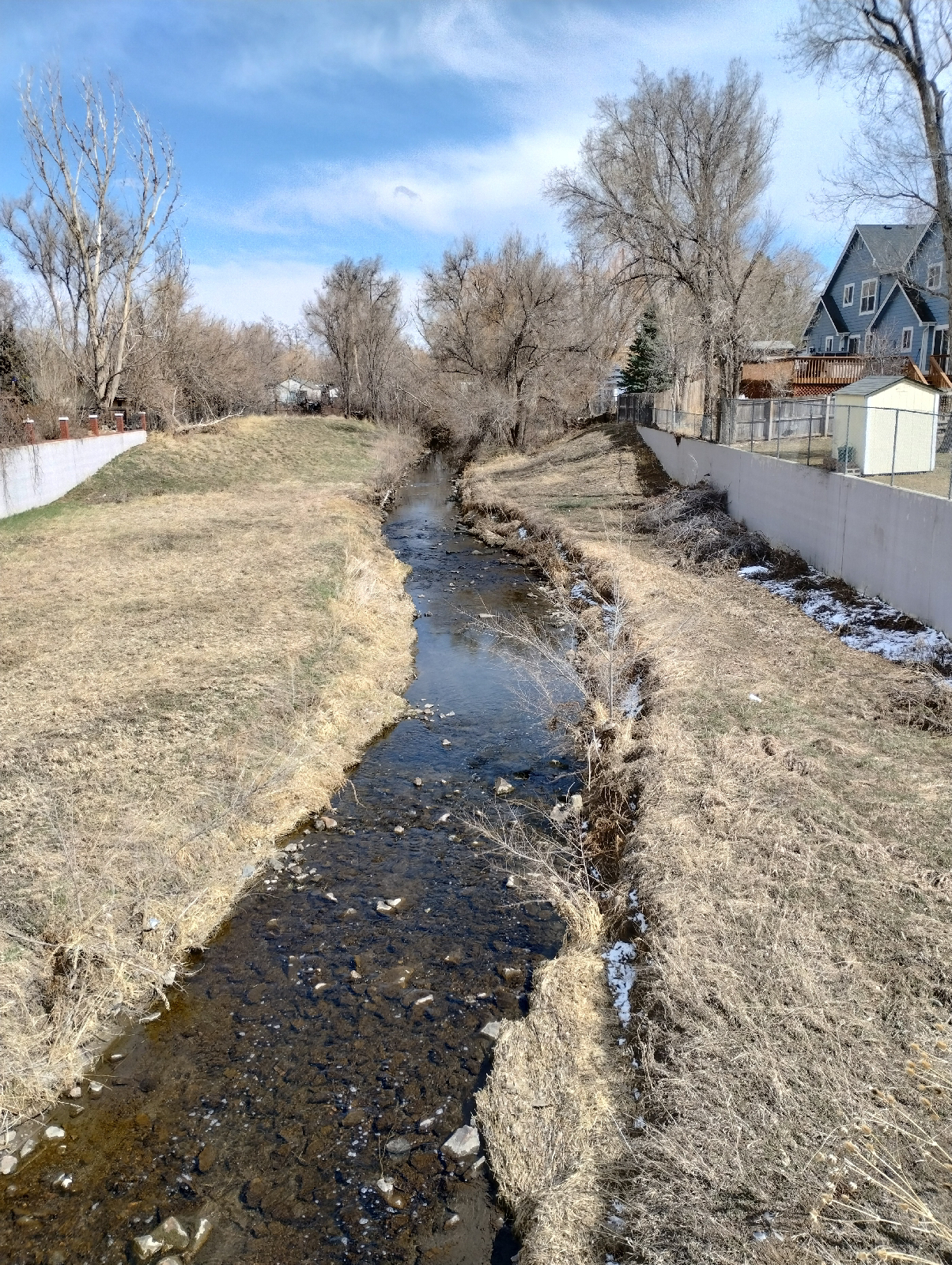
I joined Rolston Creek on the Rolston Creek Trail right in downtown Arvada.
Rolston Creek arises a little to the west in Golden Gate Canyon in northeastern Gilpin County. Rolston Creek Trail begins just north of North Table Mountain near Golden, Colorado and runs about 14 miles to the confluence of Rolston Creek with Clear Creek, where it joins the Clear Creek trail. Since these trails parallel the G Line to Pecos Junction, I'll be making use of them for a while. After that, Clear Creek and the G Line separate. The creek joins the South Platte River in Thornton. I would not want to hike back to Union Station from there 

Clear Creek has enough energy to eat away at it's banks, so there's plenty of meandering. Oxbows aren't common around here. The land isn't quite flat enough for streams to go anywhere they want. But there are a few. One nice example is in the Carson Nature Center in Littleton. There were a couple of places on this hike where it looked like Rolston Creek might make oxbow lakes if left alone. With all the urbanization and industrial parks, there's little chance of that happening.

Oxbow lakes form when a meander is choked with sediment so that it's cut off from the rest of the stream. Check out maps of streams out on the plains and you'll find many examples 


Have I mentioned that Denver likes murals? These murals in Arvada are exhibits from the 2021 Arvada Babe Walls Mural Festival. 

I left the Rolston Creek Trail at the Gold Strike Park, which commemorates the first Colorado gold strike. Along with the interpretive plaque, there are a few pieces of placier equipment on display. I'll get back to this park on my next hike.

Getting from the park to Arvada Gold Strike Station required a little navigation around urban streets but it wasn't too complicated or far and it afforded some nice views of the commuter train...

and the mountains.
The station itself is pretty typical of these G Line stations.

How do the streams in your area differ in appearance than these in the Denver Metro area? What might account for their differences?

Gold prospecting was a trend in the U.S. in the 1800s. Was there a gold rush in your area? You might be surprised. Gold is fairly rare but is widely distributed. Do your homework and you might even be able to find some in your area.

Friday, March 24, 2023

The last leg: The W Line

The terminals tend to be the most interesting stations on a line.

The W Line began in the mountains at Golden and ends in downtown Denver at Union Station. Along the way, I've seen ancient lava flows, art, antique toys, and miniature houses, and heard people's stories. 

You won't see any snow in these photos. That's funny since snow is still on the ground a few miles down the track where I live. The Front Range urban corridor, the most populated areas in Colorado just east of the Rockies, varies drastically in weather as you move north or south. Warmer downslope winds called "chinooks" crash down off the higher mountains, often with hurricane force winds, while the mountain passes let colder air through as fronts move out onto the plains. So ten miles can make a huge difference in weather here.

My hike began where I left off the last time, at the modernist event center, the Ball Arena. Although it hosts cultural events like concerts and plays, the big theme here is sports and you can see art dedicated to sports and buy items celebrating many of the local teams.

Not much of a spectator, I look and pass by.

Denver should be a Mecca for people who like bridge architecture. There are bridges everywhere illustrating many styles. These truss bridges over Cherry Creek are foot bridges connecting the Auraria neighborhoods to Denver proper. They don't span much distance so the simple truss structure works well. It works like a board across a creek.

If you built bridges as a kid, you probably remember that your plank was, well...fun? As you walked across, it sagged in the middle and bobbed up and down.

All bridges are a road or trail bed supported by some kind of structure to carry the weight of the "plank" and lead the force of the weight down into the earth. Here, sturdy steel girders form a lattice work that lays across from one bank of Cherry Creek to the other. The road bed rests on a platform of girders like the slats under your mattress. The trapezoids on either side keep it from sagging and bobbing. The trapezoids are reinforced by diagonal girders that form triangles. In a triangle, any joint is braced by the opposite side. A triangle is the most stable plane shape.

Cherry Creek and the South Platte River define major regions of Denver. West Denver is west of the river. The original settlement of Auraria where settlers of European heritage joined Chief Little Raven's tribe of Arapahoe was nestled between the two streams, and Denver proper developed across Cherry Creek. The streams have never been navigable to large river traffic but was the original draw to the area as gold was panned from them and their tributaries. Then they served as open sewers. Although they have been cleaned up considerably, they still carry an invisible load of diverse toxic metals from mining operations upstream and enteric bacteria like Escherichia coli from ongoing sewage contamination. Swim at your own risk.

Nevertheless, water fowl find the streams inviting, and I occasionally see fish there. Denver used to be on the migration routes for many birds but as the climate has warmed, more and more are staying put year round. Also, further south they get shot.

Confluence Park

The South Platte River and Cherry Creek merge in downtown Denver at Confluence Park. This area has been extensively landscaped not only for aesthetic reasons but also to manage erosion. A lot of energy is expended here and the valley shape can change quickly (over geologic time) if allowed.

Confluences are often a good place to look for heavy metals like gold. Industrial placers are troughs fitted with slats or ridges in the beds. Water is sent down under pressure (often by gravity flow). Light particles of dirt, sand, or crushed rock wash on by while the heavier partials are caught behind the slats. In a confluence, the trough is the natural stream bed and the slats are rocks and boulders that slow the flow of the water. The Sand that collects there is enriched with heavy materials and can be panned to find heavy particles.

Confluence Park is a popular place for kayaking and tubing because the water gets a big boost there. There's actual white water around the boulders that have been washed down from upstream (but keep an eye on the pollution reports if you're interested!) It's no surprised that this was the first place prospectors decided to look for gold in the area. 

Why is Denver where it is?

That's why.

Geology not only changes geography. It changes us.

But they didn't find gold at the Confluence of the South Platte and Cherry Creek. Bragging rights for the first gold panned in the area goes to the confluence of Clear and Ralston Creeks further to the west. Then they found placer gold three miles south at the confluence of the South Platte and Little Dry Creek, and the rush was on.

The pedestrian bridge at Confluence Park

Many of the bridges in the Denver area are arch suspension bridges. The road bed is suspended by cables from an arch. Of course, arches were used extensively by the Romans for their strength and stability. In the case of the pedestrian bridge at Confluence Park, each cable holds only a section of the weight of the road bed. The downward pull of the cables threaten to push the ends of the arch outward but, if you look at them, they're braced so that the force of the weight is conducted up the cables into the arch and down into the Earth.

This is a typical confluence. Two streams rarely, if ever, join at right angles. There is a stagnation zone in a larger stream just before a smaller tributary joins it. That allows particles to precipitate out of the water to form a delta pushing the junction of the two stream further downstream.

The confluence of Cherry Creek with the South Platte River from the pedestrian bridge at Confluence Park.


Near Confluence Park are three suspension bridges of innovative design. They're featured prominently in the January 13, 2019 blog, Terminus: Union Station (http://adventuringbcc.blogspot.com/2019/01/terminus-union-station-gold-drew-people.html). Here, the road bed is supported by cables attached to one or more masts. These two masts are curved outward to counteract the tendency of the weight they're carrying to pull them together. They're also springy (remember the old saying, a flexible tree doesn't break in the wind"), so you might have a little more bounce in your step as you cross the South Platte River pedestrian bridge.

Millennium Bridge from the South Platte River bridge.

Highlands pedestrian bridge from the South Platte River bridge.

All three bridges are in line and visible from each other.

This striking building, at the edge of downtown Denver, is a condominium called "the Riverfront Tower". It was built in 2002 and if you want to live there, be ready to shell out the $$$, because it's right in the middle of everything. At this writing, space goes for over $700 per square foot per month. You can sit in Commons Park and gaze at it for free. (I also like to watch humans and dogs play catch there.)

This hike (and the W Line) ended at Union Station light rail pavilion. The Millennium Bridge is just to the west (trains pass under it as they pull into the station). The big concrete barrels shown in the photograph above are works of art but, primarily, they are the ventilation shafts for Union Station's underground bus terminal. 

Union Station sits directly on the 105th meridian west. It is one of 24 meridians on which time zones are based. Running north and south, the meridians are imaginary lines of longitude used to describe positions and time zones on the globe. This one is seven hours west of the prime meridian. That means that, when it's noon at Union Station, it's 7:00 pm in Greenwich, England.


How does the topography of your area alter your weather. If it's hilly or mountainous, it might impede winds and air masses as they move across. If you live on the plains, they may crash through with impunity.

If you pay attention, the more you walk in an area, the more you become aware of migration patterns of animals. Have you noticed that habits of animals in your area have shifted? Are new species appearing or old ones disappearing?

Are there any places near you where two streams join? Is there a delta there? If so, what does it look like? Is the water in the streams different colors? Do they mix immediately or can you see the different colored waters further downstream as though there are two streams flowing down the same stream bed?

Bridges are cool! There's likely one near you. Visit it and see if you can tell how the road bed is supported. How does the force from that  weight flow from the road bed to the ground. Most energy, to be useful, has to flow from a source to a sink. For instance, in an electrical circuit, electrical force is produced by a battery or generator, some of the force is lost to heat in a load, and the rest travels into a ground. In a microscope, light is reflected from a small object, magnified by lenses, and collected by your eyes' retinas. If most of the force of a road's weight was not directed through a bridge's structure into the ground, it would strain the bridge's structural members and eventually break them.

Tuesday, August 9, 2022

Decatur-Federal Station to Auraria West Station

Lakewood Gulch at the Decatur-Federal Station has grown to quite a respectable stream.
The sound of water rushing over rocks is nice. Those rocks, of course, were placed there to break the force of the water and reduce erosion. I see many places here along the gulch where the mud is wet and slippery. It's evident that the stream has been out of its banks recently. Flash floods have occurred in this section, but the valley here is deep.

The light rail station here can be busy since it offers access to both the Department of Human Services offices and recreation like Empower football stadium and the Meow Wolf Art Exhibit.
Lakewood Gulch Trail is right on the edge of downtown Denver here.

Despite the urban setting, the South Platte
River draws water fowl. Here at the confluence of Lakewood Gulch and the South Platte River, things happen. The river has grown to a respectable size (see other photos of the South Platte in these blogs) and mixing of shallower waters carry pollutants but they also pour nutrients into the river and oxygenate it's waters. This egret seems to be looking for minnows.
After I reached the river, I had a tangle of highways to deal with, Interstates 25 and 70, Colfax Avenue and Old West Colfax Avenue, Walnut Street, First Street, Auraria Parkway, Fifth Street, the light rail and train yards, and the river. They all come together and try not to collide right here. Plus, the football stadium and Meow Wolf is tucked in amongst it all.

Meow Wolf is an interactive art exhibit in Denver run by a company in Santa Fe, New Mexico. They have other exhibits there and in Las Vegas. For the curious, the name was drawn at random from a container of slips of paper with words on them.
Denver, or the settlements that were to become Denver, was built around the promise of gold, a promise that soon played out with little result. What saved the town was a branch of the railroad that dropped down from Wyoming. Denver became associated with culture, cattle, and the railroad.

The railroad is still prominent here. It runs between Meow Wolf and much of it's parking area, so I waited awhile with several customers trying to get back to their vehicles while a long, slow train moved through.

The last stop on my itinerary was the Auraria campus, shared by Community College of Denver, Metropolitan State University of Denver, and the University of Colorado in Denver. I've been here before (Auraria West to Osage, November 10, 2018 blog) but there were parts of the campus I didn't see until I visited it with a friend a couple of weeks ago.

The campus is a mix of old (some of the oldest parts of Denver) and very new (the campus was built in 1973) architecture, and the old and still operating, Tivoli brewery serves as the student union.

The lynx is the official mascot of the University of Colorado in Denver.
For a major hub of the light rail system (the W Line branches off the rails to Union Station here), there is surprisingly little art here. As the train pulls into the station from points to the south and west, a mural appears on the side of one of the campus' administrative buildings. I say "appears" because the building is blocky and the mural is split between several walls that can only be seen as an unbroken whole from one direction.

This completes my exploration of the RTD W Line and the land (physical and cultural) surrounding it. I didn't include a lot. I passed through a major art district that offered much more than I had space to describe. The geology is complex and fascinating and I will have to revisit it. The cultures range from wealthy to the tent cities of Denver's homeless population (which is distressingly large and trapped in their circumstances.) The history spans the earliest native inhabitants to contemporary Denver.

Paths offer unique opportunities to learn from your surrounding. Following a railway, or a highway, or a stream can provide adventure and many learning opportunities.

What's in your world?

Thursday, July 21, 2022

Perry Station to Knox Station

This was another short hike and I'm glad for that because the Colorado summer heat was cranked wide open. Both Perry and Knox are small stations on mostly residential streets.

Here, the light rail and the accompanying Greenway make a straight shot to the state capitol building.

Just across Perry Street from the train station, Dry Gulch joins Lakewood Gulch.

Where two or more streams join, it's called a confluence and such a place is interesting on many different levels. For instance, many well-known confluences are also sacred sites. Whether it's psychological or physical, there's often a positive energy to such places. 

Confluences often have cultural and economic importance. The nearby confluence of the South Platte River and Cherry Creek is the birthplace of Denver, bringing life giving water, river commerce, and gold placers together to draw people from the Eastern United States to the new West.

Often, the mixing of waters from different sources will cause chemical reactions that make the separate streams visible far downstream. This water is surprisingly clear so that the effect is missing.

I tried to get a photograph of some very healthy looking minnows but they were too small.

Just downstream, the gulch widens out into a long pond.

Knox Station is just across the Lakewood Gulch here.
The retaining wall at Knox Station exhibits one of my favorite pieces of station art, Illuminating Path, by Jose Aguirre. It is a tile mosaic that looks like woven beads. It was constructed by students of the local La Academia.

Ways accumulate meaning. These railway stations would be railways stations whether there was art there or not...whether there were people there are not. There are plenty of abandoned railway stations in the world. But place one mind there and they self organize into places saturated with meaning. And they accumulate art.

A path is more than it's physical being. It has meaning..it has accumulated the meaning of all the people that have been there before. Many of the roads of the world were built on paths worn into the Earth by
bands of ungulates long before humans arrived, and they became footpaths, then highways for horses and carriages.

I come across paths in forests that have not been used for a long time. I recognize them for what they are...a mark on the landscape, but I also feel things. "I wonder where this path leads. I wonder who has used this path before me. I wonder what this path was used for."

Abandoned railways sometimes become foot trails. The Rails to Trails Conservancy exists to do just that. And the meaning grows.

Geometries, meanders and confluences, have meanings that do not exist in their physical nature, often deep significance grading to the religious. I look down a path that provides an unimpeded view of the state Capitol and something clicks in my mind. I want to record this meaningful thing.

Minds organize.