Showing posts with label stream. Show all posts

Wednesday, March 25, 2026

Berrendo Creek

 My first long hike in my new home followed Berrendo Creek through East Roswell, New Mexico. It begins South of my home. A mile south, it looks like a dry drainage ditch....a small, dry drainage ditch. Last year it flooded and took out a lot of property in Roswell 


You can tell where these desert streams sometimes are by the line of trees on a satellite image. 

These signs are no joke.


Here is Berrendo about a mile away as the meander runs.


Here, it has widened out into a broad flood plain. The same signs are on the road.

Less than a mile away.....


These 20-30 foot deep ravines, meanders, and oxbows were created by a powerful river, so where is it?

UFOs didn't put Roswell on the map.

Remember the Rule of Five. An average human can live five minutes without oxygen, five days without water, and five weeks without food  Communities are the same, five days without water, and the few little creeks in Roswell wouldn't bring nearly enough water to support a community. There were several settlers that tried.

Then, in 1899, Nathan Jaffa, a resident of Richardson Avenue drilled a well in his yard and hit the deep aquifer. Roswell had plenty of water from then on. The Pecos Valley Railroad came in 1892.

The Roswell basin actually has two aquifers  One is close to the surface but it's not very productive and has to be pumped. Then there's a deep layer of jointed limestone that's fed by the Pecos River and occasional rain runoff. This deep aquifer is capped by nonpermeable shale so it's under pressure and, when holes are punched through the shale, shoots water to the surface as artesian springs and wells. In other words, it pumps itself.

Normally, Berrendo Creek is fed by these artesian springs but all the farms and ranches in the area have these:


It's an artesian well. So much water is drawn from the deep aquifer for agricultural and industrial purposes (and to a lesser extent, household water) that it doesn't get to the creek 

On January 11, I set out to follow Berrendo Creek from North Roswell to the public fishing spot near 19th Avenue and Red Bridge Road.

I couldn't actually follow the creek without tromping through private properties, which I don't do without permission  I followed Pine Lodge Road through town, stopped at the Walmart for supplies and McDonalds for coffee, and continued east across the rural desert to Atkinson Avenue, where I turned South.


The desert along Pine Lodge Road 

Berrendo runs through a deep valley to the west of Atkinson. There's still no water.

A little further, Atkinson joins and becomes Berrendo Road. The bridge across the creek bed is interesting 


I don't see this conglomerate in the geological papers of the area. But it's outstanding. The cobbles are around tennis ball sized and seem to be solid, waterworn quartz.

The creek bed looks like it would form a nice waterfall here (about six feet) when there is water.

I stopped here for lunch.

A little further down Berrendo Road was an interesting ranch with a construction called "The Henge" that is mentioned as a significant example of modern architecture on the Internet 


The Henge was created by Roswell resident Herb Goldman and includes a gallery with mural painted by Willard Midgette. It is recognized on the State and National Register of Historic Places.

My hike from Berrendo to Red Bridge Road was through ranch lands. The sky is open, the land is flat, and it's a great place to spot raptors. It's not that great for taking photos of them with a phone.


Heh. You have to expand the photo to see it.

I joined Red Bridge Road at Bitter Lakes Farm which advertised Pistachios. This area has several tree nut farms including the pecan farm next to my home 


The house is an Adobe style ranch home.

New Mexico is famous for its nut crops.....piñon, pecan, pistachios, and peanuts.....and the piñon pine is the state tree. 

The hot, arid climate and long growing season that allows the nuts to mature are good for nut trees. Despite being in the desert, the Pecos River and it's tributaries have laid down some nicely fertile souls in some areas around Roswell.

Somewhere out among the ranches, an artesian spring feeds Berrendo Creek.


Just in time to fill the public fishing spot, which was well attended on the day of my hike. I was able to talk to some of the fishers who reported good catches. Catfish and bass are resident there and the creek is stocked with trout.

The water isn't green from pollution. It's calcium. I saw the same green water back East in the karst regions of Alabama, Tennessee, and Kentucky. This water certainly comes from that deep, limestone aquifer.

The ducks seem to like it, too 

But I was hiking and, with miles to go yet, I started out toward town.


The "Red Bridge" of Red Bridge Road

The first two miles into town is along ranchlands. Soon after entering town proper, there was an old cemetery that has plans to renovate (it currently looks a lot like pictures I've seen of boot hills from the 1800s.)

About a mile further brought me to Goddard High School. As memorial to the inventor of the liquid fuel rocket which developed to carry people to the moon, there are rockets out front (I will have to revisit this place some time in future explorations of Roswell )


Finally, reaching Main Street about five miles from home, I was ready to find supper. By the time I reached the home stretch, the 1.7 mile rural desert road to home, it was very dark and surprisingly cold (out came my headband flashlight, flannel shirt, and leather jacket.)

Some people talk bad about Roswell. I suppose it isn't a major party place but for people like me who values adventure and diversity, it offers plenty. 

And so does your home. Go find the hidden treasures around you.

Where does your city water come from and how is it treated? Is your home range famous for any particular crops? If so, why are they grown there and not somewhere else?




Monday, April 3, 2023

Olde Town Arvada to Gold Strike Station

Confluence of Clear Creek and Rolston Creek

The very place of the first gold strike in Colorado.

Rolston Creek, Rolston Point (the earlier name of Arvada), Rolston Ridge, Rolston Road, Rolston Crossing, Rolston Station...who is this Rolston guy?

In 1850, Lewis Rolston, a prospector from Georgia stopped by this very place and panned a quarter ounce of gold out of the creek that now bears his name. They left the next morning on their way to California. In 1858, Rolston returned with another group and set up a placer mine at the same site...the first gold strike in Colorado.

Rolston was born in 1804 in South Carolina but later moved to Auraria, Georgia (after which Auraria, Colorado was named and from where many of the settlers of Auraria, Colorado came). He is also sometimes credited with starting the gold rush in Georgia after he collected a shiny rock in what would later be Lumpkin County, Georgia.

He returned east in his later life, served in the Confederate army and probably died in Georgia around 1870.

When the gold played out in Rolston Creek, many of the miners settled down to farm the area.

My trek started, as usual, in Centennial and I boarded the G Line train at Union Station in downtown Denver.

I detrained at Arvada Olde Town and relaxed for a few minutes with a milk shake. The statue at the station, Frank Swanson's Track Bone, refers to the railroad as the backbone of the community. It's carved out of Colorado rose red granite.

I joined Rolston Creek on the Rolston Creek Trail right in downtown Arvada.
Rolston Creek arises a little to the west in Golden Gate Canyon in northeastern Gilpin County. Rolston Creek Trail begins just north of North Table Mountain near Golden, Colorado and runs about 14 miles to the confluence of Rolston Creek with Clear Creek, where it joins the Clear Creek trail. Since these trails parallel the G Line to Pecos Junction, I'll be making use of them for a while. After that, Clear Creek and the G Line separate. The creek joins the South Platte River in Thornton. I would not want to hike back to Union Station from there 

Clear Creek has enough energy to eat away at it's banks, so there's plenty of meandering. Oxbows aren't common around here. The land isn't quite flat enough for streams to go anywhere they want. But there are a few. One nice example is in the Carson Nature Center in Littleton. There were a couple of places on this hike where it looked like Rolston Creek might make oxbow lakes if left alone. With all the urbanization and industrial parks, there's little chance of that happening.

Oxbow lakes form when a meander is choked with sediment so that it's cut off from the rest of the stream. Check out maps of streams out on the plains and you'll find many examples 


Have I mentioned that Denver likes murals? These murals in Arvada are exhibits from the 2021 Arvada Babe Walls Mural Festival. 

I left the Rolston Creek Trail at the Gold Strike Park, which commemorates the first Colorado gold strike. Along with the interpretive plaque, there are a few pieces of placier equipment on display. I'll get back to this park on my next hike.

Getting from the park to Arvada Gold Strike Station required a little navigation around urban streets but it wasn't too complicated or far and it afforded some nice views of the commuter train...

and the mountains.
The station itself is pretty typical of these G Line stations.

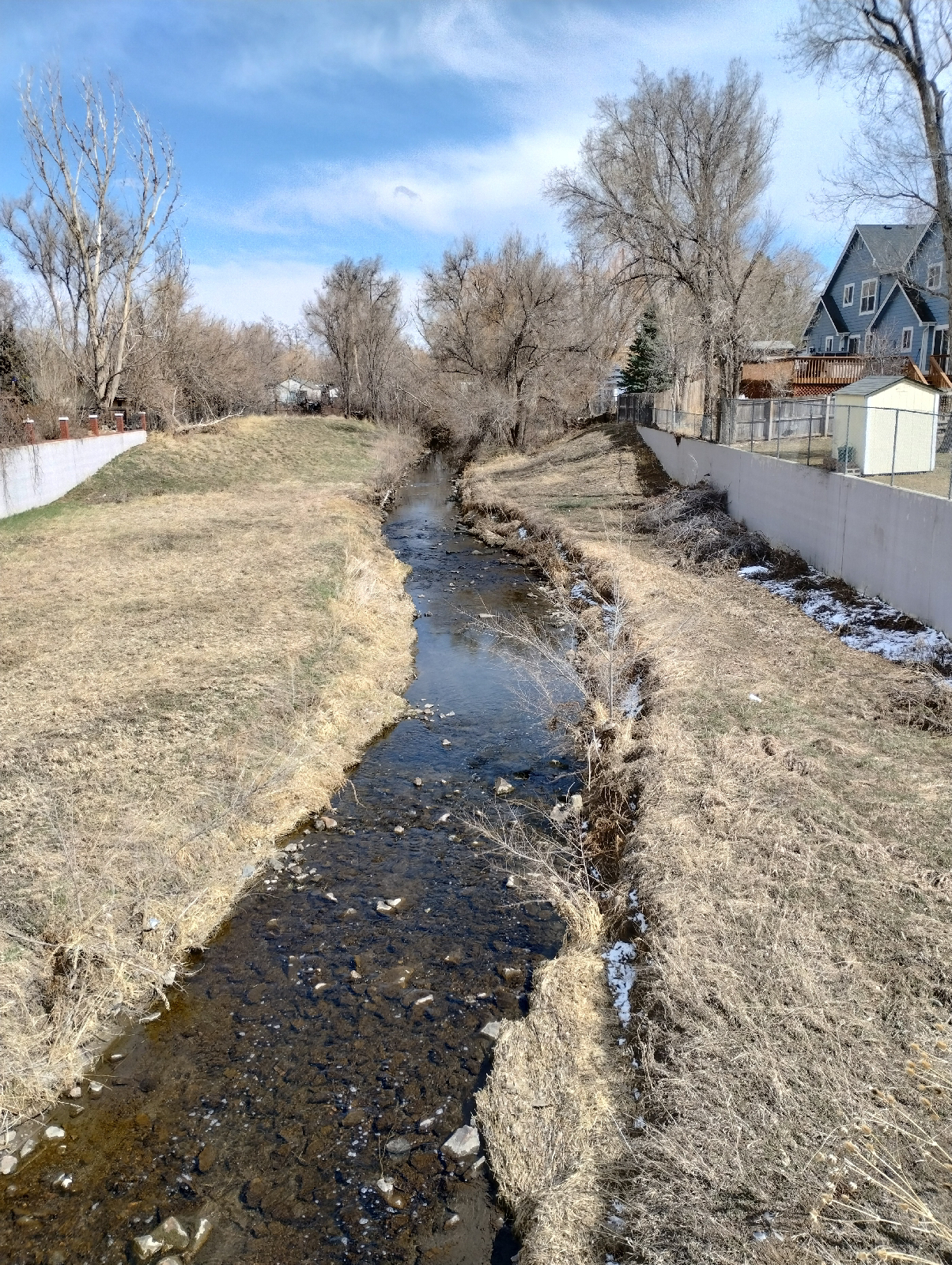
How do the streams in your area differ in appearance than these in the Denver Metro area? What might account for their differences?

Gold prospecting was a trend in the U.S. in the 1800s. Was there a gold rush in your area? You might be surprised. Gold is fairly rare but is widely distributed. Do your homework and you might even be able to find some in your area.

Tuesday, August 9, 2022

Decatur-Federal Station to Auraria West Station

Lakewood Gulch at the Decatur-Federal Station has grown to quite a respectable stream.
The sound of water rushing over rocks is nice. Those rocks, of course, were placed there to break the force of the water and reduce erosion. I see many places here along the gulch where the mud is wet and slippery. It's evident that the stream has been out of its banks recently. Flash floods have occurred in this section, but the valley here is deep.

The light rail station here can be busy since it offers access to both the Department of Human Services offices and recreation like Empower football stadium and the Meow Wolf Art Exhibit.
Lakewood Gulch Trail is right on the edge of downtown Denver here.

Despite the urban setting, the South Platte
River draws water fowl. Here at the confluence of Lakewood Gulch and the South Platte River, things happen. The river has grown to a respectable size (see other photos of the South Platte in these blogs) and mixing of shallower waters carry pollutants but they also pour nutrients into the river and oxygenate it's waters. This egret seems to be looking for minnows.
After I reached the river, I had a tangle of highways to deal with, Interstates 25 and 70, Colfax Avenue and Old West Colfax Avenue, Walnut Street, First Street, Auraria Parkway, Fifth Street, the light rail and train yards, and the river. They all come together and try not to collide right here. Plus, the football stadium and Meow Wolf is tucked in amongst it all.

Meow Wolf is an interactive art exhibit in Denver run by a company in Santa Fe, New Mexico. They have other exhibits there and in Las Vegas. For the curious, the name was drawn at random from a container of slips of paper with words on them.
Denver, or the settlements that were to become Denver, was built around the promise of gold, a promise that soon played out with little result. What saved the town was a branch of the railroad that dropped down from Wyoming. Denver became associated with culture, cattle, and the railroad.

The railroad is still prominent here. It runs between Meow Wolf and much of it's parking area, so I waited awhile with several customers trying to get back to their vehicles while a long, slow train moved through.

The last stop on my itinerary was the Auraria campus, shared by Community College of Denver, Metropolitan State University of Denver, and the University of Colorado in Denver. I've been here before (Auraria West to Osage, November 10, 2018 blog) but there were parts of the campus I didn't see until I visited it with a friend a couple of weeks ago.

The campus is a mix of old (some of the oldest parts of Denver) and very new (the campus was built in 1973) architecture, and the old and still operating, Tivoli brewery serves as the student union.

The lynx is the official mascot of the University of Colorado in Denver.
For a major hub of the light rail system (the W Line branches off the rails to Union Station here), there is surprisingly little art here. As the train pulls into the station from points to the south and west, a mural appears on the side of one of the campus' administrative buildings. I say "appears" because the building is blocky and the mural is split between several walls that can only be seen as an unbroken whole from one direction.

This completes my exploration of the RTD W Line and the land (physical and cultural) surrounding it. I didn't include a lot. I passed through a major art district that offered much more than I had space to describe. The geology is complex and fascinating and I will have to revisit it. The cultures range from wealthy to the tent cities of Denver's homeless population (which is distressingly large and trapped in their circumstances.) The history spans the earliest native inhabitants to contemporary Denver.

Paths offer unique opportunities to learn from your surrounding. Following a railway, or a highway, or a stream can provide adventure and many learning opportunities.

What's in your world?