Showing posts with label windscreens. Show all posts

Monday, July 18, 2022

Sheridan Station to Perry Station


The little cabin is the top of one of the elevators on the bridge over Sheridan Station. The bus stops on the bridge and there's a large parking garage south of the bridge. Sheridan Boulevard is one of the main north/south corridors in East Denver.

I had an errand to run, so I took a short walk to the convenience store just south of the station and cycled back down through the parking garage to the light rail station. Dry Gulch Trail starts here.

This stretch of trail (and the next) are only a half mile long. I'm very tempted to just take the next 3.3 miles and finish the W Line hikes, but I don't want to rush it and miss something interesting.

I always see people walking this trail when I come through here on the train, so it's a popular stretch.

Downtown Denver is close here.
A recurring element in the Denver metro area is community gardens. I see both vegetables and ornamentals. And I usually see local residents puttering around in them, so they are used, and I get the idea that they are places where neighbors meet casually.

Meanders are interesting and inevitable when water is streaming. If you let a thin stream of water run across an absolutely flat pane of glass, the track it takes will not be straight. Of course, at the microscopic level, no surface is absolutely flat. Atoms are bumpy, and there in lies the beginning of a meander. Throw in the fact that the Earth is constantly rotating out from under anything on it's surface (that's called the Coriolis pseudo-force..."pseudo-force" because it looks like something is pushing things out of the way) and it would be hard for anything to move in a straight line.

Once a stream veers from a straight course, it exerts more force on one bank than the other and the curve of that section is increased. Streams in mountainous or hilly surroundings tend to follow the lay of the land. Streams in flat areas are the ones that meander wildly. Pull up a map of a plains river like the Mississippi or the Platte and look at it's course.

The streams in my area have just plunged from the Rockies or have dropped into the South Platte River valley so they have a lot of energy that allows them to forge straight ahead.
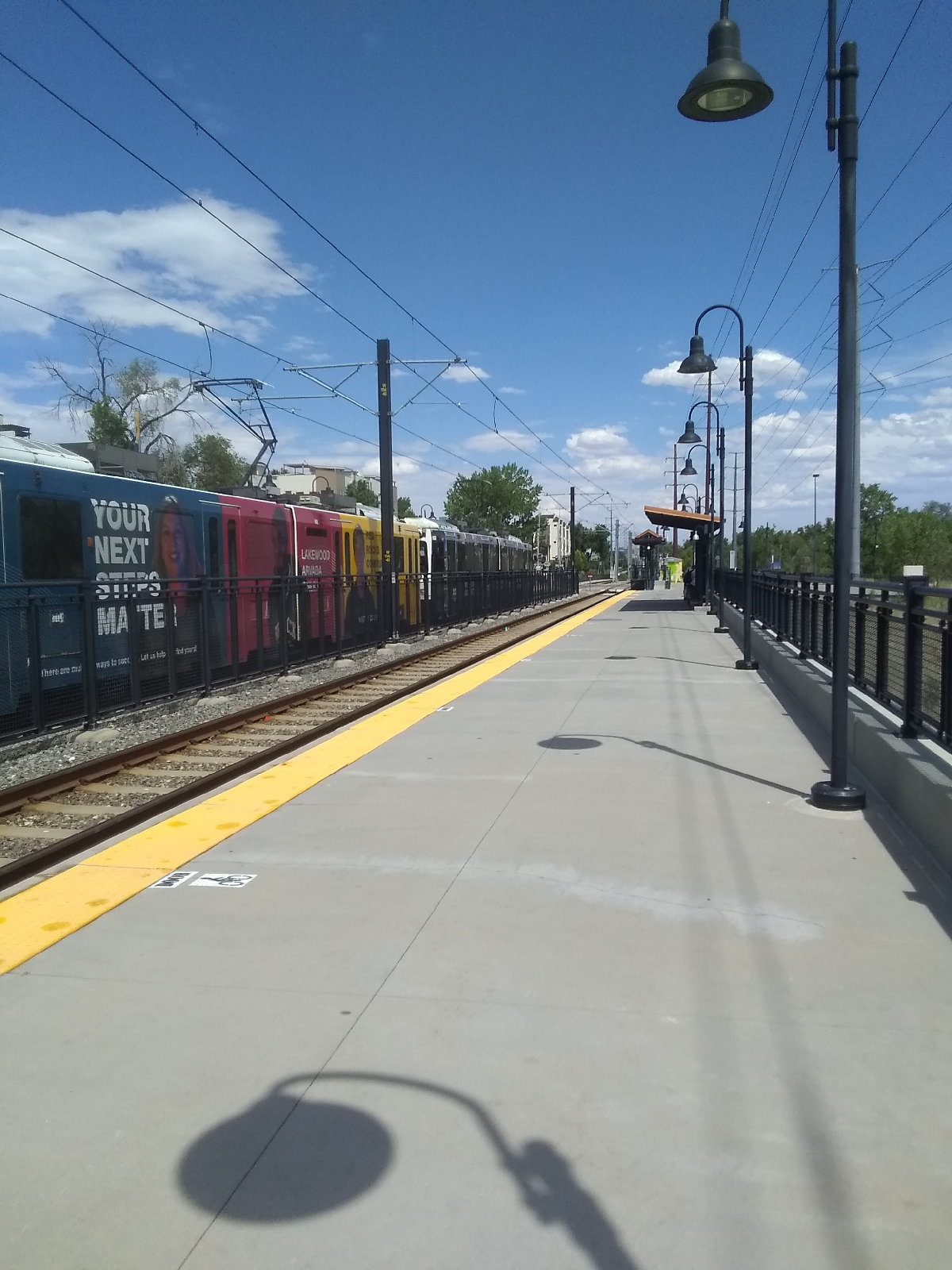
Perry Station is one of the smaller stations on the W Line. Dry Gulch flows close by and it's a short stroll from the trail to the light rail station. The main art attraction here is Interconnectivity by Joshua Wiener.
It lights up at night to add a little more illumination to the station at night. I've mentioned that all the light rail stations display art on the rail shacks and windscreens. You can see a couple of the outbuildings behind the Interconnectivity sculpture. Here are some more pictures from around Perry Station.
These windscreens emphasize recreation and community.

I'm just three hikes from the end of the W Line. The next hike will bring me to the confluence of the Lakewood and Dry Gulches and the last will show me where Lakewood Gulch meets the South Platte River.

Monday, July 1, 2019


--- Terminus: Wheat Ridge ---

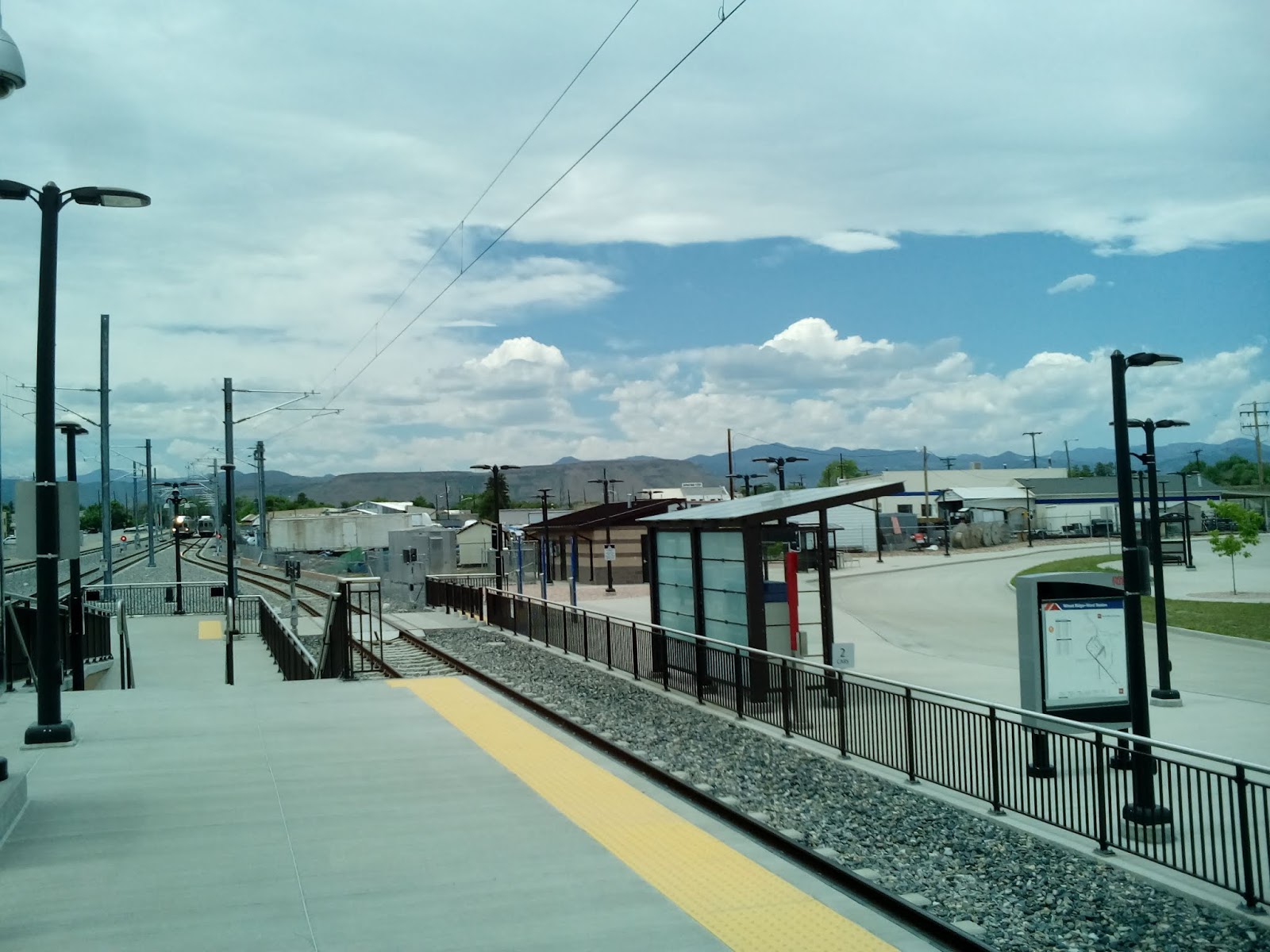
I'm not going to recommend the Wheat Ridge/Ward Road Station for tourism. The G Line that services the station is rather unspectacular with the exception of the Arvada Olde Town Station that looks like a nice place for shoppers that like quaint little villages. It has that feel. But my target was the terminus in northwestern Wheat Ridge, the only RTD light rail station in Wheat Ridge.

The G Line runs through a corridor of industrial zones and the Wheat Ridge/Ward Station is no different. It is surrounded by industry, but it does have some interesting points.

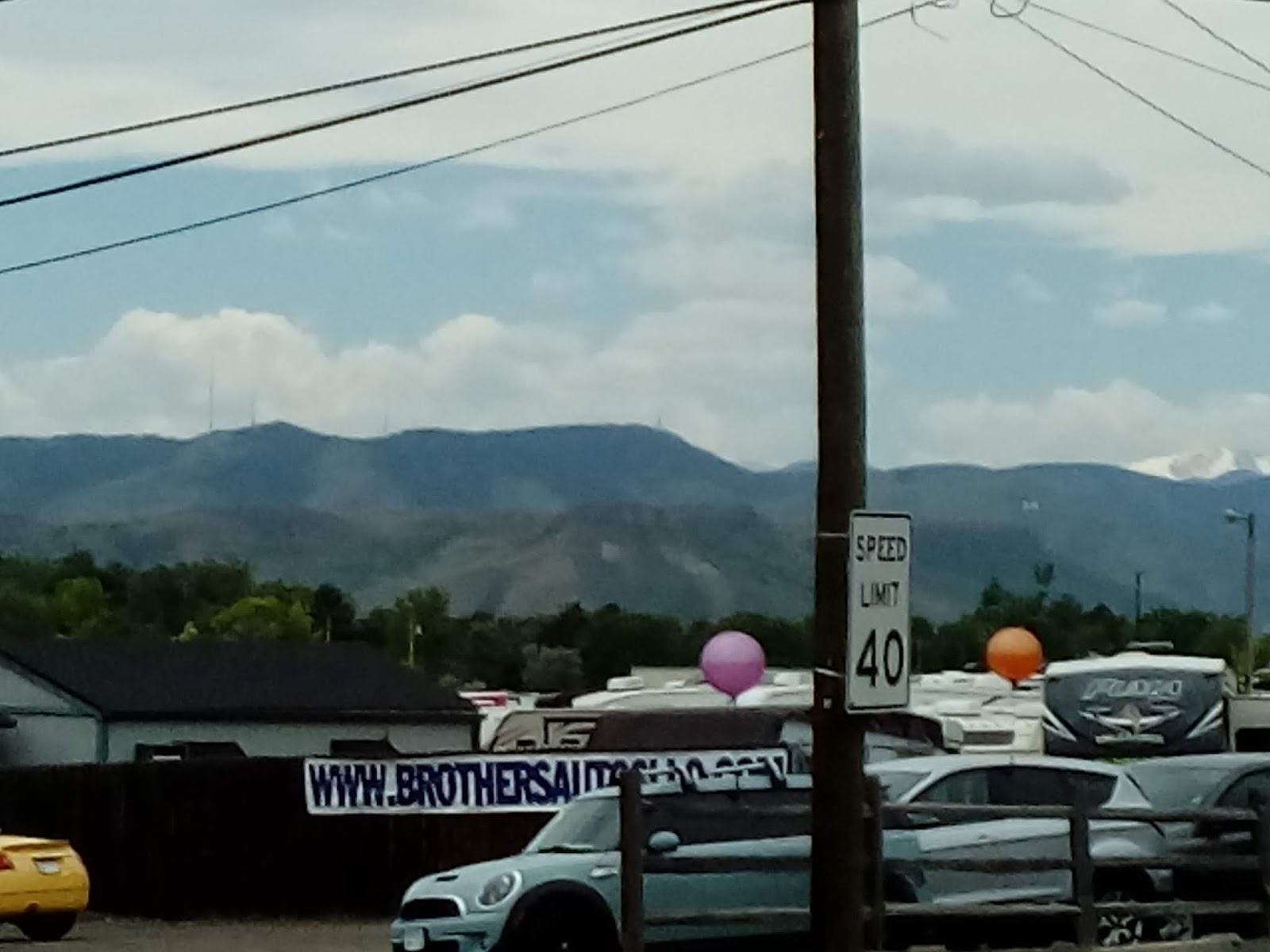
The station itself has parking for 290 cars and is a clean, attractive site. It isn't far from the foothills of the Rockies and especially offers some nice views of North Table Mountain. I was tempted to hike on over to the mountain but I'm not as familiar with that area as I am some parts of the Denver Metro area and I might have been disappointed by the real distance (as contrasted with the apparent distance) and lack of access to the mountain. Anyway, I am planning to visit the mountain in a couple of years when I look at the geology of the area.


                          [Photos of Wheat Ridge/Ward Station and the Rocky Mountains beyond]

One thing that I like about Colorado is the variety of showy wildflowers here. In the Southeast, most of the nice indigenous plants were woodland flowers and one had to do some hiking to see them. Here, any vacant lot may be a home to some pretty plants. One common plant with showy flowers is the thistle. Colorado has 15 native species and 5 non-native species, loved by bees and butterflies, browsing wildlife and wildflower enthusiasts. The one I found in the grassy burm of the light rail station is (I think) a nodding thistle (or musk thistle), considered a non-native, noxious weed.


                                                                     [Thistle]

As much as Denver is associated with the mountains, it's still a plains city and the great variety of grassland grasses are represented here. This foxtail barley is pretty common in the area. We have lots of it in our back yard.

                                                                  [Foxtail barley]

The stations of the RTD are micro-museums. Many of them display narratives of their neighborhoods. At Wheat Ridge/Ward Road you can read about the relationship between Denver and the mountains....and gold. G, in the G Line stands for "gold". The windscreens at the stations on the G Line tells the story of gold.

The artwork at Wheat Ridge/Ward Station is a modernist sculpture called "Anchored by Place". It was created by artist and art educator Michael Clapper.

                                                                [Anchored by Place]

You can read a lot about the stations of the RTD light rail, their art, including the windscreens, and stories connected to the stations and their neighborhoods at the FastTrack website, http://www.rtd-fastracks.com/main_1 .

If you follow me in my adventures and want to check out any of these places, you can prepare by going to the FasTrack site.

After wandering around the station, I walked down to Ward Road and a convenience store where I picked up a snack and then returned to wait for a train for my trip back home.

Along the way, I noticed this clump of a favorite wildflower, milk weed. Despite it's name, it's a gorgeous flower. Monarch butterflies will only lay their eggs on this plant. Check out the Fish and Wildlife website (https://medium.com/usfws/spreading-milkweed-not-myths-5df8c480912d ) to clear up misconceptions about this valuable plant.
                                                                        [Milkweed]

Ward Road has some nice views of North Table Mountain. The two Table Mountains are the exposed innards of an ancient but dead volcano. Their volcanic origin is made quite clear by the basalt deposits around the crown. Basalt is a dark, fine grain rock that is formed close to the earth's surface. It hardens too quickly for the melted magma to form large crystals like granite. These unearthed bones of dead volcanoes are sometimes called "fossil volcanoes". Luckily, they're as volcanic as the Denver area gets.


                                                            [North Table Mountain]

Regardless of how boring any area looks, if you look a little closer, you can usually find fascinating facts right in front of you.