Showing posts with label animals. Show all posts

Sunday, August 31, 2025

Fungi

Ever play 20 Questions? The classic first question is "Is if plant, animal, or mineral?"

 In my youth, biology courses were mostly descriptive. Everything was either plant, animal, or mineral but people started noticing that things were more complicated than that. For instance, where they thought that bacteria were single cell plants (they had cell walls like plants) they don't have a nucleus. The genetic material, DNA, was just floating around in the cell.

These guys


are sorta weird to. They look like plants but their cell walls are composed of chitin, the material that forms the shells of insects and crustaceans. So fungi don't quite fit the old scheme of things.

So, now, we have several "kingdoms" of living things. Plants and animals are still there but we also have the protista, single cell eukaryotic (the have cell nuclei) beings. That includes protozoa. And there are the monera that are prokaryotic (they don't have cell nuclei) and include the bacteria. The fungi have their own kingdom because of that cell walls thing.


But there are other schemes floating around. One splits the monera into the eubacteria, the true bacteria, and some weird organisms that like extreme conditions of temperature, chemical environments, pressure, etc., the archaebacteria.


Then there are slime molds that sometimes act like plants and at other times act like animals. Some protozoa lack mitochondria which is another kind of weird.

Things are a bit up in the air right now. Scientist would like to have a nice, simple classification scheme, but it looks like that is not to be 

Sunday, October 24, 2021

The Mosquitoes

When I take a vacation, I devote all of my time to learning about new surroundings...

Wrong!

I enjoy myself, but learning is a part of that. I live within sight of the Rocky Mountains, but I don't get into them that often, so I appreciate what opportunities I get.

Some tribe members came down from Michigan to spend a week in the mountains and our House stayed with them.

The Mosquito Range separates Fairplay, Colorado from Breckenridge. Fact is, we saw one mosquito the whole week and, although Colorado has a diversity of biting flies, there aren't many mosquitoes. I found some of the history of the Mosquitoes here: 


But where the name came from...I haven't the foggiest.

The drive from Denver was spectacular, bringing us over Kenosha Pass, but we didn't see any of it because it was night and we were driving through storm clouds.. an adventure in itself. The mountains open up into one of the great high altitude valleys, called parks. Fairplay is in the northwest corner of South Park, and, yes, this is the South Park of television fame/infamy (according to how you like your comedy.) Our destination was in the mountains above Fairplay.

Colorado is tricky. If you were taken from some other part of the world and placed, blindfolded, near Denver, your eyes might tell you that you are somewhere near sea level. The ground is relatively flat. The mountains are right there to the west but an unobstructed view to the east would stretch far. Your lungs would tell you something else because the land actually slopes up from the Mississippi River, over 800 miles away, to Denver, and Denver is a mile over sea level, which means that there is less atmospheric pressure and oxygen.

Fairplay is similar except, ignoring how flat the ground is, Fairplay is almost 10,000 feet above sea level, and even people from Denver might have some difficulty breathing there (I did!)

The Mosquitoes are high peaks. In the twenty miles between Fairplay and Breckenridge are four fourteeners and several other summits above thirteen thousand feet. Our lodge was at a little over ten thousand feet. It was up the side of the valley over the middle fork of the same river that flows through Denver, the South Platte.

The first morning I was at the lodge, I just missed a herd of elk tramping across the property. I missed a lot, but my camera wasn't idle so I'll share what I managed to photograph.

Aspen and evergreens dominated the fall foliage. Aspens are closely related to poplars, in fact, the scientific name for the genus is populus. They like the cold but can survive the short Colorado summers. We have one in our back yard in Centennial.

They are rathers vicious. They secret a toxin that keeps undergrowth from around their roots, which spread out to form other trees. There is a grove of about twenty aspens uphill from the lodge. They are all one tree. Individual trees might live over 100 years but there is a colony in Utah that has a root system estimated to be 80,000 years old.

Crystal Lake Trail carried some of us a few hundred feet above Alma, Colorado, A small town in the Mosquitoes. Alma was getting some snow. We were in the clouds and were getting pelted by blocky, hexagonal crystals of ice called "graupel". We persevered.

We began our 4+ mile trek out in mountane forests of evergreen and aspens but the trees quickly shrank to bushes and brambles. This stuff was all over the place.

My companions asked what it was and I didn't know, so I took a picture and later subjected it to Google Lens. (Although the lodge had WiFi, there was no Internet where we were.) All the willows I had ever seen were trees but, in montane environments, they adapt to form these low, cottony bushes. We were taken by the aromatic leaves. 

Willows were one of the early sources of pain relieving salicylates. Modern aspirin is acetylsalicylic acid, but methyl salicylate is the aromatic ester in wintergreen and other salicylates smell good also. The reason for tagging the acetyl group onto salicylate is that the other compounds are rough on stomach linings. Nevertheless, if you have a pain, you can use willow bark or wintergreen tea to get some relief. Just don't overdo it.

We crossed the treeline at around 12,000 feet and none had passed out from a lack of oxygen. One of us was used to diving around the coast of North Carolina before joining us in Colorado and it seems to help. The rest of us were a little out-of-breath. Big trees need more air to thrive than shrubs so they like lower elevations.

Our destination, Crystal Lake (and, by the way, there are at least three Crystal Lakes between Fairplay and Breckenridge. It's easy to get confused.), resides in a scooped out depression in the side of the mountain. It's pretty obvious that there was once a glacier here. These glacial depressions are called "cirques" and the lakes are called "tarns".

What drew people to these mountains was gold that is washed out of the granite by streams and collected in gravels, the gold being heavier than the other stuff in the stream beds. It's called placer mining and the above photo was taken from a mound of rock left by a mining operation. It sloped down to a marshy area that had claimed a Jeep (?!?) and, then, the lake. This place is probably packed with wildflowers in the spring.

The mountains that form the eastern wall of the Rockies can be a scrabble of metamorphic, sedimentary, and igneous rocks, but the Mosquitoes are in the heart of the Rockies and all that has been scraped off by wind, rain, and lots of ice. These are granite mountains.

The Continental Divide runs through here. The waters of the South Platte, running through Fairplay, end up in the Mississippi River and continue to the Gulf of Mexico and, thus, to the Atlantic Ocean. The waters around Breckenridge drain into the Blue River, which is a tributary of the Colorado, so they end up in the Pacific Ocean (well, they would if they were not intercepted for drinking water and irrigation by folks west of here.)

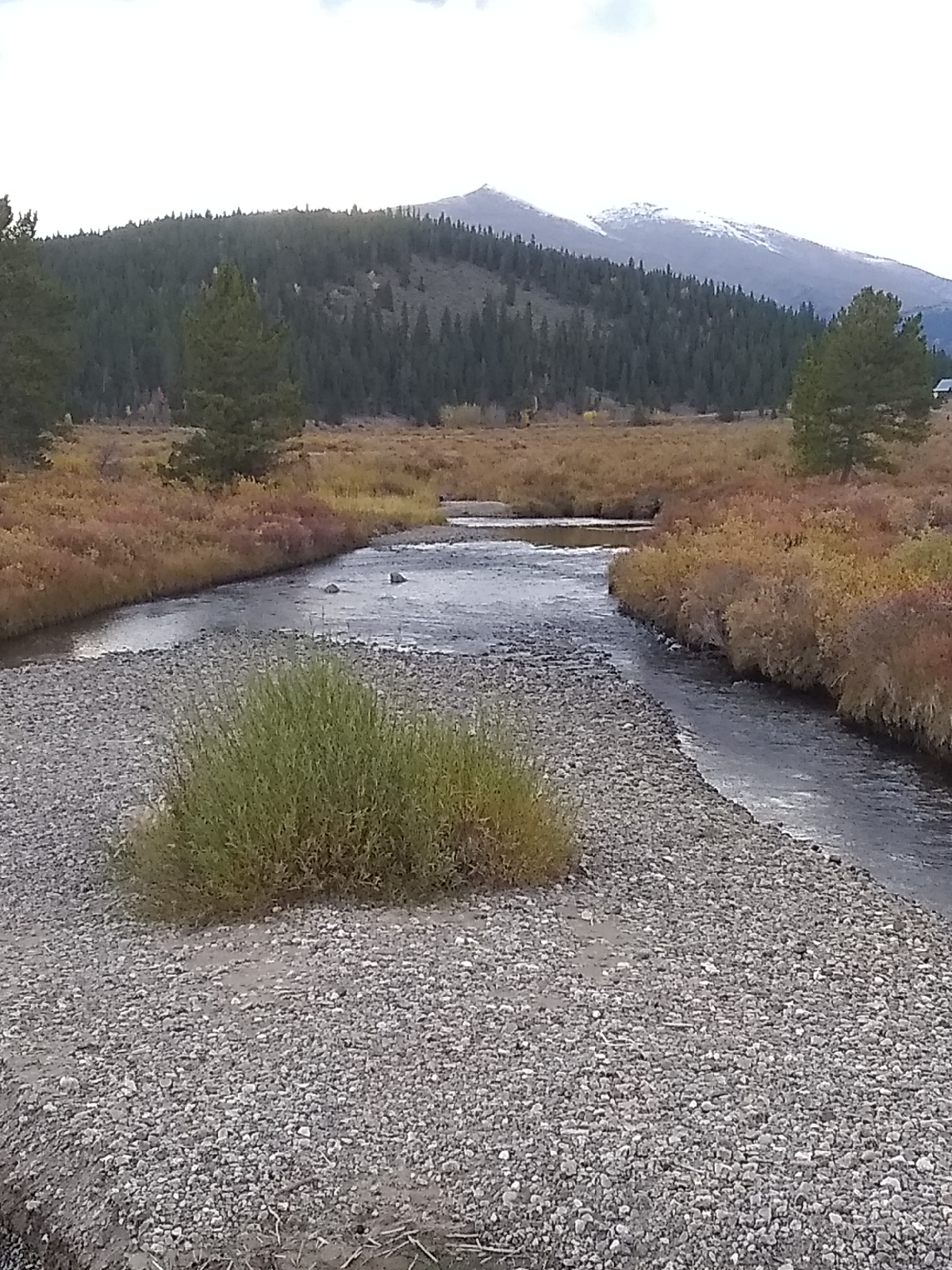
The next day, a few of us walked down to the river below the lodge. Here, the valley carved out by the South Platte broadens as it approaches South Park, itself a wide valley swept out by the South Platte and it's tributaries. The rivers pours out of the hard granite of the Mosquitoes into softer sedimentary rocks of a faulted and folded bowl between the higher mountains. The softer rock allows the river to meander more and more.

The broken thunderstorms afforded us with a nice valley rainbow.

The area is surrounded by several of the local fourteeners, like Mt. Sherman.

It was gravel beds like these that drew pioneers to the area. The granite washed out of the mountains carried with it gold. 

These streams are not like the ones I'm used to back east...or the ones where I currently live at the edge of the Great Plains. Those streams have a thick bed of soft material to dig into. The ones in the Rockies meet hard bedrock quickly so their beds tend to be shallow with vertical shoulders.

That night, I pulled out several scopes to look at the sky. The first few days were too cloudy to allow any sky gazing, but we finally got some clear skies and I saw the Milky Way for the first time since the early seventies. It's hard to find dark skies today. But the heart of the galaxy and Orion were low behind the mountain so I didn't try very hard for astrophotographs.

It was a nice week away from the faster pace of Denver.

On the way back to Denver, we pulled over to get a photo of this lady.

I've seen moose tracks around but this is the first moose that I've seen.

I advocate for learning where you are. We lose our anchor in the universe when we don't appreciate our own, personal universe. Every place has it's attractions and values. And it's easier to learn in your back yard. But travel opens new vistas and opportunities.

Friday, June 2, 2017


--- Why I talk to "animals" ---

People may think I'm crazy, greeting all the dogs on my hikes with "Hey guy!" and carrying on my one-sided conversations with them. But there is method to my madness.

If you want a good read into the mind of the nonhuman, I suspect that you couldn't do much better than to get Temple Grandin's and Catherine Johnson's  Animals in Translation. Ms. Grandin writes from a personal perspective since, she says, there are many similarities between the way a person with autism thinks and the way a nonhuman animal thinks. And she is autistic.

I also suspect that there are things that she gets wrong because, despite the similarities she sees, nonhuman animals are not autistic humans (and I will emphasize that she expresses the same in the book, so I am not contradicting her.). But it seems to me that she gets a lot of things right.

Pet owners and animal trainers are aware, have always been aware, of how stupid the Cartesian idea that nonhumans are only automatons, is. Beside that, I almost respect the Skinnerian idea that humans are also automatons. At least Skinner recognized that like implies like. If what nonhumans are doing things that look like what humans do (e.g., think), then it make more sense to posit, at least unless it has been shown to be otherwise, that they are, at least, quite similar. If it looks like a duck, and it quacks like a duck....

Regardless of what a dog thinks I'm doing when I give out a hearty, "Hey, guy!", it at least registers in it's doggy brain that I'm not aggressive and that I'm not afraid of it. There are several dogs in the neighborhood that sounds like, if they ever were to get out of their enclosure, they could do some real hurt to whoever is available. I hope it's someone like me because, at least I will be starting at a point of recognized equanimity.

I had a friend many years ago who trained his chows (in my memory, there were four) to attack on command and he wanted to demonstrate their training to me so he asked me to stand at a point in his yard and he let the dogs out of their enclosure and then he said, "Get him!".

I don't know what he planned to do to keep them from "getting me," but it was a non-issue.

They advanced on me, snarling and snapping, and I stared at them and growled. They stopped in a line and continued snarling and snapping, but they came no closer. My friend was furious and rushed them back into their fenced yard.

I think that people die in encounters with vicious dogs because the situation is so seemingly alien. Dogs are short and furry and their passion looks almost demonic. People don't seem to realize that, yes, they can fight back. They might get bit, but dogs don't enjoy being battered in the face any more than anyone else. They don't enjoy being kicked or punched in the kidneys. They're not the automatons that Descartes said they were.


Friday, April 7, 2017


--- Peoplewatching ---

"Just as a birdwatcher watches birds, so
a peoplewatcher watches people. But he
is a student of human behaviour, not a
voyeur. To him, the way an elderly
gentleman waves to a friend is quite as
exciting as the way a young girl crosses
her legs. He is a field observer of human
actions, and his field is everywhere – at
the bus-stop, the supermarket, the
airport, the street corner, the dinner party
and the football match. Wherever people
behave, there the peoplewatcher has
something to learn – something about his
fellow men and, ultimately, about
himself."

Desmond Morris, Peoplewatching

Everybody is a peoplewatcher. It's ingrained. We know about ourselves largely from watching others. We used role models to model ourselves and we are reflected by other people. We understand ourselves by paying attention to others' reactions to us. Like most animals, we are intensely curious about the people around us. It makes us happy to see other people who are happy. When we see someone injured, there is the skin-crawling sensation that something has been done to us. Also, like most animals, we can learn how to do things by watching others do them.

And, if we're not careful, we can learn errors from others. How many people have been hurt intensely by others treating them as unimportant? There is a common demonstration game called "Goat". It is common in sociology and communication classes and I have even used it as a Sunday School teacher.

In Goat, one person is selected out of a group to be the goat. I usually ask for volunteers. Everyone in the group is told exactly what will happen. Everyone knows that the whole thing is completely contrived. And everyone knows that there will be a debriefing session afterward. As you will see, there has to be a debriefing. Then there is a conversation and the goat is very definitely and pointedly excluded from the conversation. People in Goat groups are always so surprised at how painful it is to be the goat. The debriefing is actually a healing session - it is always needed. Other people are intensely interesting to us, even on a subconscious basis.

It is too bad that modern courtesy prescribes not watching other people. It doesn't eliminate peoplewatching. People still do it; they're programmed to do it. They just do it subconsciously and, therefore, there are always unexpected consequences - bad unexpected consequences. How much better would it be if people were knowledgeable and practiced students of humanity - if we strove to understand each other?

I won't talk about my peoplewatching experiences because they concern other people and, unless I have the others permission, I don't talk about them...usually. When I do, I try very hard not to make others identifiable. But I will recommend some books to read before going out on an intentional peoplewatching expedition.

The author of the quote at the beginning of this blog post, Desmond Morris, wrote a serious of "Watching" books: Peoplewatching, Bodywatching, Catwatching and Cat Lore, Dogwatching, Horsewatching, Animalwatching, Babywatching, and Watching. The earlier Manwatching was expanded into Peoplewatching. I would also recommend Temple Grandin and Catherine Johnson's "Animals in Translation," an intimate look at the inner lives of animals.

Most urban excursions involve ensembles of both humans and other animals and their intricate interactions. You really can't just watch the humans and understand what's going on. I would suggest reading up on the communication strategies - both verbal and nonverbal - of all the people you will be exposed to. For instance, on Bear Creek Trail, I am very likely to meet humans, dogs, or horses, and sometimes very personable squirrels and cats. They all play their parts.

Then there are mountain lions around here. I certainly want to know what they're thinking. We don't have problems with mountain lions attacking bikers and joggers like they do in some parts of the country, but they are here. It amazes me how similar the behaviors of mountain lions are to pet cats. I knew a mountain lion named "Prince" at the camp I used to work at. They had a wild animal rehabilitation unit and Prince was one of the inmates that could not be released into the wild. He didn't have the skills to fend for himself and he was far too used to having humans around. But I could tell very little difference between the way Prince behaved and the way all the other cats I have ever known behaved. Of course, the very big, real, material difference is that, if a house cat scratches you in play, you bled a little; if Prince scratched you, you bled a lot.

I've also made it a point to understand bear "language". I haven't run into a bear around here, but, again, they are here and I most certainly do not want to misunderstand a bear.


Abrantes, Roger (1997) Dog Language: An Encyclopedia of Canine Behavior. Dogwise Publishing

Berne, Eric (1996) Games People Play. Ballantine Books

Grandin, Temple and Catherine Johnson (2005) Animals in Translation: Using the Mysteries of Autism to Decode Animal Behavior. Scribner: New York, NY.

Livermore, David (2013) Customs of the World: Using Cultural Intelligence to Adapt, Wherever You Are. Teaching Company, Chantilly, VA. (Video)

Morris, Desmond (1990) Animalwatching. Jonathan Cape. London

Morris, Desmond (1991) Babywatching. Jonathan Cape, London

Morris, Desmond (1986) Catwatching and Cat Lore. Arrow Books Ltd.

Morris, Desmond (1986) Dogwatching. Jonathan Cape. London

Morris, Desmond (1989) Horsewatching. Jonathan Cape, London

Morris, Desmond (2002) Peoplewatching. Vintage/Random House. London, UK


Tuesday, February 21, 2017


--- Danger, Will Robinson ---

2016

I remember a photograph I saw when I was a kid. It showed parents with their child on the back of a bear in the Great Smoky Mountains National Park. Fortunately, no one was mauled. On the other hand is the case of Timothy Treadwell, aka Grizzly Man,  who spent years with the bears of Alaska. A documentary by Warner Herzog, Grizzly Man, chronicled his last five years. It shows him pawing the bears as though they were pets. According to their body language, they were quite obviously irritated with him. Finally he met a grouch which ate him and his girlfriend.

Let me repeat that. One of his beloved bears, who he had "gained the trust" of, mauled and ate him and his girlfriend. Then people killed the bear.

I can guarantee you that, if you went to Time Square in New York and treated humans the way Timothy Treadwell treated the bears in that film, someone would sooner than  later maul you and, perhaps, kill you. The bear was not to blame. Timothy was rude and rudeness is not long tolerated in nature.

Nature is dangerous and you're part of it. Your home is part of nature so there's no help in barricading yourself inside your house.

Nature is dangerous but it's not necessarily deadly.

I  was once looking for something to write about on my LiveJournal and I came upon an issue of Backpacker magazine that featured Bear Grylls as the guest editor (October 2012). In an interview, Anthony Cerretani asked him, "Has there ever been a  moment when you actually thought, 'This is it. I think I'm going to die.'?" That gave me material. I asked myself the same question and, at first guess the answer was, "Maybe a handful of times." When I started listing the episodes, I filled a page and started on another.

I'm 63 years old and have survived hurricanes, tornadoes, falls off cliffs, flying objects, huge waves, and on and on. I place myself in harms way - it's not a thrill thing. I don't go out of my way to place myself in danger but, as I said in an earlier article, there are too  many things that you can't experience unless you get involved - too many things that are worth some risk. One thing I've learned is that you can enjoy Nature if you respect her.

By "respect", I don't mean any (as the late George Carlin was likely to snipe) hippy dippy concept like "love", "adore", "grock". At base, I mean "understand well enough to get along with."

For instance, no wild animal is "cute". Most are equipped with weapons as parts of their anatomies and you are a stranger that might want to hurt them. Bambi is not your friend. Billy Bison and Maurice Moose will murder you without qualm if you fool with them. Hominids are not a favored meal of most predators but, in a pinch, you'll do. They're "just folks" (they're even "good folks") but they have to live, too. Just don't get in their way.

When you go to unfamiliar surroundings, learn as much as you can about the environment, what kind of diseases you have to guard against, the animals that live there, the climate....before you go.

In my area we have an assortment of animals on the hoof. They're skittish and have sharp hooves. There are bears and mountain lions. They rarely attack hominids but the ones around here seem to be smart enough to stay away - you rarely even see them. There are plenty of coyotes and they have little fear of humans, but they usually only attack people who think they're toys like their inbred poodles and spaniels. Don't try to feed the animals. They're rough with each other and they don't realize that you can't take it like their pack mates.

In the southeast, the environment changes slowly. Weather usually gives plenty of warning before it turns nasty. Tornadoes that start out in Texas take a while to get to Alabama. Flash floods are rarely that flashy. Preceding weather and a well known predisposition to flood is all you need to know about to get out of the way

Colorado has few buffers. When it decides to storm, there's little warning. When it does storm, it can go from toasty to bone chilling in the matter of an hour. Flash floods give no warning. If you're in Alabama and you trip and fall, you're probably falling on something you can eat. In Colorado, just about every edible plant has something that looks very similar that will, at least, make you very ill. We have bubonic plague out here. Respect Colorado!

If you want to lounge and schmooze, stay in the resort towns. If you want beauty, excitement, and positive life changing adventure, hit the trails.

But be sure, all that talk in our cultural heritage about inalienable rights to life, liberty, and the pursuit of happiness - those don't exist in nature. Nature isn't there for your convenience. Mankind might think that he has conquered nature (or can conquer nature) but, unless one of the more positive religions is right, long after humanity has died out, this planet will still be flying nonchalantly around the sun, feeling no grief at all at the loss of a microscopic culture that once flourished on her skin and was called "humanity".

Respect Nature and she will respect you. Disrespect Nature and she will eat you.