Showing posts with label Colorado. Show all posts

Monday, May 8, 2023

Volcano 1: Golden

"I don't know.
I don't know.
I don't know where I'm a gonna go
When the volcano blows."

Charles Thompson, Violet Clarke. Volcano. Sung by Jimmy Buffett, 1979.

Well this volcano won't be blowing it's top. It's been dead for 60 something million years, but it's still interesting so I went to check it out and found more questions.

Golden is more than a day's outing. There's a lot(!) to see and do there. My goal was to visit the geology museum, then take a look at the lava flows on North Table Mountain, and finally to hike out to the actual volcano, but questions intruded so this blog will be continued at a later date. First, an introduction to the area...

A good place for an overview is the Jefferson County Government Center. It's the first thing you see when you get off the train on the W Line and it sits on a hill overlooking the town (remember that if you're on foot. You'll have to come back here if you take the train back home.) You see all the mountains surrounding Golden, Golden itself, and Clear Creek Canyon in which the town is nestled. The university, the golf course, the tourist attractions... they're all down there. And the lava flows, North and South Table Mountain are to the right in the photograph above. The actual volcano is some where to the northwest. It turns out, I don't know where. It might be that hill in the left background with a white streak going up and around it. On Google Maps and Rockd, it's called Rolston Dike. There is also a spot on North Table Mountain that has been proposed as the vent. Then there's another dike between Golden and Boulder that might be the actual volcano. I'll be checking out Rolston Dike on a later hike.

Sandstone


The Denver area was once beachfront property (Actually, it's been beachfront property several times in the past.) When the sand that formed this rock was deposited by an inland sea, it was near the equator. You probably would have loved it. You could sit on your patio and watch the triceratops graze in you back forty.

The first triceratops skull in Colorado was found here. It now resides in the Denver Museum of Science and Natural History. Almost all the fossils found in the area (and there have been many!) have been found in this stuff.

I would imagine this is Dakota sandstone, the same stuff you see on Dinosaur Ridge. You won't see a hogback here in Golden, though. Clear Creek has pretty much obliterated it. You might wonder how such a little bitty creek could do so much damage. Of course, if you lived here long enough to have seen some of the past flash floods, you might not, but that's not the answer.

Did I mention that Colorado used to be near the equator? Climate has changed and when Clear Creek started carving out this part of the Rockies, there was a lot more water and it was a roaring river.

A cairn

It's a tradition around here. Hikers leave their marks by adding to these little stacks of stone. If you hike in Colorado, you will see them at the side of trails or in the middle of streams. Of course, cairns have been around for as long as humans have been around, for instance, as boundary markers or memorials, but they're not a constant part of the human landscape. I didn't see them much in the southeastern United States. I suspect that, once one person starts a stack, others join in.
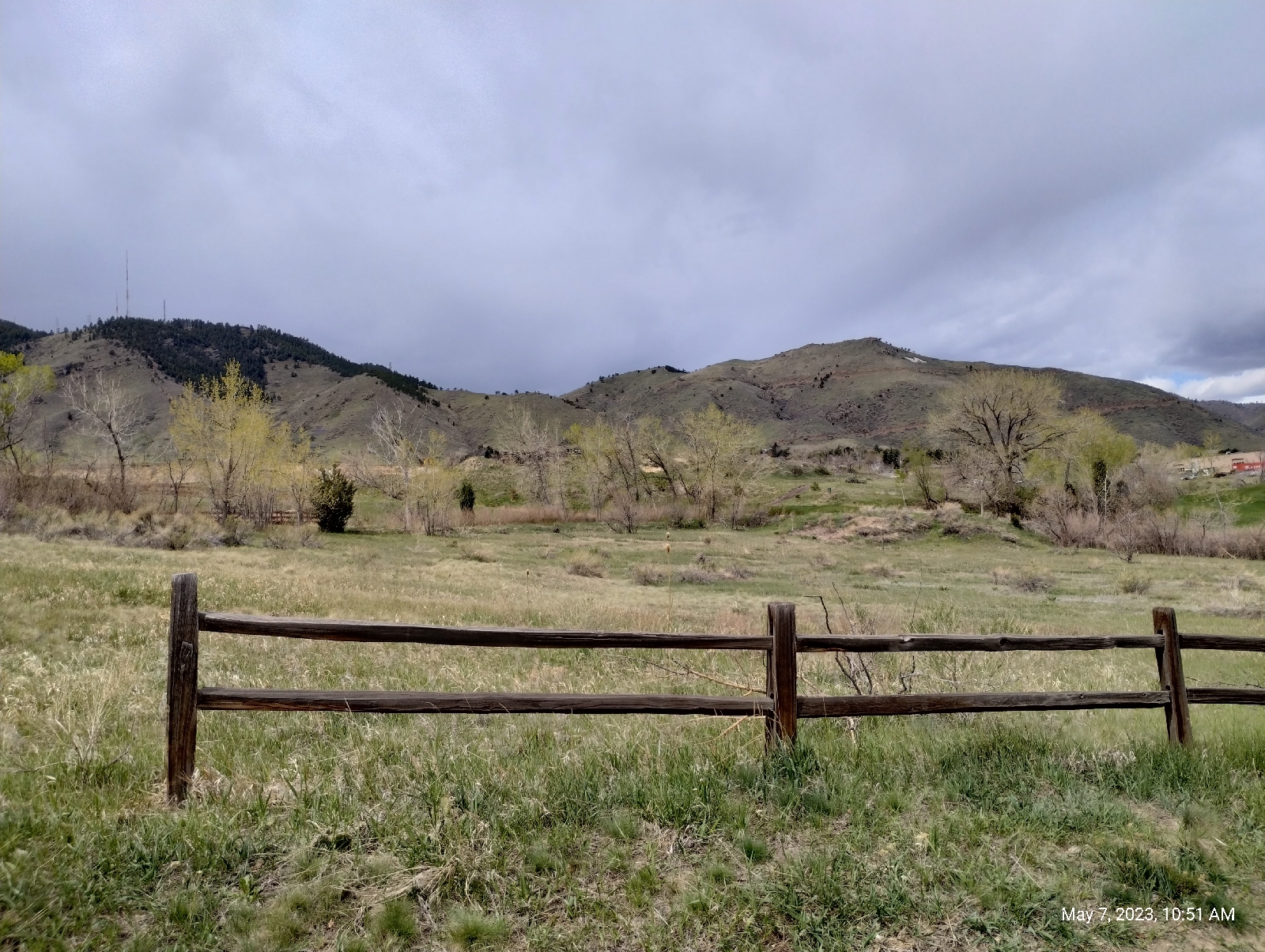
Lookout Mountain (left) and Mount Galbraith (right)

Over there, there are those huge masses of crystalline igneous and metamorphic rock, over here it's a lot of sedimentary stuff. That usually means that there's a fault somewhere around. You can't see the one that runs along the mountain front. It's covered up by a lot of debris, but it's there and it's big. When the Rocky Mountains rose, it pushed the rock from the west up and over the rocks to the east. How do we know? 

Well, we can drill down to the different layers of rock and see which layers match. We not only know that it happened...we even now how much it happened!

The Golden fault parallels highway 6 in Golden about a city block west. It pushed the very old rocks to the west about 14,000 feet up and about a mile and a half east up and over the younger rocks of the plains. Mind you, it didn't happen overnight, but with all that slippage, something had to break and that would explain the volcanic activity here, and near Colorado Springs, and in the San Juan mountains of southern Colorado (which are almost all volcanic), and other places in Colorado.

School of Mines visitor center.

It doesn't sound like much, "School of Mines", but I realized when I was a tutor, that the Golden School of Mines is a prestigious university with tough entrance requirements. They are leading edge, for instance, beginning the first graduate program in space resources in 2018. Although they do offer minors in arts degrees, all the majors are STEM subjects and economics.

I always enjoy college campuses. They are usually sprawling museums and offer programs for the surrounding communities. Mines isn't different. The grounds is peppered with numerous statues.

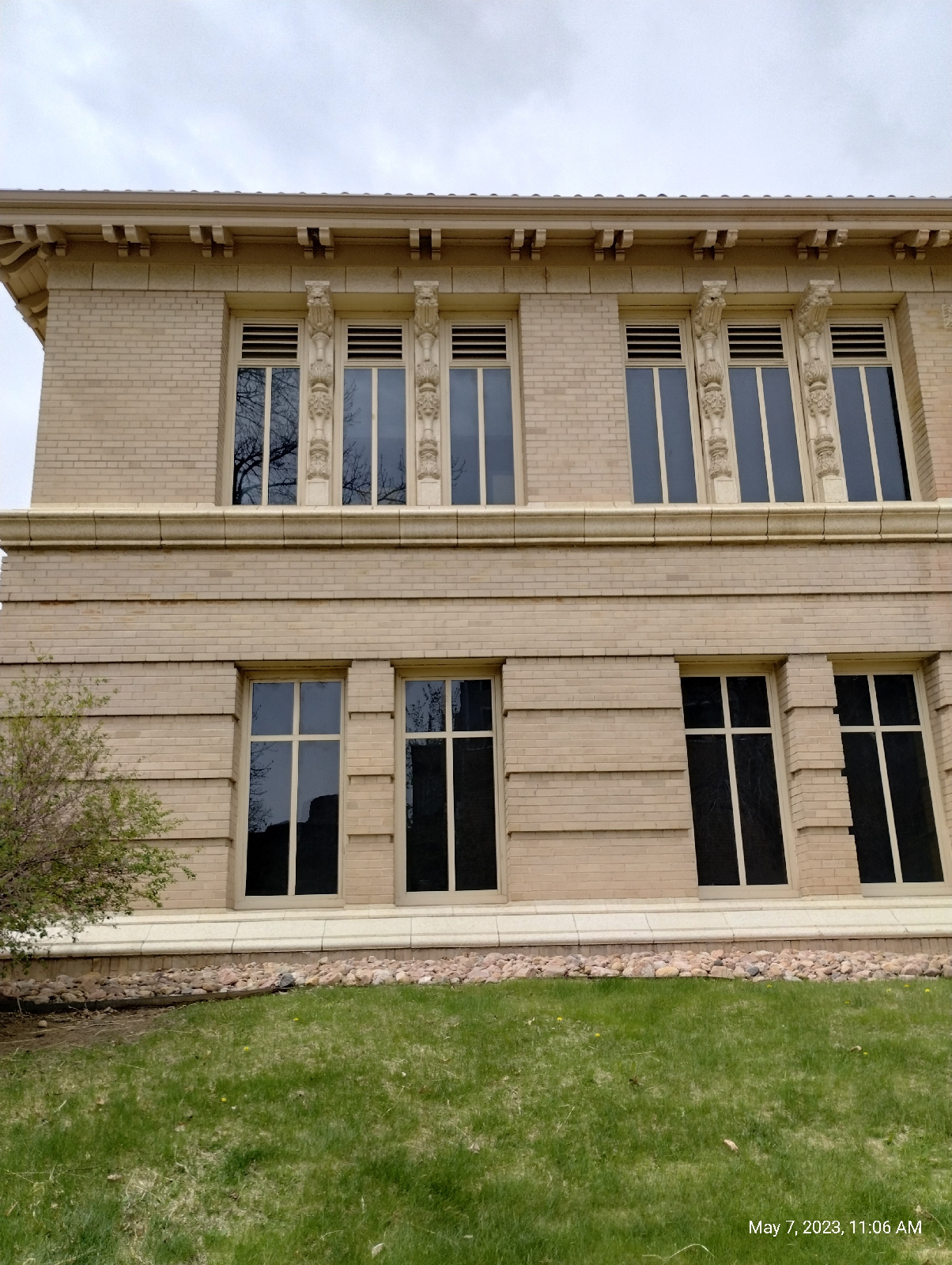
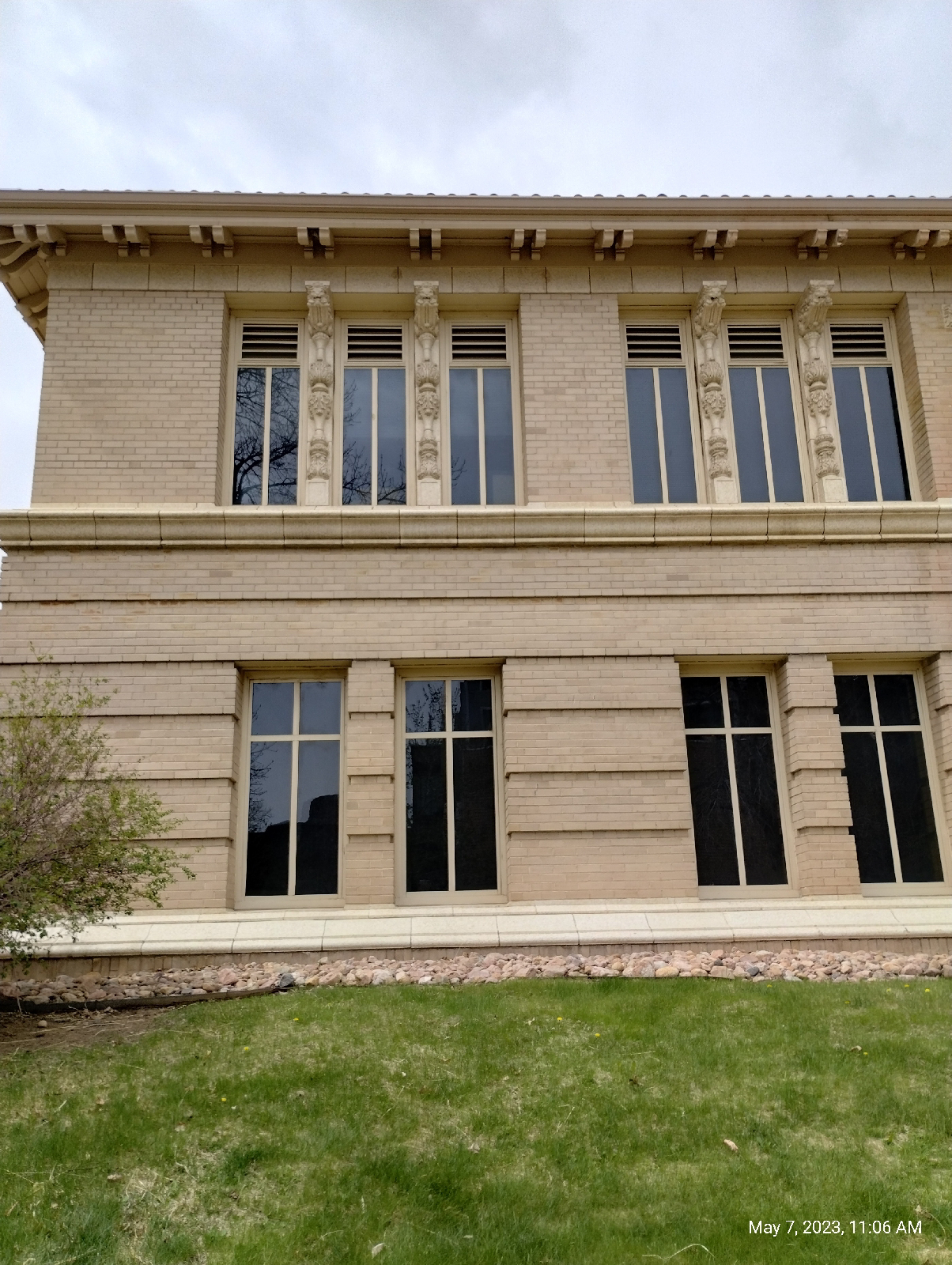
The architecture is always fun to look at. Check out the pilasters on this building.

The building across from the geology museum, the Steinhauer Field House, is especially ornamented.

It was a Sunday, so the museum was only open from 1:00 to 4:00 pm. I had plenty of time to wonder around Golden before then.

Just down the street from the museum, Clear Creek is already a respectable stream. Of course, Clear Creek, the same Clear Creek I visited on the G Line, is many of the reasons for Golden. Geographically, the stream provided the canyon that Golden resides in. It is also what drew prospectors to this part of the country (the name "Rolston" is as prominent here as in Arvada) and Golden in particular. I made it a point to collect some material from the stream bed to look at. And when big industries came to Golden, they crowded around to creek for water and the train lines that developed nearby. Clear Creek also provides for tourists by offering trails and water sports like fishing and kayaking.

The Golden History Museum, on both banks of Clear Creek in downtown Golden, provides glimpses into the early life of Golden including this preserved slice of Golden from the latter part of the 1800s.

Notice the sign on the fence warning visitors that the bee hives are real and stingy.

The museum is housed in a large building with many thousands of items, but the public display is in a single room. It's mostly a big (but breathtaking) mineral collection, but it does show a collection of antique instruments.

The minerals are from around the world (organized by region)...
Native gold

 Colorado...
Rhodochrosite

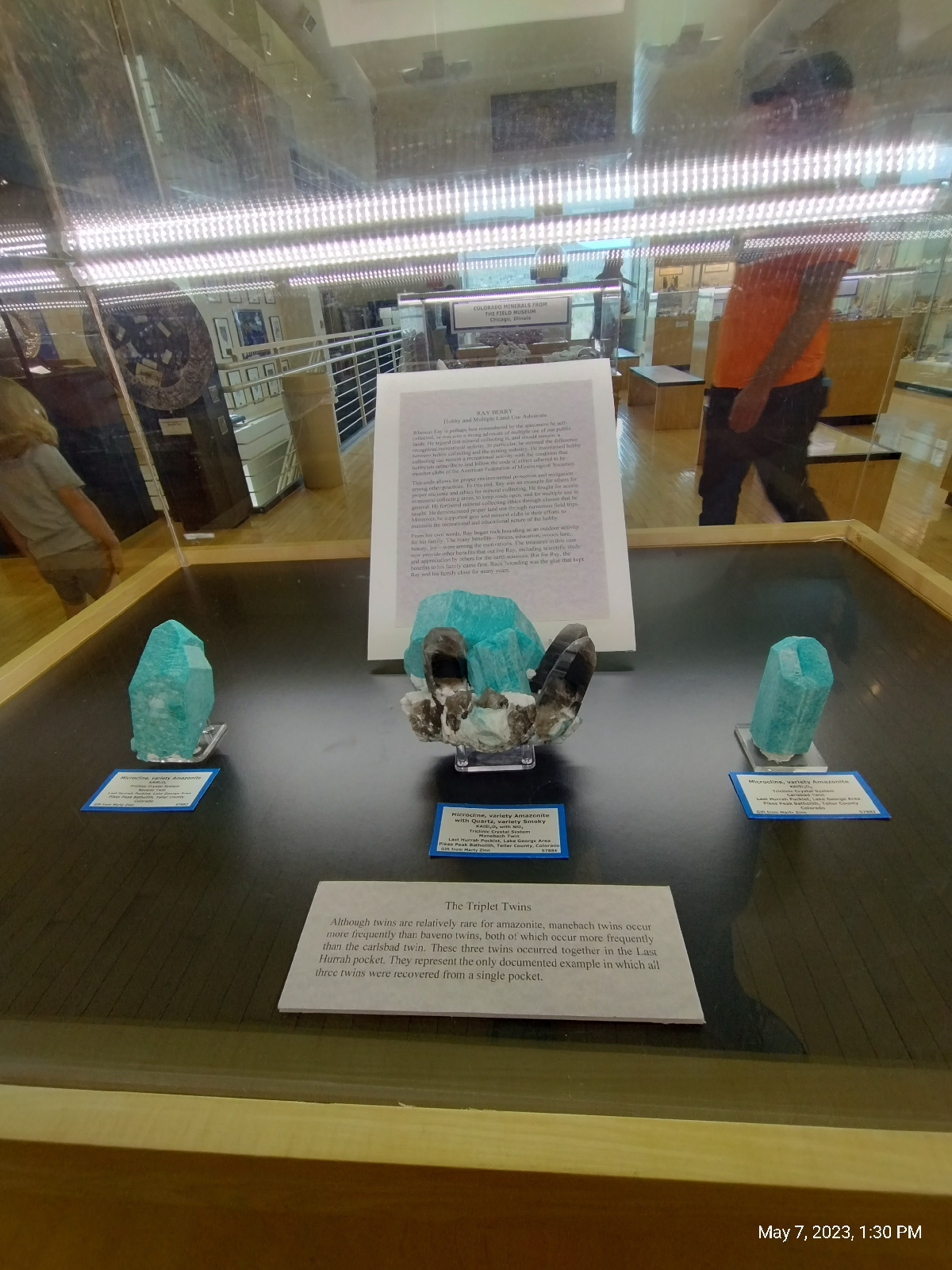
Amazonite

and, more to the point of this blog, Golden.
Zeolites from North Table Mountain.

Zeolites are moderately rare in nature but are so useful that they have been manufactured in a great variety. They're useful because the aluminum silicate molecules have an open ring structure that's called "microscopically porous." By adding other elements and changing the conditions under which the crystals form, the size of the spaces between atoms and the charges on the molecules can be custom made for different purposes. Microfilters and ion-exchange materials are often made of zeolites, but there are many other uses.

In nature, there are a handful of different zeolites. The above specimens were collected on the Table Mountain lava flows above Golden. These are huge compared to the typical specimen, such as the one below that I photographed on North Table Mountain.


There are three lava flows on North Table mountain and two on South Table Mountain. The zeolites occur in the second flow as a white filling in bubbles (called "vesicles") in the basalt. They form as alkaline ground water percolates through the basalt and precipitates dissolved materials into the bubbles.

 After drooling over the gorgeous specimens in the museum, I headed back to Clear Creek, and made my way to the flank of North Table Mountain, a grueling hike up steep residential streets.

View from North Table Mountain
Lookout Mountain to the right
South Table Mountain to the left
To the Rockies side
South Table Mountain (that's Castle Rock at right center)

My destination this time was the Golden Cliffs trailhead. The trail from there runs up from a parking area to and along the base of the top lava flow.

Golden Cliffs

Detail

The Golden Cliffs trailhead is a good choice for exploring the basalt cliffs of North Table Mountain. The West trailhead, on the other hand, provides a more gentle ramp up to the top. 

The photos from Boulder Canyon show a course, crystalline rich, granite. Basalt is not that. The difference is that granite and related rocks solidify from magma deep underground. They solidify slowly, allowing recognizable crystals to form from the melt. Basalt, on the other hand, solidifies from lava on the Earth's surface. It solidified quickly so that the molecules don't have time to organize into crystals. The microscopic particles tend to be amorphous like glass. But the chemical constitution of basalt is similar to the larger grained igneous rocks.

Basalt is an example of what's called an aphanitic rock, an igneous rock with a texture in which individual particles are not visible to unaided vision and are often not crystalline. Phanitic rocks, like granite, have easily distinguishable grains.

A few basalt outcrops get most of the attention. The famous ones are the Giant's Causeway in Scotland and the Devil's Tower (also known as Bear Butte) in Wyoming. But basalt outcrops are widely distributed. And, in North America, they're not exclusive to the west. The Palisades along the Hudson River are a good example.

The Table Mountain basalts have the same columnar appearance as the other major outcroppings (it makes them popular with rock climbers). Called "columnar jointing", it's just the way they break as they cool and shrink. You may have noticed that, when an expanse of mud dries out, the material tends to shrink and break up into polygonal shapes. The same thing happens to basalt as it solidifies.
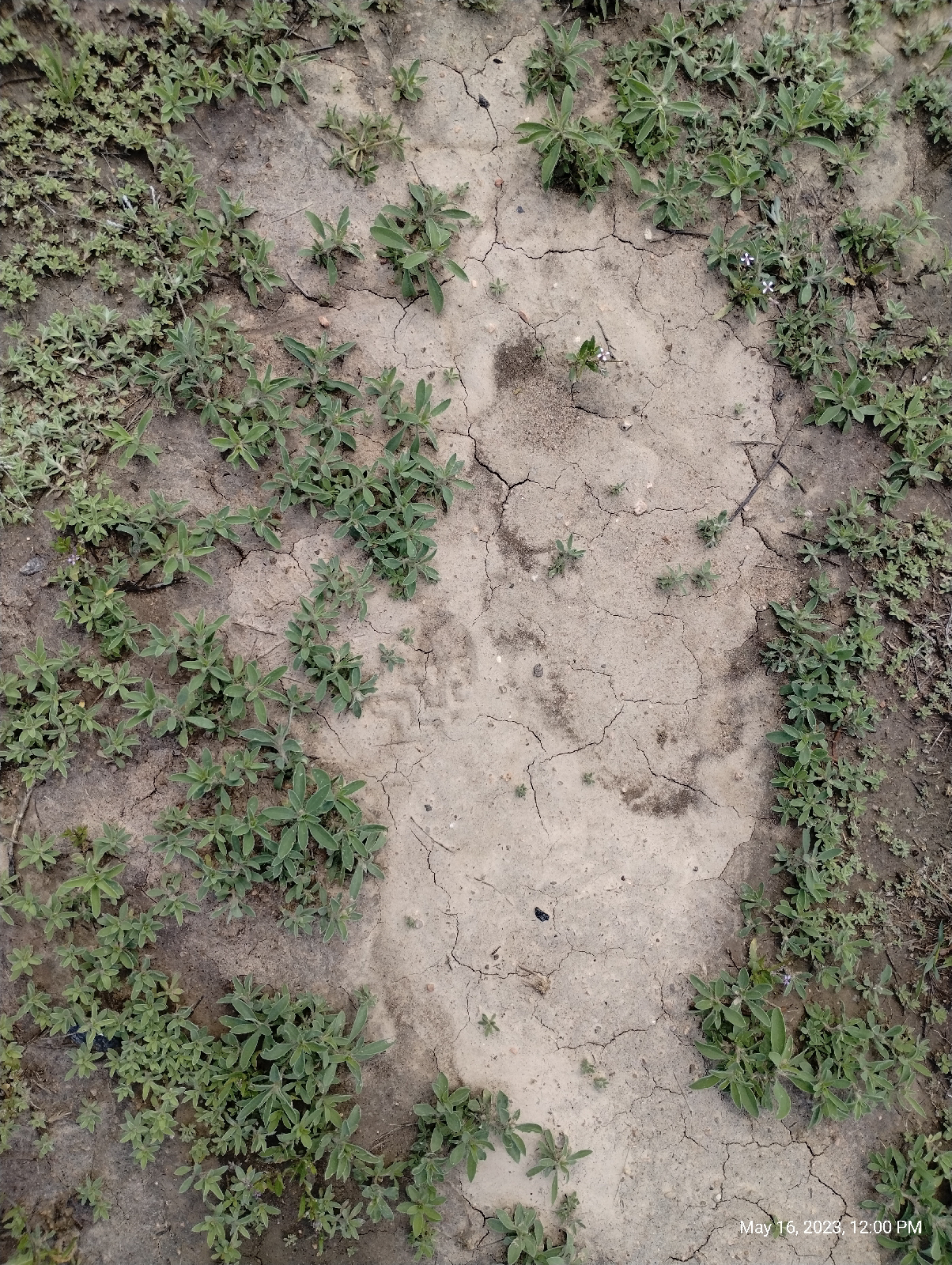
Mud on Little Dry Creek Trail

Lichen on basalt

The Table Mountains are also known as a conservation site for lichens. Golden Parks and Recreation ask that visitors stay to the trails to protect these delicate symbiotic organisms, but, of course, some hikers won't, so there are areas of the mesa that are off limits.

Normally, algae and cyanobacteria can't survive in dry climates. They prefer hanging out on rocks in ponds, but in lichen, they have solved the problem. Lichen is actually two organisms in one. The fungus protects its companion organisms from the arid environment while it obtains nutrients from them. And they have an important place in their environment by being food for both large (for example, reindeer) and small (springtails).

There is a lot packed into the narrow valley between the Table Mountains. A lot of it is the Coors brewery and associated industries but there's also Rocky Mountain Metal Containers, the Colorado Railroad Museum, Colorado highway 58 and West 44th Avenue, and, of course, Clear Creek. Clear Creek, after all, is the reason the gap is there.

The volcano and lava flows are 62 to 64 million years old. Geologically, that's not very old, but they've been around long enough to have been deeply buried by sediments from the Rocky Mountains. Clear Creek, then a powerful river, flowed straight across those sediments and, when it got down to the lava, it kept right on cutting until it cut through all three flows. It's not nearly as big now, but it's still flowing out of the Mountains, through Golden, between the Table Mountains and through Arvada, to join the South Platte River North of Denver.

By the way, Clear Creek is weird in that one of it's tributaries is a river, Fall River. And, of course, Clear Creek was the site of the first gold strike in Colorado and the reason that people started flocking to the future Denver.

After exploring the flank of North Table Mountain, I returned home, thankfully by train with most of the walking downhill.

Now, the sample of sand I collected from the bed of Clear Creek in Golden...

I wasn't really looking for gold, although people do pan for gold on Clear Creek. They might even find some!

My father and I panned for gold in North Georgia for fun. One of our main pieces of equipment was an eye dropper, which we used to suck up the tiny specks of gold we found in creek sand. Those are called, by the initiated, "color" or, more often, "dust".

The Bible is often quoted to say, "gold is where they find it." That's a mistranslation for two reasons. The passage is Job 28:1, "Surely, there is a vein for the silver, and a place for gold where they fine it."(King James version) The second error is that the word is "fine", not "find".

In other words, don't expect to find gold where you're looking for it. You'll find it where it's fined (that is, refined).

Gold is found here...
(in the museum), or here...
(on your electroplated flatware.)

No, I was just sifting through the sand to see what Clear Creek was washing out of the mountains, and I was not disappointed with that, either. It was exactly what I expected.

First, I spread out the sand on a Petri dish and eyeballed it. The grains graded from course chunks of rock around a couple of millimeters to very fine dust. There were some sparkly bits but they turned out to be mica.

Next, I shined and ultraviolet light on the sample and was surprised to see that it actually fluoresced pink! I didn't expect that and I don't know if it was caused by some pollutant or it there is something in the rocks west of town.
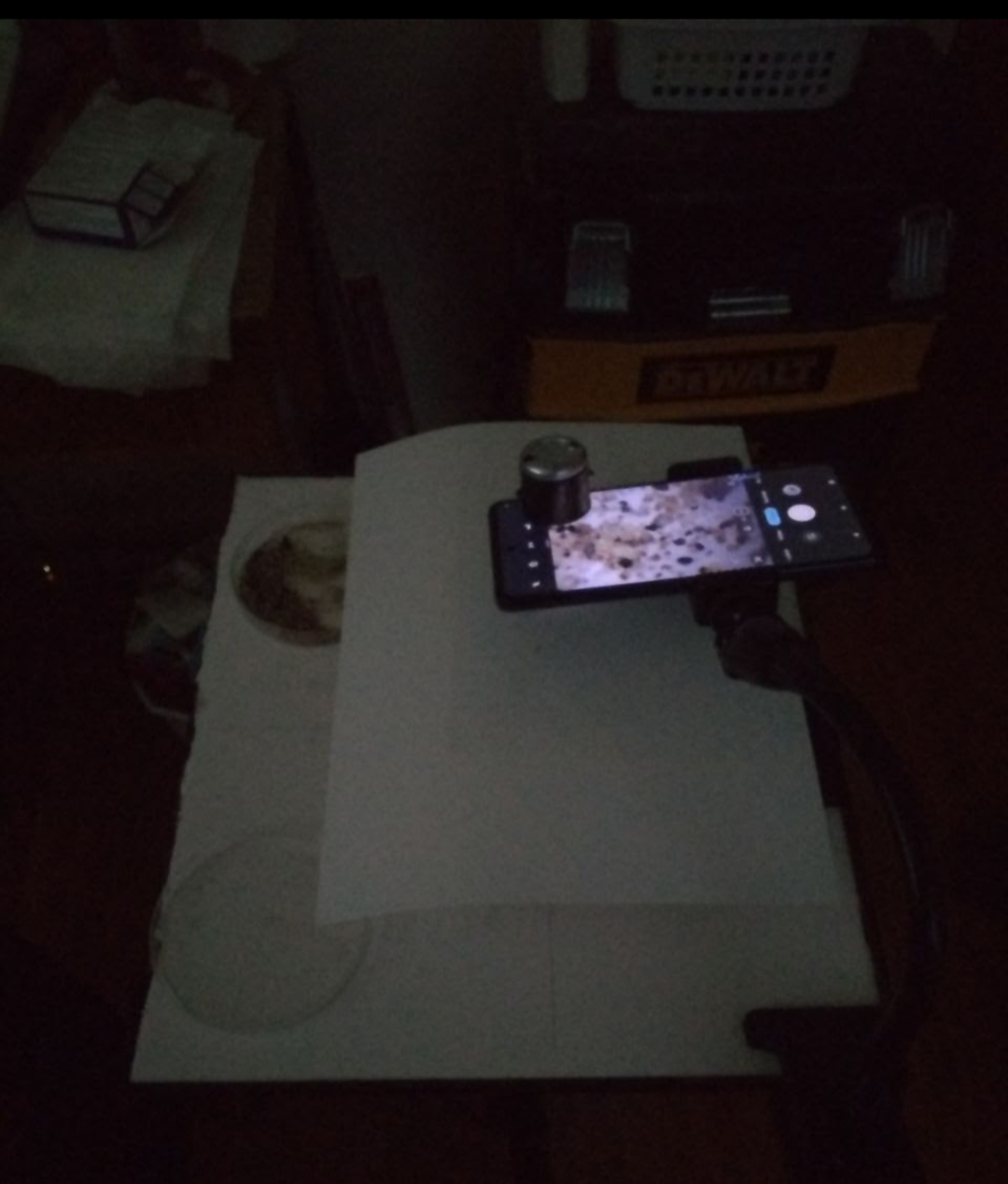
Finally, I used my smartphone microscope...
to look at the sample. 

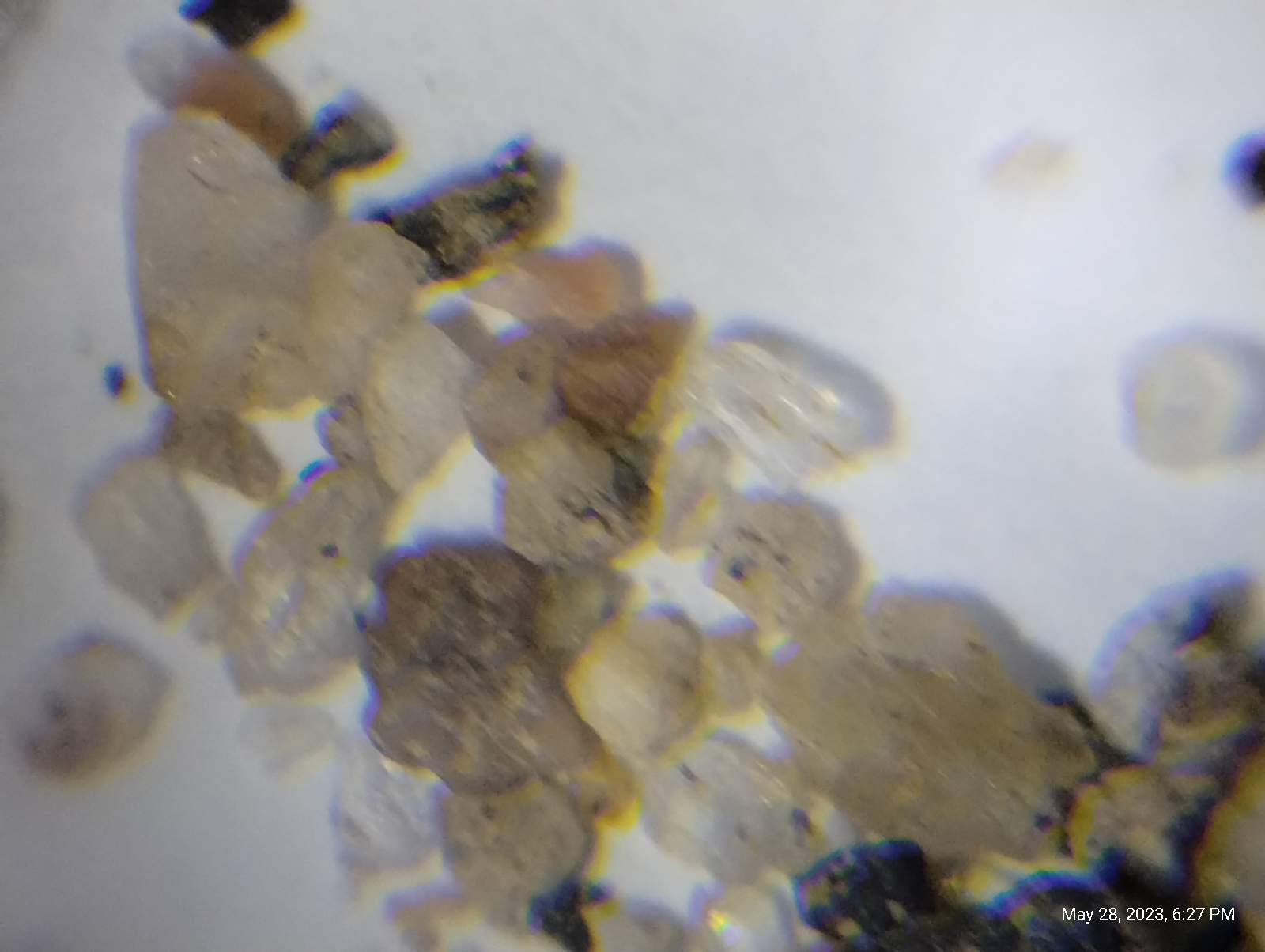
Most of the sand was obviously washed out of the igneous and metamorphic rocks west of the Golden fault.

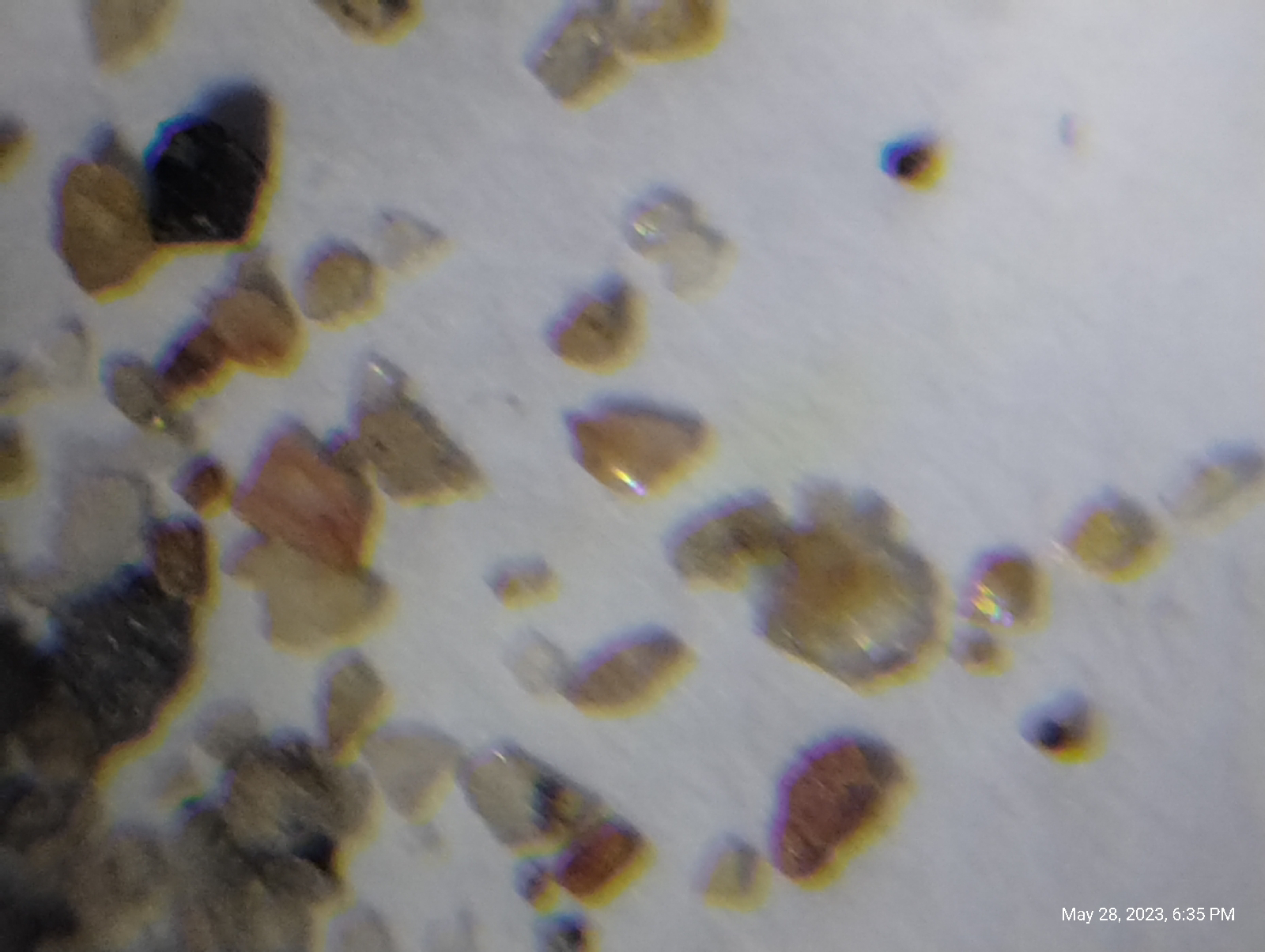
The chunkier stuff is granite. 
Of the individual particles, the clear grains are quartz, the cloudy white or red grains are feldspar (when I caught the light just right, they would shine like moonstone), the flat clear flakes are mica, and the black crystals are mostly hornblende. These are the fundamental rock building minerals of igneous rock. Two others are amphiboles, also dark minerals related to the hornblende, and olivine, which is a constituent in many basaltic rocks.

Here are some more photomicrographs.

Mind you, don't pass up the pleasure of looking at sand under a microscope. As a teenager, I walked down to the creek at the bottom of the hill below my house and collected some sand. When I shined an ultraviolet light on it, some of the grains glowed a brilliant orange. Under the microscope, those grains were tiny octagons of thorite. I also saw zircons and tourmaline crystals.

I'll be revisiting North Table Mountain soon. Stay tuned.

Are there any ancient lava flows near you? Check out the Wikipedia article "List of places with columnar jointed volcanics" for hints.

Pull out a microscope and look at some samples of stream sand from streams near you. What kind of materials do you see? If you have a black light, do they fluoresce? Where did the sand come from - what kind of rock produced it?

Saturday, May 6, 2023

Prepping

I'm not a geologist. I'm a rehabilitation specialist trained in human physiology and social psychology. These blogs are a learning experience for me that I enjoy sharing with you. I hope it doesn't stop there. I hope you go out and explore your own areas.

I don't rely on my own observations and knowledge. I go through a preparation process before an adventure, carry guides with me, and go back over my references and notes before writing a blog.

Along with general geology texts, I currently use two guide books to tell me what I see on these geology hikes:

Roadside Geology of Colorado was written by Felicie Williams and Halka Chronic and the third edition was published in 2015 by Mountain Press Publishing Company. It's a geological driving tour guide for the whole state of Colorado.

Geology Underfoot Along Colorado's Front Range by Lon Abbott and Terri Cook covers a much smaller region in more detail, mostly the areas west of what's known as the Front Range Metropolitan Corridor from Fort Collins to Colorado Springs. It was published in 2012, again by Mountain Press Publishing Company in Missoula, Montana.

Both of these books are parts of series so, especially if you live in North America, you may be able to find one about your area. In other parts of the world, there may be publications about your neighborhood.

I also do an Internet search of "geology of..." the place I'm about to visit and study the topographic and geologic maps. My Rockd and All trails apps are a great help to give me an overview of what to expect.

I've been gathering supplies (including trail mix) this week in preparation for tomorrow's foot tour of the Golden area. I'll pack my geology kit (see the blog for Friday, February 25, 2022, Expedition: Dry Run for a description of the geology kit.) tonight and get to bed early so I can get up in time for my morning chores and to let my pills take effect.

I've really been looking forward to this one. Golden, Colorado is packed with geological and paleontological points of interest but the big draw is the ancient volcano that spewed out the lava flows that cap Golden's Table Mountains.

After I recover from the hike, I'll use the Blogger app to put together the photographs with narrative about my experiences (I'll re-refer to the books to make sure I have the details right and then I'll see you again in the funny papers (well, on the Internet, same Wolf page...same Wolf channel)).

Tuesday, April 26, 2022

Another GPS check

I was missing one activity for the first excursion I'm working on for the Geology LabBook so I decided to knock it out on a recent visit to Littleton, Colorado. It was actually in the opposite direction but was near the bus terminal for the route 66 to Littleton so I figured I would take the full tour and see where the bus went, so I hiked up to the Arapahoe at Village Center light rail station to cross I-25 for a short walk to the nearby NGS survey marker.

If you want to know where you are, a survey marker is your best reference. That's, in fact, what it's there for (for more details on survey markers, see the blog for February 8, 2021, Survey Quest). All I needed was to lay my smartphone on the plaque and use the GPS tool of my Physics Toolbox Suite to get my bearings. Here's a copy of my results.

Going to the National Geodetic Survey website, I collected the data for this survey marker.

https://geodesy.noaa.gov/NGSDataExplorer/

39° 36' 25.29718"(N) 104° 53' 29.26822"(W) 
Ellip Ht. 1730.432 (meters) 6/27/12 adjusted
Epoch 2010.00
Ortho Ht. 1747.6 (meters) 5634 (feet) GPS OBS

In the US the National Geodetic Survey uses the best data available from multiple precision survey methods to determine geographic measures for sites across the country (many other countries have similar services). If you want to see how they came up with data at a particular site, the url listed above will tell you.

On April 18th, 2022 at 12:34 PM (according to the time stamp on the screenshot shown above) my smartphone accessed the transmissions from 22 satellites to triangulate (I guess with 22 satellites that would be eikosiduolate) my global coordinates and elevation. It was off by 0.14398 seconds of latitude to the south, 0.01582 seconds of longitude to the east, 5.432 meters too low in elevation. According to the program I wrote that calculates the distance between two global coordinates, my GPS was  off by 0.08 meters. 

I know...at one place I say the error is 8 centimeters and at another, 3.22 meters. Which is it?

Remember, I hiked up to the survey marker for a standard reference for local measures of position and altitude. My assumption that the survey data is exact is faulty. All measurements have error, but I feel justified in thinking that the error in the survey data is negligible. And my app being only 8 cm off makes me really happy. Of course, on another day, it might be 3 meters too high or 2 meters too low. How do I know?

The app said so. When it says the error is ±3.22 meters, it means that the true value might be anywhere within 3.22 meters to either side of the reported value.  The reported global coordinates may be as far as 3.22 meters away from the survey marker. 8 cm is well inside that area. Actually, 3.22 meters is pretty good for satellites 20,000 kilometers away.

3.22 meters is the result of the app taking several.measures and calculating the spread.

It was a nice day. I strolled back to the bus terminal and boarded 66 for Littleton. It's a pretty little town with interesting little shops like the Savory Spice Shop, which had a spectacular smoked black pepper mix, and Penzey's Spices, where I found a  Bird's Eye pepper I had been looking for. And Zoey's Place pet market had a cow ear for Vincent.

Then I caught bus 66 back up the hill (Littleton is on the river) to home.

Thursday, December 20, 2018


--- Terminus: Golden ---

I took the first E Line from University Station after 8:00 am, transferred to the W Line at Auraria West Station and pulled into Golden Station at 9:45.

                                                                  [Golden Station]

The W Line ends just at the eastern outskirts of Golden at Jeffco (Jefferson County) Government Center. There is a pedestrian bridge over Highway 6 to what looks like apartments and some shops called "Golden Ridge". My destination is the Chimney Gulch Trailhead, which I know to be about two miles west on the south side of the highway, but there is no pavement, so I stayed on the north side and took the 6th Avenue Trail into Golden.

The Jeffco Government Center is an impressive structure with a high central rotunda and grounds that are landscaped into gardens.

                                                       [Jeffco Government Center]

I didn't know how long my hike would take - it proved to be demanding - so I skipped the sightseeing and determined to turn around at 2:00 pm regardless of where I was. I didn't want to be struck on the mountain trail after dark. I will return to Golden when I start back the station-to-station hikes and this building will certainly be one stop.

The walk down through Golden is through parks including one devoted to geology and paleontology - Triceratops Trail - and I see several signs to museums and other points of interest. I'm sure I'll be coming back.

                                                               [6th Avenue Trail]

The North and South Table Mountains are fossil volcanoes that display vertical bluffs of basalt around their rims. (Correction: these mountains are not the actual volcano, but are lava flows that poured from the volcano.)

                                                             [Table Mountains]

                                                          [Triceratops Trail Plaque]

Golden advertises that it's "Where the West Lives" and here's the cowboy and horses to prove it. I did notice a rodeo grounds as the train neared Golden.

I'm not sure what that means, though. There are "Old West" looking buildings aplenty and I'm sure a goodly proportion of the museums are about the Old West, but the people seem pretty modern to me.

I was impressed with how friendly and outgoing the folks in Golden were.

                                                                         [Checkmate]

The statue is called "Checkmate"  and is located in a small park situated on a bridge where 19th Street crosses 6th Avenue.

The iconic "M" on the side of Mount Zion overlooking Golden - a friend once told me that it was where Buffalo Bill Cody was buried. He was wrong. I've also read that it stands for "Mountain" and is there to show Texans what a mountain looks like. Actually, it stands for "Mines' as in "School of Mines' which is a university located in Golden. In 2017, the School of Mines ranks 82nd in the U.S. News and World Report "Best National Universities" and was ranked by QS World University rankings as the top institution in the world for mineral and mining engineering. This school has recently turned it's sites on space as a "final frontier" for natural resources.

                                                                       [The M]

The parking area for the Chimney Gulch Trailhead is on the south side of Highway 6 across from Harry D. Campbell Field. Not knowing about the small culvert cum pedestrian underpass where the intermittent creek that runs down Chimney Gulch passes under Highway 6, I trotted across the busy road, and spent several minutes trying to find the trail. (The underpass is along the small creek on the western side of the sports field.)

                                             [Lookout Mountain from the parking area]

                                          [Highway 6 along the flank of Mount Zion]

I was surprised to see this chunk of rose quartz on the trail. It was much rosier than it looks in the photograph. I left it where it was.


The environment along the lower part of the trail is foothills with grasses and straggly brush and many of the wildlife that I see around Mount Carbon. I didn't see deer but I spotted plenty of droppings.

                                                        [Trail at about 5935 feet]

This trail is described as "difficult" and I would agree but not for any lack of maintenance. The trail is well kept. The difficulty has to do with it's steepness and. perhaps, traffic, although I chose to hike it early on a weekday and did not encounter much mountain bike traffic until later in the afternoon, and even then it was not bad.

All the hikers and biker were friendly, outgoing, and polite. I met three joggers headed up the trail ("Up" - I want to emphasize that word.) I was tired after the two mile hike from the railway station down to the trailhead. Jogging was not even in my range of possibilities.

                                                            [Chimney Gulch Trail]

That's the Coors Brewery to the right.

Chimney Gulch actually is a gulch (in contrast to Harvard Gulch, for instance). It is, in fact, a V-shaped valley with steep walls. It was named for it's appearance after a forest fire ran through it.

                                                                          [Magpie]

I have a hard time getting photos of birds. They will sit there until I get my finger on the "shutter release" button and will fly away. I asked this fellow if he minded if I took his picture and he sat there for a shot. I, of course, thanked him, and paid him $20 (just joking about the $20).

The trail crossed a dirt drive in one of the neighborhoods on the flank of Lookout Mountain and, at that altitude, Denver was in clear view.

                                                                 [Denver skyline]

                                                                        [Broader view]

Golden is in a broad valley between Lookout Mountain, Mount Zion, and Galbraith Mountains to the south and the two Table Mountains to the north. The main stream is Clear Creek so I'm guessing that it's the culprit. It probably gets pretty uppity during the spring.

Further up the gulch, and not very far, there was still ice in the creeks and across the trail.

                                                                  [Bridge with ice]

                                                                 [Ice and snow]

After a while, I crossed from the straggly plains environs into pinyon and Ponderosa pine forests and, here, I noticed that I was looking down on the tops of those two ancient volcanoes.

                                                                 [Table Mountain]

Unaccountably, my pictures of Windy Saddle didn't take. Maybe my phone froze.  I did get this picture of an engine cylinder head at the top on Lookout Mountain Trail. (?)

                                                                  [Cylinder Head]

A saddle is a ridge between two mountains that divide two deep valleys. In mathematical terms, it's a hyperbolic paraboloid (I'm getting into mathematics next year so I had to throw that in.) This particular saddle is evidently a natural wind tunnel since winds blow there constantly at considerable velocity. The temperature dropped from 62.7 degrees Fahrenheit to 46.9, and I had to put my coat back on.

The forests turned to true montaine habitats and, suddenly, I was unmistakeably in the Rockies. There were lots of tiny finches and they would have nothing to do with my photography. They played "squirrel", staying just on the opposite sides of trees.

I considered continuing to the top of Lookout Mountain but, at 1:30 I thought that if I made it, I would want to look around and rest and I wouldn't be able to do much before 2:00, so I turned around and headed back down.

Did I mention that Golden is in a valley. Once I reached Highway 6 I still had two miles uphill to walk to the train station. The train was waiting for me. I sat down and sent my family a message: "I'm on the train. It's not moving. I don't care."

I don't know how high I hiked. I've seen estimates from 1000 feet to two thousand feet. I measured it at 1430 feet but my phone doesn't have an onboard barometer so the altimeter readings are less accurate. The contours on the Google topographic map places the trailhead at about 5800' and Windy Saddle at about 6900' giving an altitude gain of about 1100'. The summit of Lookout Mountain is at 7377', so, according to that, I ended up somewhere between 1100' and 1577' above the trailhead. 1430' sounds about right.

I've read that you can see seven states from Lookout Mountain....wait, that's the one in Tennessee. I've been there, too. If you're in the South, it's worth visiting. It has the only river that runs it's entire course on top of a mountain. That's what the ads say. It also has one of several deepest gorges east of the Mississippi River. And it's where Neil Gaiman set his final climactic confrontation  in American Gods.

There are two Lookout Mountains in California, one in Idaho, one in New Jersey, one in Oklahoma (there's a mountain in Oklahoma?), three in Oregon, and a Lookout Summit in Washington State. There are probably others. You should check out the one nearest you.

I didn't get to check out the eating places in Golden. I will certainly come back to that in the future.

There's a lot you can't see and experience unless you go there on your feet but a hike like this requires planning and a good constitution. Study the area before you go. What is the weather like? The difference of about a tenth of a mile on the Chimney Gulch trail dropped the temperature 15.8 degrees with a sudden wind that would suck the heat right out of you. Carry snacks and don't forget the water. Dehydration is a serious condition on a trail where there is no phone or Internet coverage. Watch your pace and don't overdo it.

Addendum...My cousin from Georgia and her husband visited me Monday, May 2, 2022 and we drove up Lookout Mountain. It was cloudy but I got a decent shot of Windy Saddle.