Showing posts with label Civic Center Park. Show all posts

Friday, March 8, 2019


--- The courts ---

There is a fractility in the United States government. What I mean by "fractility" (and I will be talking much more about that as time goes on, because it is one of the characteristics of complexity) is that patterns on one level are repeated on other levels. This patterning allows a balance of powers, the pattern is three-fold and the three parts are set against each other (if things work right). Any one of the three parts can stymie either of the other two parts if it really wants to. The founders of American government quite consciously and intentionally crippled the government.

Why? Because they didn't trust government.

We had had quite enough of government control in the form of the English monarchy. But the founders realized that we had to have some form - some degree - of government - sort of a "can't live with it and can't live without it" attitude.

So we have three parts of federal government and that three-fold pattern is repeated at the state level, and the county level, and the city level, and often at levels between and possibly at the neighborhood level and in organizations.

Executive - legislative - judicial. Those are the three branches of government in the United States. The legislative branch makes the laws, the executive executes them, and the judicial interprets them.

If you want to see an instance that breaks the three-fold pattern, check out Louisiana.

I visited the site of the headquarters of the first two branches of government in Colorado in January. It's the capitol. Both the governor, the head of the executive branch, and the legislative branch are housed there. The other branch is more complicated and is scattered around all over the city and, indeed, across the state. But the highest level of the judicial branch is located just across Civic Center Park from the Capitol in the Ralph L. Carr Colorado Judicial Center located at 2 E. 14th Avenue, Denver, Colorado near Broadway. This is the highest court of appeals in the state of Colorado. If you have a problem that you need to carry to court, you start at the bottom and if you don't like the result and you can convince a higher court that the lower court made a mistake, you get to move up the chain. The Supreme Court housed in the Ralph L. Carr Building is the end of the line - the highest state court. From there, if it's actually a federal issue, you might be able to jump to the federal supreme court in Washington, D.C., but that's a little far for me to walk so, on the 26th of February, I visited the Ralph L. Carr Building, and monumental structure, more modern, but, in many ways, just as spectacular as the Capitol across the street.

I took the light rail from University Station to the Convention Center Station and walked down the 16th Street Mall to Civic Center Park around which much of Colorado government takes place. I guess I could have taken the Mall Flier Bus the few blocks down to Lincoln or Broadway, I enjoy the walk through downtown.

Walking around the perimeter of Civic Center Park carried me by the monumental City and County Government Building that encloses the park, with the Capitol like a set of parentheses. The curve of the facade and the ornate columns match the classical style of many of the other buildings around the park.


                                                                      [City Hall]

The Denver Public Library is just to the east of the Ralph Carr building with its disparate jumble of sections looking much like a modernized castle. To the south are the art museum and History Colorado museum. You could spend a couple of days just looking around this area.


                                                           [Denver Public Library]

The Ralph L. Carr Building as a modern counterpart to the stately classical style building around it. There are columns and a rotunda but the columns are square and the rotunda is glass.


                                                            [Ralph L. Carr Building]

If you've followed me in this blog, you've heard of Ralph Carr. His statue is at Sakura Square to commemorate the governor who bucked public opinion to speak out against the treatment of Japanese Americans during and after World War II.

The interior is beautifully adorned with modernist murals and the floor of the rotunda is decorated with a stylistic columbine blossom.

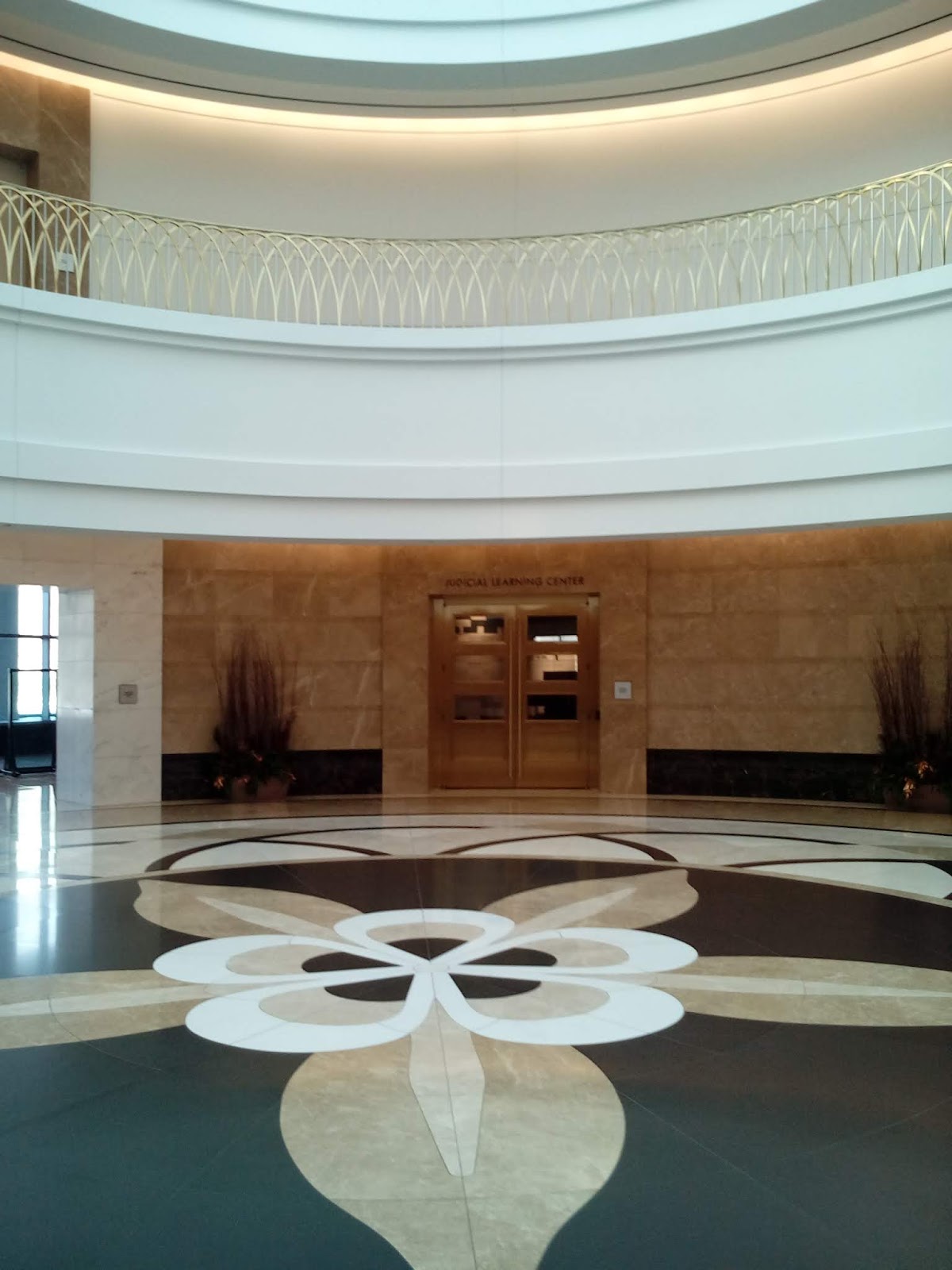


                                                    [Interior of the Ralph Carr Building]

The learning center is just off the main lobby on the first floor. Although photographs would not convey much about the room, if you want to know about the legal process in the United States and Colorado, visit it. This is your complete and fun education of the judicial system. Interactive exhibits let you experience the parts of judges and lawyers. The history of the courts is laid out on columns. And, if that's not enough, plan your visit so you can sit in on a deliberation of the court.

The website is here:

https://www.courts.state.co.us

And, like legislative sessions, you can find recordings of supreme court deliberations on the website.

                                                                       [Pigeons]

In the United States, it's too strong to say that you are controlled by your government (still, if you don't understand how the government works, there's a good chance that you are controlled), but you are regulated. That's not necessarily a bad thing, but does it really make sense to be regulated and not know how you're regulated? In the United States, the courts, legislature and executive branch are transparent. If you want to know how they work, you have every opportunity to do so. If the wool is being pulled over your eyes (so to speak) it's because someone walked up to you and said, "This is wool. I'm going to put it over your eyes and while you can't see, I'm going to do things....you might not like it." Sooooo.....one of the things that every citizen of a country should make it a point to know is how their country works.

A visit to your country's, state's, county's, city's seat of government is fascinating and fun and what you learn there might or might not change your life, but it will certainly help you avoid wool.




Monday, October 29, 2018


--- Pride of Place: Denver's History of Public Art ---

It's interesting to see how much of the forces that drove New Haven's public art movement (described in Melissa Sand's section of Pride of Place: New Haven Material and Visual Culture - Discovering New Haven's History of Public Art. http://teachersinstitute.yale.edu/curriculum/units/2008/3 accessed 10/15/2018)  also drove Denver's. Of course, from the first (which is much more recent than New Haven's "first", Denver worked hard for recognition as a cultural center, but the early steps were rather amateurish.

What really jump started the public arts movement (in the whole United States) was the New Deal Public Works of Art Project (PWAP) of the 1930s. This brought such works as the two Gladys Caldwell Fisher sculptures at the Byron White courthouse, Rocky Mountain Sheep and White Ram, and the Hugh Weller East High School murals.

The Federal Art Project of the 30s and 40s provided further impetus that continues to the current day. Much of the art in Denver was funded through these government programs. Denver's Public Art Program was established in 1988. It directs that one percent of any capital improvement project costing over one million dollars must be set aside for public art to be included in these projects.

Public art intersects intensively with both culture, politics, and history. I attended a presentation on the history of southwestern Denver and a topic that was brought up was the survival of neon sign art from the 50s.


                                                            [Voorhies memorial]

The Voorhies Memorial was placed in the northern section of Denver's Civic Center Park in 1919. Funded by John Voorhies, it was to be a memorial gateway. The ensemble includes the Greek Theater and Colonnade of Civic Benefactors. Water features and ancient-style murals break the powerful architecture. The colonnade was designed by William E. Fisher and Arthur A. Fisher, and the Greek Theater was designed by Willis A. Marean and Albert J. Norton. These architects were active in many of the early architectural projects in Denver including the Cheesman Park Pavilion, the Governor's Mansion, and the Brown Palace Hotel.

The memorial would fit quite well in the National Mall in Washington, D.C. The sheer size of solidity exudes pomp and power.

It is interesting that two different architectural firms came together to create such a unity of form, a testament to early Denver's vision of a cultural center for the West. I keep saying "early Denver" but keep in mind that Denver itself is a recent city when compared to the centuries older cities of the east and much more ancient cities of the rest of the world.

The creation captures a classical style while addressing local topics, such as the murals, "The Trapper" and "The Prospector" in the Greek Theater, modernistic works that, nevertheless, fit well into the feeling of ancient splendor. They do point to the idea that the triumphant sentiment reflects the conquest of nature - the West - instead of a conquest of nations, a sentiment that would have been appreciated at the turn of the century at the beginning of World War I (1914).

The animal heads in the photographs are a recent exhibition based on the Chinese Zodiac.


                                                                   [Mural - Alameda]

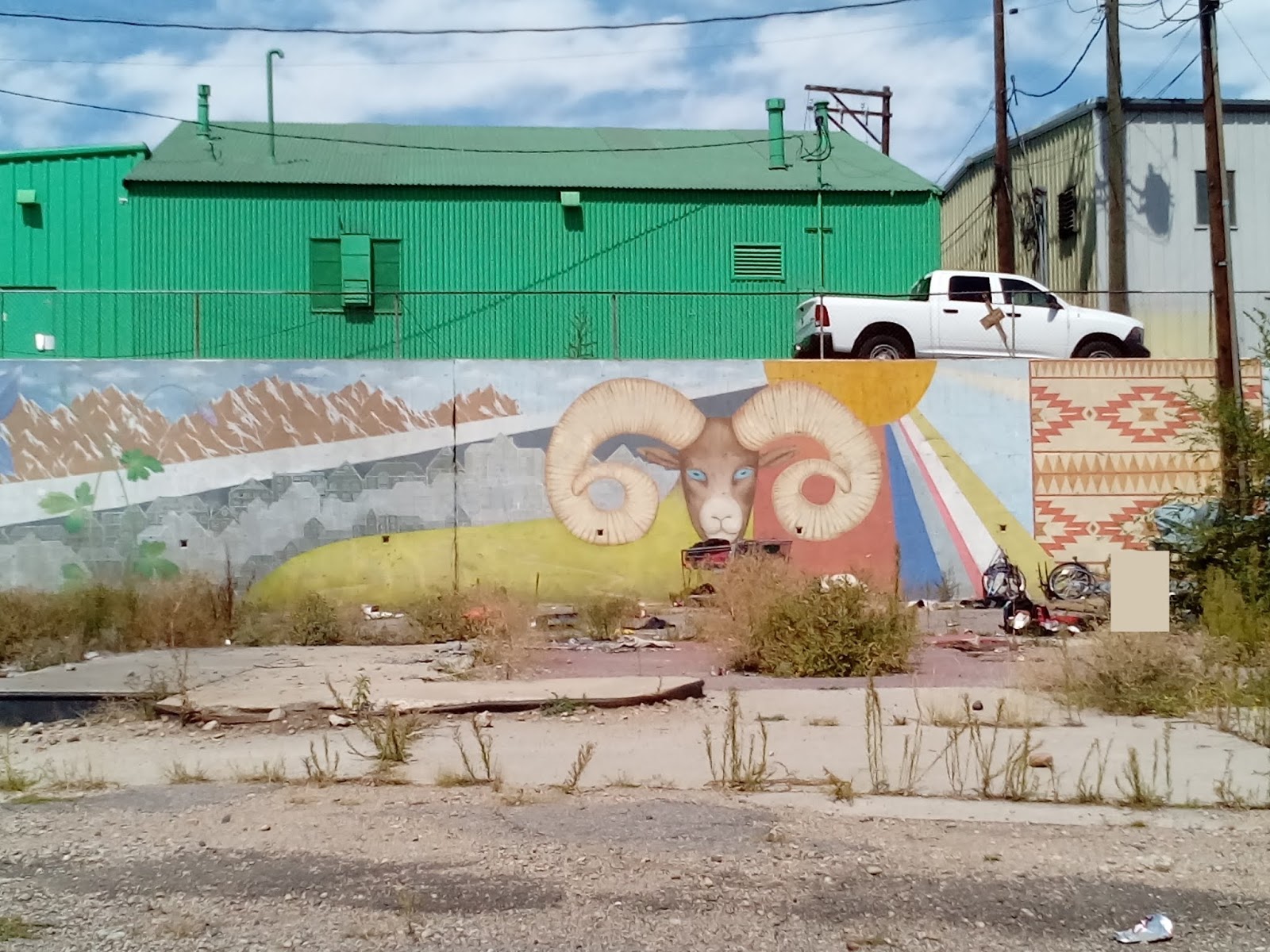
This mural, painted by Yulia Avgustinovich, is at the intersection of Santa F Drive and West Alameda Avenue. Called "Viva Colorado", it incorporates characteristically Coloradan elements including the state animal (bighorn sheep), bird (lark bunting), flower (columbine), cactus (claret cup) and insect (Colorado hairstreak butterfly), mountains, and a pioneer wagon. There is also a fish that I take to be a green cutthroat trout ( the Colorado state fish) and a blanket in Native American pattern. And above it all the trademark Colorado sun (I swear it's a different sun that what I was used to back east.)

There is a detailed description of the mural on the artist's website.

http://yulia-art.com/project/denver-mural-viva-colorado

The pale pastels give the mural a dreamlike quality and I can't help thinking about the writings of Carlos Castenada when I see that spooky looking, blue eyed bighorn. Of course, that might just be me - I've had a lot of spooky in my life. Certainly an artwork will draw drastically different associations from different people.

Obviously, this mural is blatantly about Colorado. One motivation the artist mentions in creating the work was to beautify a previously ugly wall.

The pioneers portrayed are not the usual "Old West" stock. One is, maybe, Spanish, playing a guitar, and the other strikes me as, perhaps German, blowing a horn. The small dog seems rather, unimpressed. The horse practically gambols. It all has an antique feel to it but there are modern cityscapes here also. Colorado - nature, history, culture - seems compressed into one here. The pioneers could be modern city dwellers.Anachronism can be used in artworks to tie the past with the present. Unlike (what seems to me) the electric, "edgy" (despite the picnickers) mural at Alameda station, this mural is endowed with an almost mystical peacefulness.

Most of these murals seem to be unaffected by political motives of patrons, and if Denver commissioned them and said, "paint what you want." In this busy intersection at Santa Fe, and Alameda, and Interstate 25, I must believe that the painter has attempted to give busy people a small does of peace.

                                                [Historical sculpture - Coming Home]

This grouping by Susan Grant Raymond consists of two draft horses lead by a man, with a child riding one of the horses and a colt trailing behind the team. The sculpture is visible from South Santa Fe Boulevard and South Prince Street as well as the Platte River Trail in Littleton. It represents a farmer and his son headed home at the end of a work day with their horses.

The bronze statues were created in 1987.

I sense the peace of the prairie in the fatigue of a days work. People like this settled the Platte River Valley. Southwestern Denver was farmlands until well into the 20th century.

The Littleton Fine Art Committee commissioned the piece from the artist who grew up in Littleton to add to the considerable collection begun in 1964.


                                                       [Modern artwork - big blue bear]

The big blue bear at the Denver Convention Center is the creation of Lawrence Argent, an associate professor of art and, later, professor emeritus at the University of Denver until his death in 2017. The actual name of the project is "I See What You Mean'. It is 40 feet tall and weighs around 10,000 pounds.

It is composed of fiberglass and, if you look closely, you can see that it's not furry. It is more...polyhedral. The blue color was an accident. Argent had originally intended to use the earth colors commonly seen around Denver but, due to an error in the copying process, the planning layout came out blue. Argent liked it, so blue it remained.

The bear is quite intentionally playful and funny, meant to get visitors into a lighthearted frame of mind.

The statue was installed in 2005 and has been well maintained. To emphasize the humorous aspect, there is a big coil that is sometimes brought out and placed under the bear between his feet. I guess if a bathroom tissue can make an ad campaign out of that old saw, Denver can, too. There has also been a ball and chain attached to the bear's leg.

The piece was inspired by a newspaper article that showed a bear looking into the house of a Colorado resident. Absolutely appropriate because there are bear statues all over Denver, the bear looks right at home.

It was  actually constructed in California before being shipped to Colorado, the project costing $424,400. It is a part of the Denver Office of Cultural Affairs Public Art Program. Reproduced in various sizes and photographed around the world, this is one of the most beloved art pieces to knock on Denver's windows.


                                                     [Stained glass at Evans Chapel]

Evans Memorial Chapel was completed in 1878 in downtown Denver by Governor John Evans, also founder of the University of Denver. It was built in memory of his daughter, Josephine, who had died of tuberculosis a decade earlier. In 1960, the building was moved to it's current position on the campus of the University of Denver.

It stands on the west side of the Harper Humanities water gardens. One of the reflecting ponds is at it's east wall. The High Victorian Gothic chapel is built of rough hewn stone and displays a collection of stained glass windows.

The large stained glass window in the eastern window depicts a scene from Ruth that personifies grief. The small inset at the bottom shows Naomi followed by her daughters-in-law after proclaiming, "call me bitterness".

The National Register of Historic Places Inventory Nomination Form for Evans Chapel is accessible here:

https://npgallery.nps.gov/NRHP/GetAsset/NRHP/74000567_text

and provides more historic information about the chapel.


[Architecture - Buchtel Memorial Tower, University of Denver]

The Buchtel Tower was built in 1917 as part of the Memorial Chapel Building that burned down in 1982. It was dedicated to the memory of alumni who died during World War I. It was named after Henry Buchtel, who was the university's chancellor from 1900 to 1924.

The space around the tower - an amphitheater and garden with stone features and metal lattices - is the Holocaust Memorial Social Action Site dedicated to the spirit of inclusion and respect.

Although the whole ensemble is located on busy Evans Avenue, it has a feeling of quietness and solemnity. The stone and metal projects a sense of age and strength, perhaps of commitment in the face of adversity and social resistance.

 In 2015, the tower was rededicated to honor current military veterans in the DU student body.

Holocaust is a part of the human psyche. Any of us could be victim or perpetrator. I doubt if we can ever rid ourselves of the hatred of that which is different from us, but the memorial underscores the need to always be vigilant. Historically humanity is a vicious and hateful creature, but humans are also rational animals capable of choosing different directions. We can be better.

You have artworks in your area that are relevant to the spirit of your community (I know you do!). What are they? Can you interpret them in the light of the history of your community and your current world? Do they engender any feelings or emotions in you?

Look up the history of a local artwork. Does anything surprise you about it? Did the creator's intent differ from your interpretations? Has the message of the artwork changed over time?