Wednesday, April 23, 2025

Cherry Creek: Lincoln Road to Hess Road

 The seasons, they are a changin'. I walked through my first cloud of midges of the year. Maybe there will be some wildflowers soon, but there's still room for another snow, even a deep snowfall.


The mouse conservation continues on the South side of Lincoln Road. I still haven't seen one (and probably won't since these little fellows are very shy and have a lot of grass to hide in) but I can at least read about them. (Expand the photo above and learn about the little mouse that jumps )


In these Southern segments, the flood plain is broad and allows Cherry Creek to spread out a lot. Here, it's a braided stream. Although it's not obvious in the photographs, in many places, the stream is higher than the surrounding flood plain because a platform of sediment has built up and the stream has cut channels into it.


Not only sediments, but remnants of culture travel on streams. I had to stare long and hard to figure this one out (I wasn't set up for wading). It was a plastic posey. Maybe there was a wedding somewhere upstream 

I used to look at junk in streams and just shake my head at the thoughtlessness of the humans in the area until I hosted a campout in northwestern Alabama. You can't walk 200 feet without encountering a waterfall in many places and this one area was dense with them.

One particular waterfall looked to be almost unknown. It was right by the road but effectively hidden in the landscape. The only reason I found it was that we were on foot and I heard it. It was a big three tiered fall and the several times we camped there, we ended up cleaning junk out of the lower splash pool.

It occurred to me that the laundry detergent bottles and other assorted garbage must have come from far upstream. It's not the kind of stuff people usually leave at a picnic site.


The weather is warming up and algae is beginning to grow in quieter areas of the streams. 

When I was in high school, living things were divided into two Kingdoms: Plantae and Animalia. There were weird things like fungi, algae, bacteria, and some very primitive extremophiles that were.......problems, but, for instance, bacteria were grouped with plants because they generally had a tough cell wall. Protozoa were usually more pliable and had phospholipid cell walls like animals, so.....animals 

Since then, the division has broken living things up into five or six Kingdoms. The algae have maintained their position in the plant kingdom. The ones shown above are colonies of single celled individuals that stay put except when they're moved by water currents. Others have flagellum or cilium that help them move around. They're all eukaryotes, having well defined cell nuclei containing genetic material. The cyanobacterium, also photosynthetic, single celled, colonial beings are prokaryotes (no nucleus, the DNA is scattered through the cytoplasm) so they're usually not classified as algae or plants.

Another catch is that algae can be multicellular like plants although they don't have the complex structures like roots and true leaves and there are algae that have no pigmentation or something different than chlorophyll. Sea weeds are algae.

These little creatures place a significant amount of oxygen into the atmosphere and are good for larger aquatic organisms. When we dump too much phosphate fertilizer into the streams they grow like crazy and clog up streams and waterworks. Nothing else can compete in an algae bloom so everything else dies. Then water purification operations can't keep up and your tap water gets yucky.


This stretch of the Cherry Creek trail affords some nice views of both Pike's Peak to the South and the Front Range to the north all the way to Long's Peak which is the signature mountain of the Rocky Mountain National Park.


Salisbury Equestrian Park is right off Parker Road in the Salisbury Heights neighborhood. It's not an "ecological park" like many of the areas around Cherry Creek so the stream here is nicely landscaped. There aren't many places where the creek is this straight and the banks are this sharp.


Hess Road is the southernmost point on my hike but my bus connection is back north on Parker Road and I need to do some shopping, so I turn around and backtrack  a mile.


This section of the trail is lined with numerous memorials to members of local families who have died. The above memorial to local children is near Salisbury Park. The low wall is tiled with memorials and children's drawings.


I needed to pick up something from the local Walmart, so I backtracked about a mile to Sulphur Gulch Trail that leads into Parker. I have no idea why "sulphur". I neither saw nor smelled sulfur in the area .

The "gulch" like the many other gulches in the Denver area is there to catch rain and transport it to a natural stream, in this case, Cherry Creek. It's usually dry in the summer but fills up with snow melt and storm water in the spring.


Denver is 744 miles from the Pacific ocean. What are these sea gulls doing here?

Actually, ring-billed gulls prefer inland areas and many are native to Colorado. Of course, that doesn't explain the pelican I saw in Great Falls.

I was with a church group on a construction ministry to a small church in Great Falls. It had been built over an underground river which was washing it's foundation away, so we replaced it with a floating foundation. During the week, we did some sightseeing. The falls were breathtaking. They would have been more impressive without the huge hydroelectric dam built across them but, I guess, progress.....

On a rock in the middle of the Missouri River below the dam was a pelican. A man next to us opined that it was plastic. That became a buzz line for the rest of the trip.....


That's not a real cliff..... it's plastic.
That's not a real glacier ..... it's plastic.
That's not a real tree..... it's plastic 
That otter......yep, plastic.

Just to remind folks that I'm still hiking on the prairie....


Wednesday, February 19, 2025

Cherry Creek: Dayton Station to Arapahoe Road


My last hike up Cherry Creek ended at Nine Mile Station. This one began at Dayton Street Station. There is a trail that connects the two but it runs along the trough between Cherry Creek Reservoir Dam and Interstate 225. Since they try to keep things from growing on the embankment of the dam, there's not much there to see so I skipped the nicely maintained dam, knowing I had a considerable distance to travel anyway. Also, I was breaking in some new boots and expected them to give me trouble before the hole was over.


The train platform has two elevators and a pedestrian bridge that leads back to the parking area and bus stops north of the interstate. Further down is another pedestrian bridge that recrosses both the highway and the tracks to the dam.


These are wetlands and, as such, they're favored areas for birds (and, of course, bird watchers.)


Here's a bridge-eye view of the train station which, like several stations on the R line are in the median of a highway.


Here's a warning I haven't seen on my hikes in the Denver area. Most of my explorations have been West of the Valley Highway that divides the South Platte Valley and the Cherry Creek Valley. Nearer the mountains, we have few tornadic storms full of lightning but Cherry Creek is well out on the plains and Interstate 25 is the beginning of tornado country. There's little shelter from storms out here.


Cherry Creek Reservoir Dam is one of the larger earthen dams in the area. It's 4400 meters (a little over 2.7 miles) long and rises to a height of 43 meters (about 141 feet). It looks over two railway stations and the interstate. Like all the local dams (Strontia, Chatfield, Englewood, Holly, etc.), the purpose of Cherry Creek Dam is flood control. It was constructed by the Corps of Engineers between 1948 and 1950.


On the average, the reservoir fed by Cherry Creek and several smaller tributaries only covers 3.6 square kilometers and is 5.23 kilometers in length. It's average depth is about 14 meters and it's stocked for sport fishermen. There are several docks for boating. The reservoir has a capacity of 170 million cubic meters.

Most of the reservoir parks (Cherry Creek Park is a Colorado state park.) in the Denver Metro area conserve important wetlands.

The water was low at the time. The extra capacity will be needed in the spring when snows melt. Cherry Creek has a history of some devastating floods. Currently, I can't see the lake from the Interstate but I have seen it from the eastern end of the dam. The creek fluctuates wildly over a year.


Cherry Creek Gage heights from the United States Geological Survey website

Keep in mind that this isn't a mountain stream. It arises from Palmer Divide south of Denver so it's fed by the same aquifers as Little Dry and Willow Creeks. The drainage area is broader but it doesn't get runoff from mountain snowpacks directly (although those do feed the aquifers in the Denver Basin.)


The park is bordered on the west by the affluent neighborhood of Greenwood Village and the Denver Tech Center.


It is a refuge for a variety of wildlife. I saw a herd of deer but I wasn't quick enough with my camera.


At one point, a flock of geese flew low overhead, so low that I could clearly hear the sound the wings make. They don't flap that often. They mostly glide.

That geese fly in V-formation is common knowledge. Some other birds do it also. Canadian geese used to migrate through Colorado on the way to warmer lands to the south, but with global warming, they have decided that Colorado is a nice place to put down stakes and we have a pretty year round stable goose population here.


Geese fly close to each other and they swap out the front position. A goose further back flies a little above the goose in front of it. Each goose provides and uplifting force for the next goose back. The "point goose" works the hardest..... that's why they change positions.

Once while driving through Kansas at night (the flat makes me nuts during the day) I noticed a lot of weird red lights ahead....a broad area of red lights. As I got closer, I heard, "whoop.......whoop.......whoop...." What was this?! I was in the middle of the field of electric generating windmills before I realized what the were.

The downstroke of a goose's wing gives off the same "whoop" sound but, over that, there's a "burrr". It sounds a little like a card inserted into the spokes of a bicycle wheel. My son-in-law explained that it comes from the second and third lead feathers of the wing.

A goose's wing produces a horizontal tube of turbulence that creates an upward push off the top of the wing. That's the secret of the V-formation.

If you want to know more, Robert M. May wrote an article on bird flight for Nature magazine.


Geese aren't the only wildlife along Cherry Creek. It's actually a very active corridor for wildlife into the Denver Metro area (Denver likes it's wildlife).

I don't imagine that many animals come directly from the mountains across Interstate 25. But Cherry Creek provides a clear path up from the more rural Palmer Divide which separates the South Platte and Arkansas River watersheds and is a spur of the Rocky Mountains to the West. 

I saw deer and bald eagles too but they were quicker than my camera 


Beaver are a keystone species along Cherry Creek. A keystone species may have a small population but they have a huge effect on their environment. They are nature's terraformers and wildlife managers 

One outstanding keystone animal is the wolf. When all the wolves were removed from the Yellowstone River watersheds, the prey species overpopulated and ate the vegetation that kept erosion in check. Sediment plugged up the river and changed it's course. The reparian plants and spawning salmon suffered, too. When wildlife managers brought wolves back to the area, everything returned to normal.

That can backfire.

When I was in college, a friend and I decided to canoe down Chewacle Creek from Auburn to Tuskegee. We didn't make it. The wildlife managers had stocked the area with beavers to build dams and help with erosion. What they did was undermine the trees along the banks and the next hurricane that came through dumped all the trees into the creek. We spent most of the time porting the canoe around obstacles.

As we neared the first road we saw on the map, we kept hearing cars...a welcome sound, until we came around a bend and saw it on the far side of a thirty foot high pile of trees and bramble. It took us an hour to saw through that.

Cherry Creek has several beaver dams along its length. Their presence overall is beneficial to the ecosystem providing small lakes for erosion and flood control and a place for aquatic and amphibian wildlife and water fowl.


A nice thing about Cherry Creek trail is that there are bathrooms in many of the parks that dot the creek. You can actually ask Google if there's a bathroom near you and it will usually direct you to one.


Winter isn't a very picturesque time on the plains. If you have time to stay in one place (these Cherry Creek hikes are through hikes so I don't have a lot of time to just sit) you might be surprised at how much wildlife you can spot in an area like this. But the spring is a better time for that.


Wetlands are inconvenient for some folks. They might want to build on them. Or they might not like the view from their picture window. But wetlands are vital to the environment. They not only provide habitat for wildlife but they're buffer zones. Things happen more slowly in wetlands. They provide larger areas for storm water to collect and reduce flooding and erosion. They also cleanse water that feeds aquifers.

When I was young, outdoorsy people used to say that, if you want to drink out of a stream, follow it downstream for 100 feet (a third of a football field) and if you don't encounter a source of pollution (dead animal, sewer outlet, etc.) the water is clean.......not so much anymore. Everywhere is suspicious. But streams and wetlands still clean the water flowing through them to some extent.


Some cities conserve their wetlands. There are greenways and wetland parks all over the Denver Metro area. There are even constructed street margins, "berms", designed as micro-wetlands to control flood waters and cleanse water seeping into the ground.


How does your area handle wetlands? It's a consideration of activists in many areas 


Monday, January 27, 2025

Cherry Creek: From Arapahoe Road to Lincoln Road


The Rockies from Greenwood Plaza

My weather meter

First order of business: check the weather. I can't do much better here than a spot check, the weather is so unpredictable. There's nothing going on to the west. That's a nice snow pack on Blue Sky. That's where a lot of our water comes from in the Denver area. Some of the snow melt will pour into the South Platte River.

62.8° F.... comfortable 
30% humidity....fairly dry
Barometric pressure steady at 30.25 inches mercury

I can expect a good day weather-wise.


The Cherry Creek Trail runs through a string of parks that parallels the creek .


We've had a lot of snow lately but the creek is stable. No flash floods expected.


This stretch of trail features a string of parks including an ecological park which provides educational materials and activities relating to high plains ecology and another reconstructed way station on the Smoky Hills trail.


That's not wildlife. It's a metal dog in a big dog park just south of Arapahoe Road. There was only one living dog in the park that day.


A sign with a map welcomes visitors to the Cherry Creek Valley Ecological Park. There wasn't much going on the day I hiked by. This is the entrance from the trail. There are also street entrances.

The Cherry Creek Stewardship Partners provides ecological events in the areas. Here's their website.


This area is high plains. The flat landscape belies the fact that it's still a mile above sea level with generally dry climate and often brutal, windy winters. Trees are generally short and scraggly without a lot of variation......cottonwoods and willows around small streams.

Creeks are often conserved in this area providing urban corridors for birds, prairie dogs, beavers, coyotes, deer, bobcats, cougar, fox, occasional bears, and other wildlife.


If I were not on a through hike, I could have brought a camp chair and staked out this area.


Plaques along the trail provide information about the ecology and history of the area.


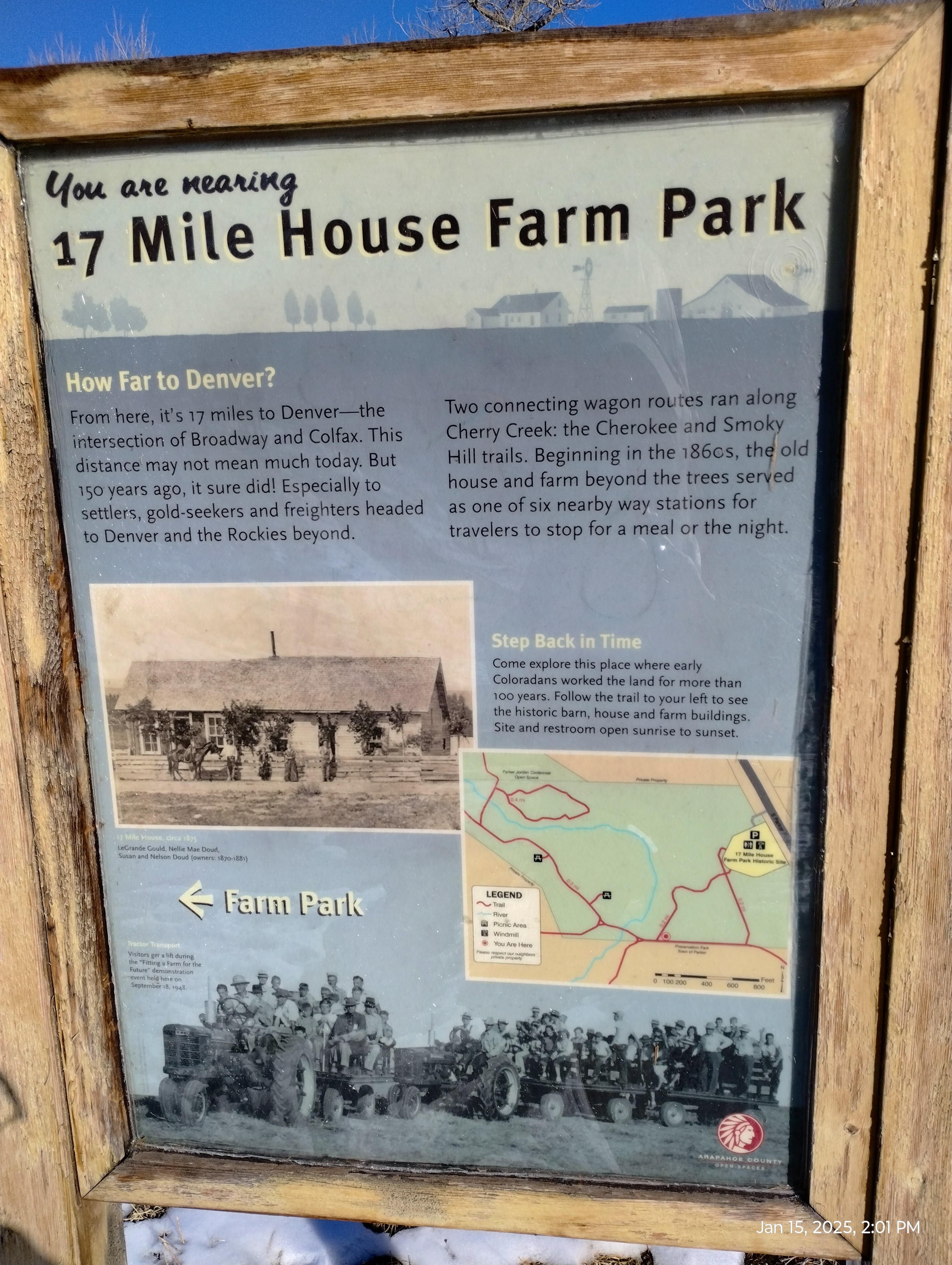
The 17 mile House is the third way station that has been conserved on the Smokey Hill Trail, a historical frontier approach to Denver from the South. (A fourth is under water behind Cherry Creek Reservoir Dam.)


Construction is under way on the High Plains Trail which is intended to connect the Cherry Creek Trail in Parker to the Highline Canal Trail in northern Aurora. This footbridge is part of phase one of the project.


Conservation efforts along the trail include grassland habitats, deer, beaver, and these little bitty jumping mice. They have a big yard laid out just for them North of Lincoln Avenue at the Lincoln Recreation center.

It's February here in Colorado and some of the weather here is brutal. The Werehouse ecology has featured a cocktail of viruses including SARS and a new Flu A to go along with the new avian strain. It triggered off a round of bronchitis and gastroenteritis to delay my return to Cherry Creek, but first chance I get......


Tuesday, December 10, 2024

Life


Top left clockwise: lichen on rock, hawk on street light, autumnal trees, grasses, plants, cheeky squirrel 


Top left clockwise: chipmunk (also cheeky), moose, duck, the same hawk, milkweed

Most people would consider all those things to be living things, but what do they have in common that makes them "living" and how do they differ from these things


Top left counterclockwise: minerals at the School of Mines in Golden, Colorado, cabbage rolls, fire (too close to my fingers), water worn arcose sandstone pebble, water from our tap


 things that people consider non-living like rocks and fire and tornadoes and steaks and (and this is a really tough one), viruses.

Animals are animated....they move around under their own volition. It's no coincidence that the two word, "animal" and "animated" are similar. In classical Greek thought, the soul (animus) is what animated animals. An animist is a person who believes that everything possesses soul (or spirit, those two words tend to be rather nebulous in meaning, sometimes interchangeable, sometimes not) but they don't usually require motion, just some kind of self recognition. The closely related panpsychic is a person that believes that everything has consciousness.

Animation might be regarded as a characteristic of living things. Even plants move in relation to light. But a lot of things move. Air and water move, generally in response to gravity, but plants and animals also move in response to other things. Fire spreads. Maybe movement isn't a good choice for something that's fundamental to life.

These problematic things that I listed above: rocks, fire, tornadoes, steaks and viruses......maybe they have to display a set of characteristics to qualify as "living", what Wittgenstein called a "family resemblance.

Not long ago, most people who even thought of such things were vitalists. They believed that living things were living because they possessed a mysterious energy that animated them, but the more people studied living things, they first found that the chemicals that percolated through living bodies, organic chemicals, could be produced from inorganic chemicals through regular chemical changes, and that life seemed to emerge from chemical reactions.

Over time, scientists came up with a list of characteristics that qualified things as "living". Here they are:

1. Living things grow. They take materials out of their environment and make it part of themselves.

2. Living things reproduce. They create similar things to themselves with important modifications  

3.  Living things respond to their environment.

4. Living things use and emit energy using chemical reactions called "metabolism.

5.  Living things maintain their internal state within tolerable limits. That's called "homeostasis".

6. Living things evolve. When they make copies of themselves, they do so to adapt their kind to their environment. They tend to create offspring that work better than themselves 

The mineral crystals grew into the form they display in the School of Mines museum, but any internal change of state is driven by outside influences. 

The cabbage roles used to be alive but they can't create other cabbage roles by themselves. They'll never produce seeds like the cabbages they once were . If they're hot, it's because the air around them heated them. They can't maintain a constant body temperature.

The fire uses fuel to transform chemicals into heat and it grows and can even split into more fires, consuming as they go. But they can't maintain an internal state that allows them to just keep going.

The rock and the water are at the mercy of their environment. They can't protect themselves.

These are the things I'll be looking at in the future. 

Go outside and look around. Do you see all the living things? Are you missing anything? Did you notice the fungi in the soil beneath you? What about yourself? You carry a world of living things around with you.....tiny mites that clean your skin and hair of microorganisms, bacteria in your gut that help you digest your food.....Did you look under the rocks? Look closer.


Exploring the eyes (the adventurous way)

You will never see me suggesting a dissection.

It's not that I don't see the importance of cutting into animals to see how they work, but there are a lot of very explicit dissections and medical procedures on the Internet. We can let things live now.

There are some really good alternatives to getting your hands into some cadaver's abdominal cavity: Two are Internet videos, and yourself. I'm not suggesting that you take a scalpel to your torso. But everyone (sooner or later) has medical procedures and we finally have free access to our medical records. In my case, my doctors use a tool called "My Chart". I'm having a blast with it.

After I had the cataracts removed from my eyes (both of them in two sessions), I watched the procedure on YouTube. The surgery itself was painless and fascinating. I enjoyed it thoroughly. The videos were great, too.

I'm glad I waited to watch them until after my surgery!

And now, after knocking the retina loose in my left eye and having it fixed, I have learned a lot about eyes.

Actually, you can see inside your own eyes. Much of my Observing and Recording LabBook (on this page

https://theriantime.wordpress.com/labbooks)

Is about vision and there are explorations of the inside of your eyes. Check it out.

There is that other thing.....

If you hunt for food, you'll be killing and "dressing out" animals. If you're going to be disassembling animals for food, you might as well be learning anatomy while you do it. Just stay safe.

There are at least two famous cases of biologists that were killed by their own curiosity.

In 2007, Eric York, a research biologist in the Grand Canyon National Park, found a collared female cougar dead of unknown causes. Taking her back to his lab, he opened her up to try to determine what killed her. He soon became sick and succumbed to pneumonic plague (closely related to bubonic plague).

In 1626, Sir Francis Bacon, father of modern experimental science, bought a bird from a woman, had her clean it, and stuffed it with snow to study how well it preserved the meat. There was a lot of trudging around in the winter weather. Soon after, Sir Bacon died of pneumonia.

So learning is fun.....just don't kill yourself doing it 

Do you have access to your medical information? If not, you're doctor's staff may be able to tell you how to get access. When you get the results of a visit, look them up online to see what they mean.

For instance, using My Chart, I can see that my last visit to my surgeon included an ocular coherence tomography and that some "drusen" were found. There are links that explain these terms. In addition, there is an article about ocular coherence tomography on the Wikipedia site.