It's daunting - this freedom thing.
My computer crashed, so now I have the opportunity to rewrite myself. I think I'll take it. You see, using a cell phone for my computer, I'm no longer tied to a location. It's like those science fictions where the hero is accompanied by an assistant, either a robot or a chip in their head....hmmm, in fact it's exactly like that.
Daunting because I lost a huge amount of information when my computer went down.
But rewriting myself. What an enthralling concept!
Remember the comic strip Bloom County (the one with the penguin?) and how it turned into Outland and got weird? That might happen here.
Who knows? We'll see.
People a

Stories and ideas for adventurers and lifelong learners.
Showing posts with label adventuring. Show all posts
Showing posts with label adventuring. Show all posts
Tuesday, September 17, 2019

Sunday, January 28, 2018
--- Best laid plans and a new beginning ---
If you're keeping up with this blog, you know that the blogs have been appearing slowly lately. Well, I've been learning. There's been some rather harsh lessons, from which I might just draw from in later blogs. It's been a wild season.
In July, I learned about zoning laws and moving into a new house (see the July 14 blog, "A moving experience"), then in September I got a job and learned that you should be careful if you are retired and decide to pick up some work (according to how your benefits operate), and then I spent October getting over the pinched nerves in my back and refurbishing my benefits. Some walking tours in November taught me that I am no longer in my thirties. You can read about some of that and the after effects in December in the January 12 blog, "Notes on life and death." That pretty much took care of December 2017 and January 2018 for me - learning, indeed.
But here, on January 28, with some fatigue left after sitting around for two months, I'm almost back to normal (whatever that is) and am looking forward to a year of looking deeper into what it means to not be 32 any more (I'll have to experiment some more to really find the limits.)
What's coming up?
I was hoping to be through with this pass through psychology and philosophy (I may make it back around to them again) by the end of the year (I was also hoping to hike Waterton Canyon, but that, too, is put off until a later date.) but I have another couple of posts, tying up loose ends, actually. Then, next year, I plan to address religion and social sciences - there's plenty of grist in this area for these mills, and I suspect you have many opportunities for adventure in your areas also.
Denver has an astounding variety of religions for a "secular" area. In fact, the recent influx of people from all parts of the country and the world has brought a new interest in spirituality and religion. Being a lifelong church-goer, I was delighted to find a friendly church that has recently found a new impetus forward right across the street from our new home. Churches that are in the process of picking up after a dry or traumatic period are often some of the most exciting and vital of churches. I'm pretty much set for an adventure in religion.
And society in Denver is in the process of flux. The opportunities here are vast and the barriers are frightening. Regular people are becoming aware of a harsh underbelly in the city (admit it, your city has one too. They all do. Believe it, we all do float down here.) and many want to do something about it. For a sociologist, times are fascinating. What's gonna happen? Stay tuned!
Wednesday, April 5, 2017
--- Lectures for lifelong learning ---
2016
I've mentioned that I'm a lifelong learner. That's my hobby but saying that is like saying I only eat food. My idea of lifelong learning is to try to pick up as much and as varied information as I can in this life. Adventuring, for me is just another phase of lifelong learning.
My bookmarks for online sources of lectures make up a long list. Still, I have some favorites - more coverage, better quality - and I'll share a few with you. Four are sources of free downloads (called "opencourseware") and one is commercial but well worth every cent.
Many colleges and universities make their content available to anyone. Only their students can get credit for taking the courses but, for lifelong learners, credit isn't the important part - it's the experience and the information. MIT is preeminent. They provide opencourseware in just about every field from sailing to differential equations and medical technology. The courses vary from "Here's the books we use. Read them." to full video lectures with textbook, tests, and software. But the video lectures they do have are excellent. Here's a link:
http://ocw.mit.edu/index.htm
Another excellent source of lectures is Gresham College. They have several series of special lectures, not particularly opencourseware. The topics are varied but the speakers are active in their fields, informative, and engaging. Gresham College can be found here:
http://www.gresham.ac.uk/attend
Academic Earth brings together many of the best open courses from many schools. They try to keep the quality high and, for the most part, succeed. Here's a link to that site:
http://academicearth.org
Another source that brings together different sources is the Wikipedia article on opencourseware:
https://en.wikipedia.org/wiki/OpenCourseWare
It provides a worldwide sample of educational opportunities.
The Teaching Company is a commercial source of courses. The lecture series are rather expensive but every item goes on sale at least once during the year and, then, the prices are very affordable. The company auditions their lecturers and use customer feedback to choose future topics and lecturers. One thing I like about these products is that the lecturers are active in their fields and I almost always hear things that I've never heard before. I've never bought a Teaching Company product and regretted the purchase. Here is their home site:
http://www.thegreatcourses.com
Friday, March 17, 2017
--- Appreciation and mindfulness ---
Many people have taken art appreciation classes and many more have been through music appreciation classes. I, personally, having taken both, have never been in a class that explained what "appreciation" was. Mostly people learn names and dates, techniques and composition elements, types of art objects, etc. Is that supposed to help you appreciate the art or is that, in some mystical way, an act of appreciation?
In fact, appreciation is a mode of perceiving. There are several ways to appreciate art, and that can be visual art, music, drama, dance, a fine meal, or a sporting event.
For a while, as a vocational evaluator, my office was isolated in a building in back of the main facility building, so, when I had no client, I could have music playing as much and as loudly as I wanted and my tastes are very broad. The result is that, now, just about all music is background music. That is one mode of perception in which the perceiver is barely even conscious of an art object. It's just there as sort of a pleasant element of the environment.
Another form of art perception is pure entertainment. Art is art because it's beautiful in some way. I have only been to one concert (barring all the gospel music concerts I've been to, but seeing as I am a retired gospel musician, that goes without saying) and that was a Jethro Tull concert in Atlanta, Georgia. I went for no other reason than to hear the band. Jethro Tull puts on a very entertaining concert.
An art historian may visit a traveling exhibition for a very different reason and you may see them standing in front of one piece making copious notes. One out of a hundred people may view that piece of art in the same way as the historian.
Appreciation, whether it is of painting, or music, wines or football, is simply another way of appreciating art. It could be called immersion. And, indeed, what is being perceived doesn't even have to be art. Mathematicians can approach math as an object of appreciation. A chemist may very likely appreciate the chemical reaction that is happening in their laboratory. Appreciation implies a certain amount of passion.
An act of appreciation is prefixed by preparation. That is why there are so many names, dates, and technical terms in an art appreciation class. There is an attempt to understand the background of art objects. In 1802, Beethoven wrote his Second Symphony, a spry and jaunty piece full of musical jokes that irritated many of his critics. One wrote that it was a "hideously writhing, wounded dragon that refused to die, but writhing in its last agonies and, in the fourth movement, bleeding to death." To modern ears, the symphony sounds great and perhaps even joyful. It adds something of spice to the listener to realize that Beethoven has placed his severe gastric problems to music in that last movement.
The only way I can enjoy a football game (I am not a devotee of spectator sports), is to read histories of the players, understand the rivalries, and go into the experience as a social psychologist observing a conflict between two very serious teams of stakeholders. In a similar way, I can no longer enjoy any music fully without this "total immersion" process.
Another approach to art that is not mutually exclusive to appreciation is mindfulness. Despite the Buddhist history of mindfulness, it is a very natural "process" (or, maybe more accurately, "state"). The way Temple Grandin describes the mental processes of animals (in Animals in Translation), many people with autism, and, in my own observations, many Weres, mindfulness is very natural in nature. Briefly, I think in pictures and if I have nothing particularly interesting on my mind, I'm not consciously thinking at all. In other words, I let my environment happen to me, perceptually.
Followers of Buddhist and other contemplative disciplines often work hard many years to achieve this state of mind. Why?
Well, C. S Lewis often wrote that trying to be good could easily distract a person from actually being good. In the same way, listening to a piece of music actively can often destroy the joy of just listening to the music.
I compose and, so, I am painfully aware of what goes into music - its composition and its performance. I catch every glitch and, if it's a tape of one of my own performances, I am doubly aware of the horrible assaults I make on the musical sensibilities of my audience (whether they are conscious of them or not!). I am incapable of listening to a recording of myself without picking it apart.
But I usually, very pointedly, set the evaluative part of my brain aside when in the presence of others' artistic productions.
Most people have an internal dialog that just.will.not.stop. This is the very antithesis of mindfulness. In the mindful state, as I said above, you let the environment happen to you. You simply shut your brain's internal dialog up and let what's going on around you guide your perceptions. The result is that, without all that internal noise, you perceive and remember subtle details of your environment much better.
I had a friend send me the theme music of two anime saying that they struck him as very similar but he couldn't figure out why. When I listened to them, I could practically see that the main theme of one was the base theme of the other. When I told him, he couldn't hear the two pieces without recognizing the one in the other. A characteristic of mindfulness is that the whole mind seems to be involved in the perceiving.
And what does all this have to do with adventuring?
I propose that the ideal mindset for adventuring for the purpose of lifelong learning is a combination of appreciation and mindfulness. Learn everything that might be relevant on your adventure before you begin and then stop talking to yourself when you hit the trail. Your preparation will make you sensitive to the topic you are persuing and your mind will log all the relevant details without all the distractions involved in trying to learn.
That said, I can recommend a lecture series by The Teaching Company called Practicing Mindfulness: An Introduction to Meditation, presented by Mark W. Muesse (http://www.thegreatcourses.com/courses/practicing-mindfulness-an-introduction-to-meditation.html ). It's a pretty good introduction to how to do mindfulness. As for appreciating nature? Well, that's what this blog is all about.
Wednesday, January 25, 2017
--- My range ---
2016
When I was working, my dream weekend vacation was to take a trip to a random county within a 300 mile radius of Selma, Alabama, hike a trail, stay in a camp ground, take recommendations of where and what to eat - just soak up the local flavor.
I got to do that three times.
Now I'm a pedestrian - I sold the van I moved here in and, now, I either walk or take a bus. That's pretty good. I can take a bus just about anywhere in the Denver area including Golden, Aurora, Boulder, Idaho Springs, Evergreen, and Morrison (well, I walk to Morrison). I can also take the casino bus to Black Hawk or Central City. I can cover the high desert around Denver or the front range west of Denver. Occasionally, I take trips further afield with friends and family.
My walking range is the intricate trail system along the South Platte River and into the mountains via Bear Creek. One way, I can walk to Warrior Mountain.
My regular range is Bear Creek Trail. It follows Bear Creek from its confluence with the South Platte to Morrison, Colorado. The trail ends there but Bear Creek continues through The Lair O' the Bear Park up through Evergreen to Mount Evans Wilderness. Most of my explorations will be between the South Platte and Morrison.
The South Platte pours out of the Rockies at Waterton Canyon south west of Denver and gouges a path through the high plains through Denver. The marshy confluence with Bear Creek is behind the River Point shopping area in Englewood. Bear Creek runs through a shallow gorge through the foothills of the Rockies, running out of the mountains through Bear Creek Canyon. The small mountain town of Morrison is located in Bear Creek Canyon. Just east of Morrison, the creek runs through Bear Creek Lake Park where it joins with several other mountain streams before flowing through Mount Carbon Dam.
Bear Creek Trail descends from the mountains through canyons, grasslands, hills, and plains, giving me a wide variety of scenery.
My local playground is Bear Creek Park, behind Bear Creek Shopping Center which is at the junction of Hampden Road and Sheridan Boulevard. It's a popular park with nice facilities. Here, the creek runs a couple of good rapids. Bikers, joggers, strollers, folks with their dogs, and people just wanting to get from A to B use this area.
I live on the shoulder of Bear Creek Valley. I used an altimeter app on my phone to measure the hill I live on. From the bottom of the hill to my house is 74 feet (22.5 meters); from there to the top of the hill is 105 feet (32 meters). So from the creek up to the top is about 180 feet (about 55 meters). That means that the last leg of any hike on Bear Creek, whether it is a stroll to the shopping center or a day hike to Morrison, is a steep, 74 foot upgrade. If I leave going toward Denver, the first thing I see is a 100 foot rise.
But the view from the top is gorgeous. That's where I took the panorama I use above.
I left on a hike to measure the eastern leg of Bear Creek Trail. I had an altimeter and an app called GPS Compass Explorer (Evgeni Ganchev). The altimeter was a bit of a disappointment since, although it did give me an altitude profile, I could find no way to save it and it dropped the display when I tried to use a screenshot program to capture the image. I have since replaced the app. The GPS Compass Explorer, on the other hand, worked flawlessly.
I also carried my camera. I use my regular camera for normal shots to save phone battery power. I reserve my phone for closeups, telephoto and microphoto shots. I also have a professional setup but I only use it for professional type work.
The trip back from the start of Bear Creek Trail was 2.95 kilometers (1.83 miles) and the change in altitude was 105 feet. Here, the creek cuts a shallow gorge into the plains south of Denver to meet the South Platte River. There is an abundance of water fowl and wildflowers at both ends of this section (at the confluence and at Bear Creek Park). If you want an elevation profile for the whole trail, check the Walk Ride Colorado website (http://www.walkridecolorado.com/denver-metro-single-trails/bear-creek-trail-englewood-to-lakewood). Here are a few landmarks.

(South Platte River Trail connects Bear Creek Trail)
0 kilometers (0 miles): Bear Creek Trail branches off the South Platte River Trail at River Point shopping park where the South Platte River Trail crosses the river by foot bridge. There are an assortment of food sources here including Panera Bread, Steak and Shake, and HuHot Mongolian Grill. There is also a Target up the hill from the footbridge and a large movie theater in sight of the trail head. The area provides a nice view of the Rockies.

(Plaza at River Bend)


(Confluence of Bear Creek and South Platte River)
0.38 kilometers (0.24 miles): The River Point area is marshy and is a favorite hangout for waterfowl and other wildlife. There's a broad walkway and plaza where people can sit and rest and dispose of trash. This section gets a lot of bike and pedestrian traffic but I find the people there to be courteous and friendly.

(Weir across Bear Creek)
0.57 kilometers (0.35 miles): Just a little way down, Bear Creek flows over a weir and splits into several streams before emptying into the river. Up the hill at 0.64 kilometers is a golf course.

(Federal Boulevard)
At 1.42 kilometers (0.88 miles), the creek and trail passes under Federal Boulevard. Along side the trail is Carroll's Pub Corner and, within sight is a McDonald's.

(Park at McBroom homestead)
At 1.61 kilometers (1 mile) is a flowery park that commemorates one of the early settlers in the area. This stretch of Bear Creek was the site of the McBroom homestead. The park has a water fountain.

(Lowell Street bridge)
The Lowell Street bridge at 2.16 kilometer (1.34 mile) is the only place where a pedestrian using Bear Creek Trail has to deal with automobile traffic on the eastern leg of the trail. Just north of there, across Hampden Avenue (there are cross walks and lights), there is a 7-11 convenience store, and just south is a playground.

(Colorado Heights University)
Colorado Heights University is just up the hill from my home and can be seen from most of my range. It's a comforting landmark when I've been walking for several hours.

(Bridge at Bear Creek Park)
Bear Creek Trail crosses the creek at Bear Creek Park at 2.95 kilometers (1.83 miles) at the end of Raleigh Street. This marks the end of what I have been calling the eastern leg of the Bear Creek Trail. The park is popular. It has a large playground and spacious picnic facilities. The creek passes over a scenic cascade at the bridge and has several rapids within the park. The park is within easy walking distance to Bear Creek Shopping Center, WalMart, McDonald's, and Dartmouth Place Shopping Center (which has my favorite coffee and ice cream shop, Bear Valley Coffee Company).
On the seventh of August, I set out to survey the west end of Bear Creek Trail. At 6:00 it was 56 degrees and clear. I started where I left off on the last hike: at the footbridge at Bear Creek Park. The creek was low and my altimeter read 5320 feet.

(Bear Creek at 285 underpass)
The trail runs through Bear Creek Park and, at 0.52 kilometers (0.32 mile) passes under highway 285, Hampden Avenue. On the other side of the underpass is Bear Creek Shopping Center which has several shops including a King Soopers grocery, Subway Deli, Home Depot, and Dollar Tree. The creek has several rapids in the park. Trails to the east lead to Fort Logan National Cemetery. It's not quite as large as Arlington but it's pretty impressive. There's also a YMCA up there on Sheridan.

(Spillway at Sheridan)
At 0.89 kilometers (0.55 mile), the trail passes under Sheridan Boulevard and there is a pretty spillway - about the closest thing we have in my neighborhood to a waterfall. On the other side, there is a WalMart, McDonald's, and Dartmouth Place Shopping Center which has several restaurants including a Chinese and Italian restaurant and my favorite coffee shop, Bear Valley Coffee Company. I stopped there for a chocolate muffin, a large cup of mocha, and a friendly barista. Coffee bars have all the good part of a booze bar without any of the negatives.
I took note that my left knee was being a little clunky and I would have to watch it on the hike.

(Bear Valley Park)
The creek flows into the narrower confines of Bear Creek Park from a broader valley where it has more room to meander. On the other side of Dartmouth Shopping Center is Bear Valley Park beginning at 1.77 kilometers (1.1 miles). There was a deer foraging there (but my photo didn't come out very well).

(Bridge across Bear Creek)

(Mount Morrison at the end of Dartmouth)
Both Dartmouth Avenue and Bear Creek Valley Park dead end at 3.42 kilometers (2.1 miles) before reaching Wadsworth Boulevard. The trail continues over the creek and behind the Alta convenience store, before it passes under Wadsworth.
Here the trail is at 5353 feet elevation.

(Prairie dogs)

(Bear Creek Open Space)
On the other side of Wadsworth, the trail opens out into a broad open space where a lot of prairie dogs have decided to lay down stakes. I've also seen coyotes in this area. The trail has risen to 5378 feet elevation at 3.7 kilometers (2.3 miles).

(Other end of open space)
This plot of prairie is broad and the trail travels along the creek and then shoots straight across to the other side of the open space before reentering forest at 4.2 kilometers (2.6 miles). Here the elevation is 5384 feet (according to my phone app.)

(Underpass at South Estes Street)
South Estes Street is at 4.66 kilometers (2.9 miles) and the trail is at 5400 feet elevation. The many rapids along this stretch of creek indicates a consistent slope.

(Rapids near East Kipling street)
Just before the underpass at South Kipling Street is one of the more picturesque rapids on the creek at 5.32 kilometers (3.3 miles) and 5406 feet elevation.
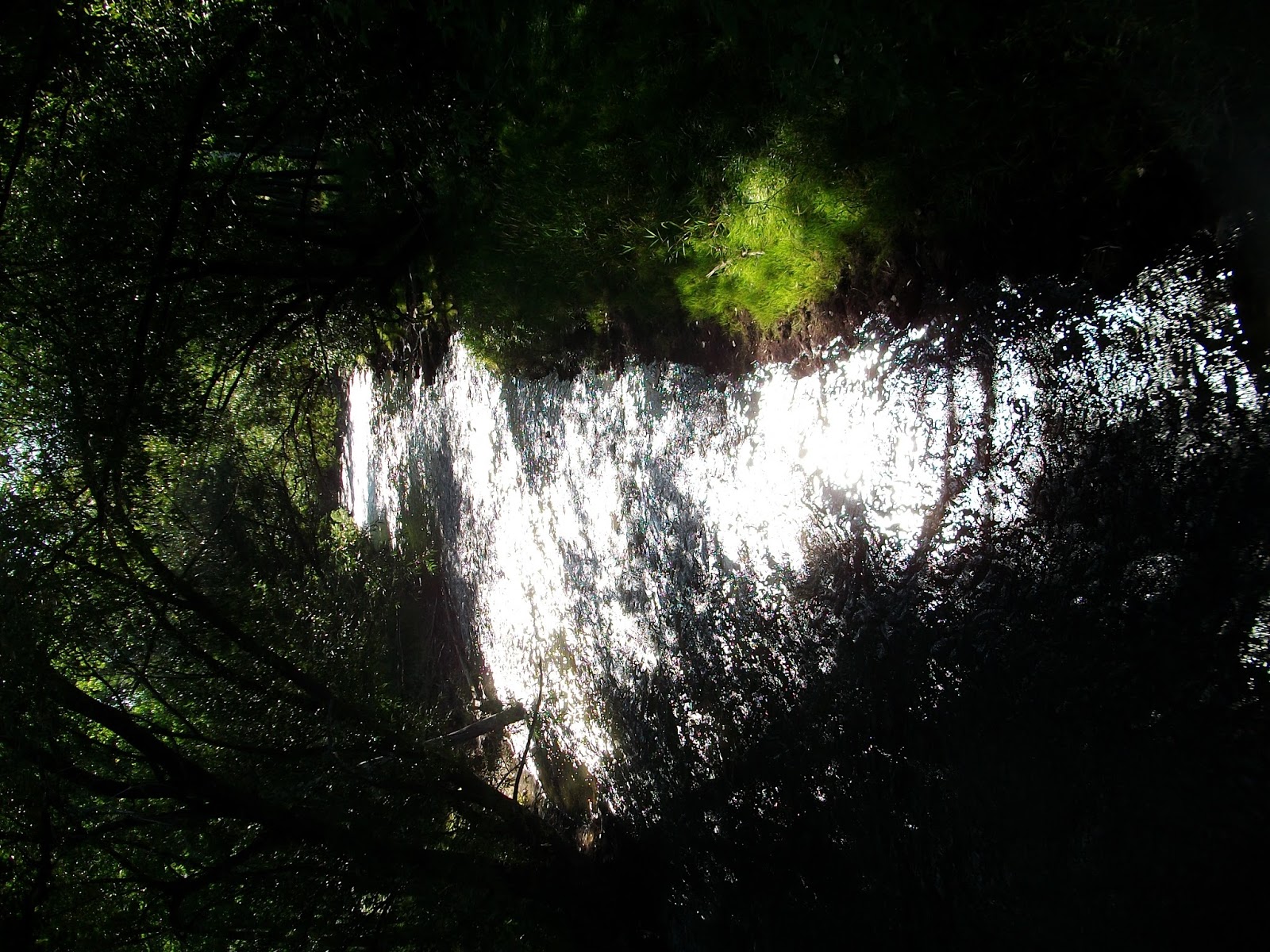
(Light on the water under South Kipling underpass)
The trail passes under South Kipling at 5.83 kilometers (3.6 miles)

(Connection to Kipling Trail)
At 6.11 kilometers (3.8 miles), Bear Creek Trail connects to the Kipling Trail and continues under South Kipling Parkway. Kipling Trail is little more than a sidewalk along the parkway but it leads up to Jewell Avenue which leads west to Green Mountain and Dinosaur Ridge. At the underpass, Bear Creek trail has risen to 5429 feet elevation.

(Mount Carbon at Fox Hollow Lane and Morrison Road.)
At 6.97 kilometers (4.3 miles), Bear Creek Trail meets Fox Hollow Lane and Morrison Road. There is a bench and trail map here and you can see Mount Carbon, which you will have to pass over to get to Morrison. The alternative is to road walk over the southern shoulder of Green Mountain. I don't know which is better. The trail will now run through two golf courses, over Mount Carbon, and through Bear Creek Lakes Park, following beside Hampden Avenue for much of it's course. At Fox Hollow, it is at 5437 feet elevation. Things are about to get steep.

(Mount Carbon)

(Mount Carbon Dam)
In 1896 and 1938, Bear Creek flooded catastrophically. Several other streams coming from he mountains also flooded. That motivated the Corps of Engineers in the late 1970s to build several dams for flood control, including Mount Carbon Dam, to protect the Denver Metropolitan Area from further flooding. The base of the dam at 7.9 kilometers (4.9 miles) is at 5499 feet elevation (again, according to my phone app). There is a lot of wildflower photo ops here including mullein.

(Mullein)

(Mountain View)

(Green Mountain)

(Mt. Morrison and Red Rocks)

(Mt. Falcon)
The plaque says that the top of Mount Carbon, Mountain View, is at 5774 feet. From Bear Creek Park, the trail is at 8.23 kilometers (5.1 miles), so the last 0.33 kilometer (0.2 mile), the trail has risen 275 feet. Bikers love this trail (whew!). The views from the top are spectacular. The ridgeback, Red Rocks formation, and Front Range are visible from Lookout Mountain to the north to Pike's Peak to the south. Mount Evans, third highest peak in the Front Range is often visible, snow covered for much of the year. On a clear day, the Denver skyline is visible. Due to a weird fog, it is totally eclipsed today. Green Mountain is just to the north and Bear Creek Lake is just below.
There is also a shelter and spacious restrooms here. It's a nice place to get your breath after the switchbacks. You can also contemplate the switchbacks down the other side.

(Down the west side)
There is a branch of Bear Creek Trail that splits off to a trailhead on Hampden Avenue at 8 kilometers (5 miles).

(Mount Carbon from the west)
There is also a rest area partway down the mountain at 8.22 kilometers (5.1 miles) and 5637 feet elevation.

(Clouds moving in)

(Bear Creek Lake)
Several landscapes meet here. The trail, itself, passes through prairie, and finally into some forests. Bear Creek Lake is to the north. At 11:30, clouds were building up behind the mountains threatening rain.

(Turkey Creek)
There's a shelter just before Turkey Creek at 9.9 kilometers (6 miles) and altitude 5637 feet. The temperature was at 68 degrees with 77% humidity. There was no precipitation in the forecast for at least two hours, but showers and a thunderstorm in the evening.
A littl further on, at 10 kilometers (6.2 miles) is a campground with restrooms and a water faucet, a road crossing and an archery field.

(Bear Creek Lakes Park Visitor Center)

(Ridgeback from visitor center)
At 11 kilometers (6.8 miles) is the Bear Creek Lakes Park Visitor Center. Across the road are two lake, the Big and Little Soda Lakes, that have swimming beaches. Here the elevation is 5657 feet.
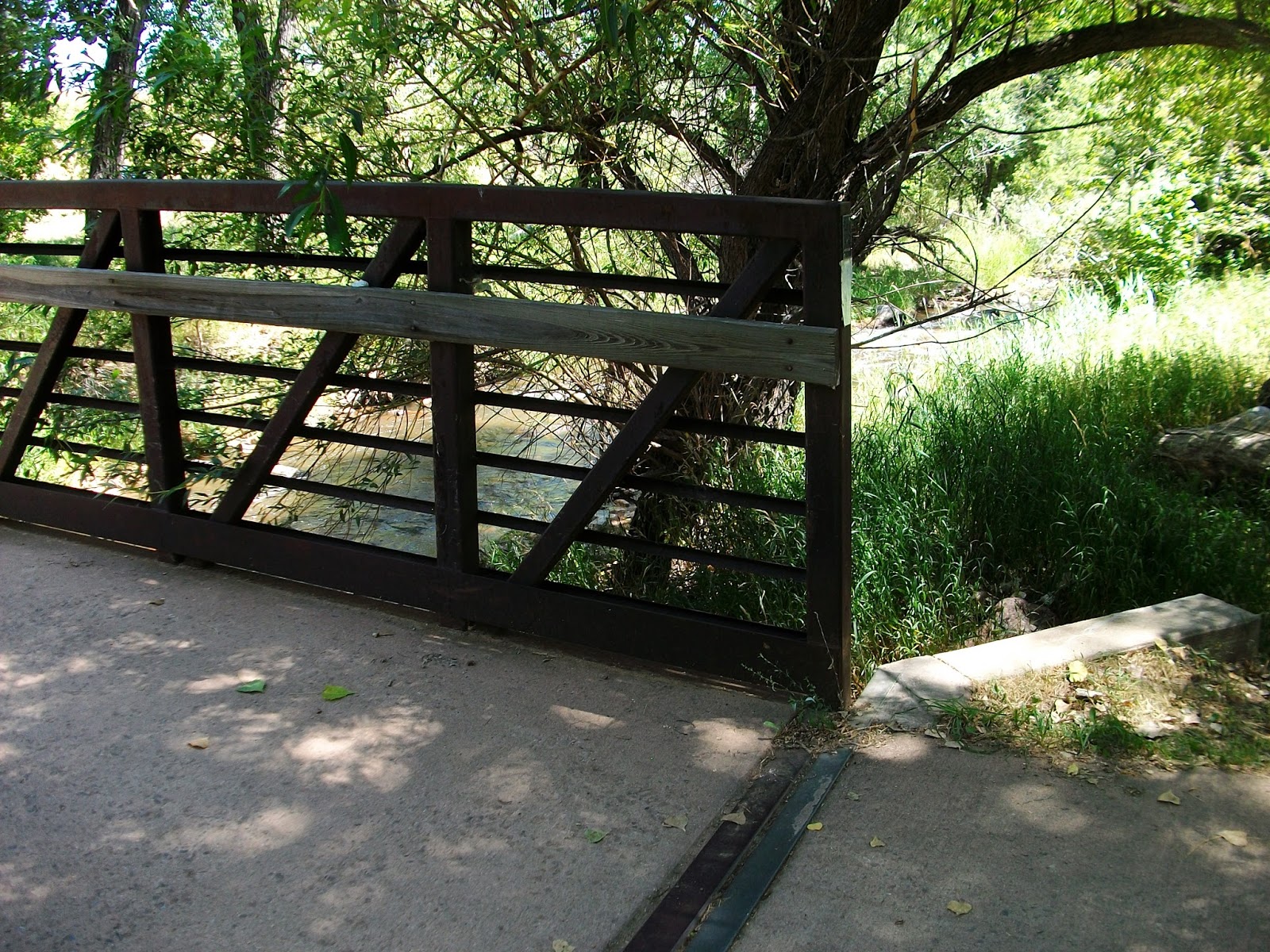
(Bear Creek crossing at Morrison Road.)
In a little band of forest, the trail crosses Bear Creek and comes out at a picnic area by Morrison Road. At 11.7 kilometers (7.3 miles) the trail is at 5701 feet elevation. Highway 470, the main four lane that follows the foothills up to Golden, is in sight. On the other side is Morrison.

(Bear Creek Canyon)

(Red Rocks)
There is a Conoco convenience store and gas station just as you come into Morrison. The town is nestled in Bear Creek Canyon and is packed with shops and restaurants. I generally stop in at the Mill Street Deli for a hamburger and milkshake. People complain about the wait but they're good so they're busy. As far as I'm concerned, they're worth the wait and, after I've walked over Mount Carbon, I want some excuse to just sit and vegetate for a while.
Red Rocks amphitheater is spectacular and visible from town. Bear Creek Trail ends at the Memory Plaza at 12.9 kilometers (8 miles). The elevation is 5742 feet.

(Elevation profile)
The whole trail is 15.85 kilometers (9.8 miles) and the elevation rise from the South Platte River to Morrison is 516 feet (but, then, there's that two hundred foot rise at Mount Carbon to get over.)
In the future, I'll be looking at this trail from many different angles.
Saturday, January 21, 2017
---
This blog ---
2016
I
am using Google's Blogger to create this blog. It's a first time
thing for me. I have a website but I've never "blogged".
I
compose using KeyNote NF 1.7.8, a tabbed notebook program for Windows
created by Marek Jedlinski and developed further by Daniel Prado
Velasco.
This
is one of my favorite programs. It works pretty much like a digital
notebook with tabbed pages, so I can use it to organize my thoughts
and my composition. In addition, it has lots of commands that make it
a fairly powerful word processor.
Files
can easily be exported in a rich text format that transfers really
well to websites.
KeyNote
is available on SourceForge if you want a copy.
When
composing on my smartphone, I generally use the notepad app that came
with it.
Bear
Creek Commentaries is a companion project to my website, The Therian
Timeline, which has sections on scientific excursions and cooking;
and a YouTube channel, Open the World, a series of science tutorials
and demonstrations (I haven't posted this one yet and won't for some
time, but I will before I approach physics on the trail since it will
be a prelude to that section.) [2023 correction. Open The World never happened. I even had some videos ready but my computer crashed and ate them, so I gave it up.]
I
will be telling stories. I enjoy hearing other people's stories and I
enjoy telling them. I find that stories are a good way to teach. I
like to "open up the hood" on the world and show people how
things work inside. I like to play around with the engine and let
people watch, or even help. Stories draw people in. People become
part of stories when they listen. I have some very old stories, some
told by friends like Wolf, Coyote, and Bear, and some related by
people who know streams that have gone underground for centuries
before reemerging to the surface of the earth, or stories told by
rocks that still show the footprints of massive lizards (did I say,
"lizards"? Perhaps I should have said "chickens".) Some of my stories are relatively new - stories about the Wild West
or the struggles for equality in the South. And some of the stories
are going on right now.
These
are my adventures, stories, meditations, contemplations, and
daydreams.
Let's
take a walk.....
Thursday, January 19, 2017

---
The adventurer ---
2016
I
don't want this blog to be about me, but I will be making
recommendations and giving opinions along and, you probably need to
know a little about me.
My
name is Wolf VanZandt. I'm a 63 year old (at this posting - it keeps
changing) retired vocational evaluator that lives in the Denver,
Colorado area. Until I moved here, I had never lived outside the
southeastern United States and had only traveled outside that region
four times - three times to Denver. I was born in south Florida and
grew up in Georgia and Alabama. My jobs have included ornamental
plant shipper, library assistant, textile mill worker, security
guard, retail salesperson, self-service gas station clerk, laboratory
assistant, media department manager, animal handler for a dairy unit
(that would be a cow poke to some of you), offshore pipeline lay
barge welder helper, camp counselor at a camp for disabled persons,
and, for twenty years, a professional vocational rehabilitation
specialist.
When
people ask me what I like doing, I generally report, truthfully, that
I don't like bookkeeping. My actual hobby is life long learning.
One
reason for this website is that I suspect that my other website, the
Therian Timeline, makes other people think that it's only for
Therians. It is specifically for Therians but it also has a lot of
general interest stuff (I'll be providing links here.)
Most
people, it turns out, are hybrid homo sapiens x homo
Neanderthalensis, but where most of them show as pure human, I and
folks like me show all the Neanderthal traits. I consider us
Neanderthal. As such, I'm one of a subset that shows shamanic
tendencies and (in my opinion) that makes me a Werewolf. Other have
different ideas about what constitutes a Were or a Therian but that's
my take on the subject. Regardless, I'm not in the first or second
standard deviation of humanity, but neither am I alone.
I
like diversity. I enjoy hearing others takes on things - I like
hearing stories. I like other cultures.
I'm
a devout and orthodox Christian (orthodox in that I accept the Bible
as fundamental to the Christian faith and I adhere to the Apostles'
Creed). As I also adhere to sola scriptura, I'm pretty sure the
Apostles would not recognize today's Christianity as a legitimate
embodiment of Christ's teachings. That and my outlier life
experiences undoubtedly color my beliefs.
People
ask how my therianthropy changes my world view and I have no idea how
to answer because I have nothing to compare it with and it pervades
my life, so, even if I could give an answer, it would be too long,
complex, and involved to be tolerated by a being with finite
attention span. And I've probably stretched this introduction beyond
that tolerance limit, so I will move on to other things.
Subscribe to:
Posts (Atom)