Showing posts with label Cherry Creek. Show all posts

Thursday, May 29, 2025

Cherry Creek: The Pinery to Castlewood Canyon entrance


This is the first mile marker that I saw on this hike. These posts have been my constant companions throughout the hikes from the confluence of Cherry Creek and the South Platte River. At this point I have hiked 33.5 miles along Cherry Creek and I am nearing the end of the journey.

I began this segment where I left off the last. I went as far as I could on trains and buses and had to take a Lyft taxi from downtown Parker to the Pinery Park and Ride. From there, I hiked down to the Cherry Creek Trail .


I was in for some big changes on this long section of the trail. On earlier hikes, I was walking between major bus stops. Pinery Park and Ride was the last RTD public transportation stop for me. 

The creek was mostly a meandering stream with some stretches with high banks and some areas where it became braided with multiple branches spreading out and coming back together. That usually happens when the gradient is shallow and there is little to keep banks from eroding. 

There was little of braided sections from here on up. I could feel the slope increasing as the terrain became hillier.


To this point, the valley walls have been like a wide bowl. Starting at I25, there's been a gentle slope down to the creek and the same on the other side of Cherry Creek. Here, the edges of the valley are high bluffs. Steeper gradients give the runoff more power to carve the landscape.
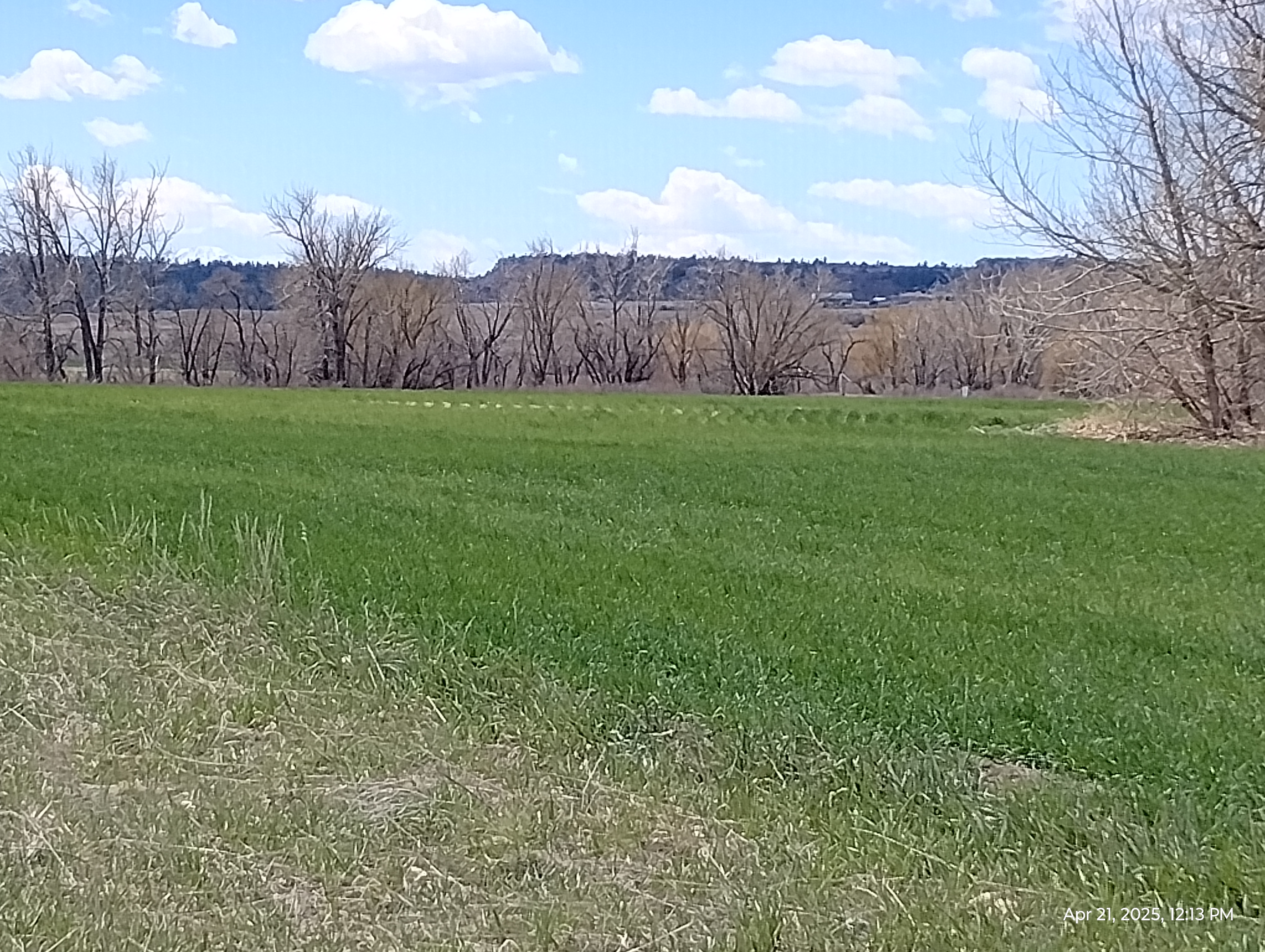

I'm moving onto Palmer Divide, the rise in the land that separates the South Platte River and Arkansas River water sheds.

Most of the bedrock here is the same unconsolidated stuff that fills the Denver Basin, but Palmer Divide is special. It's capped by a hard layer of rock that prevents erosion in areas. The result is mesalands.

36.7 million years ago (by radiometric dating) a mountain near present day Buena Vista, Colorado blew it's top in an eruption that absolutely dwarfs anything in human history. It produced pyroclastic flows that spread as far as 65 miles to the east where present day Castle Rock is situated. It covered that distance in less than two hours. The hot cloud of volcanic ash settled and welded together to form the Wall Mountain tuff. The erosion resistant cap that covers Palmer Divide is composed of the tuff and Castle Rock conglomerate that contains big chunks of this tuff mixed with other odds and ends, one being a blue quartzite (boulders up to six feet in diameter) which has a source 46 miles away near present day Boulder near Eldorado Canyon.


The Castle Rock conglomerate was deposited somewhere between 33.9 and 36.7 million years ago in a massive flood (or floods) or rivers that flowed from the northwest. It's been calculated that, for a flood to have moved such boulders so far, the stream velocities had to have been more than 27 miles per hour. No boulders this size moved by any modern Colorado River has been found more than three miles away from the mountains. Even the Big Thomson flood could not compare.

Big events in the past created this arm of hills jutting out from the Rockies into the plains.


Hidden Mesa is part of this hilly landscape rising 600 feet from the valley floor. If I were not trying to reach the canyon on this hike, I could have taken a trail to the top where a couple of hikers assured me there were great views of the surrounding land. The park also boasts of an experimental orchard and vegetable farm.


Instead, I walked into Franktown and ate at Adriana's Mexican restaurant, a friendly place with good food. I tried valiantly to not stuff myself .....and failed.

Franktown was the last town before the canyon and from there the rim of the valley closed in. This was ranch country and most of the area by the trail was posted.


There was plenty of life, wild and otherwise, along the trail. The entire Cherry Creek Trail has been popular with bicyclists, joggers, hikers, strollers and dogs. None of it has been crowded but no part of it has been empty of people. I've seen plenty of bird life (including hawks and eagles), prairie dogs, Beaver dams. The only megafauna other than humans (technically "megafauna" is any animal over 100 pounds) I've seen are deer but I'm pretty sure I've seen signs of coyotes (tracks, droppings).

I think the herd of deer in the picture above is the third I've seen on the trail.

One last switchback brought me up to the Eastern entrance to Castlewood Canyon State Park.


I think I've mentioned that I've never seen a photograph that does the canyon justice. In real life, the view from the entrance (first photo above) is breathtaking. If you enlarge the top photo, you can see the cap of Castle Rock conglomerate layer on top. 

The road in the picture runs through most of the canyon to the west entrance.

If you look really hard at the bottom photo, you can see the switchbacks of the Cherry Creek Trail. The mesas and plains extend our into the distance.

Hopefully, I will be able to return here to finish the Cherry Creek Trail.


Wednesday, April 23, 2025

Cherry Creek: Lincoln Road to Hess Road

 The seasons, they are a changin'. I walked through my first cloud of midges of the year. Maybe there will be some wildflowers soon, but there's still room for another snow, even a deep snowfall.


The mouse conservation continues on the South side of Lincoln Road. I still haven't seen one (and probably won't since these little fellows are very shy and have a lot of grass to hide in) but I can at least read about them. (Expand the photo above and learn about the little mouse that jumps )


In these Southern segments, the flood plain is broad and allows Cherry Creek to spread out a lot. Here, it's a braided stream. Although it's not obvious in the photographs, in many places, the stream is higher than the surrounding flood plain because a platform of sediment has built up and the stream has cut channels into it.


Not only sediments, but remnants of culture travel on streams. I had to stare long and hard to figure this one out (I wasn't set up for wading). It was a plastic posey. Maybe there was a wedding somewhere upstream 

I used to look at junk in streams and just shake my head at the thoughtlessness of the humans in the area until I hosted a campout in northwestern Alabama. You can't walk 200 feet without encountering a waterfall in many places and this one area was dense with them.

One particular waterfall looked to be almost unknown. It was right by the road but effectively hidden in the landscape. The only reason I found it was that we were on foot and I heard it. It was a big three tiered fall and the several times we camped there, we ended up cleaning junk out of the lower splash pool.

It occurred to me that the laundry detergent bottles and other assorted garbage must have come from far upstream. It's not the kind of stuff people usually leave at a picnic site.


The weather is warming up and algae is beginning to grow in quieter areas of the streams. 

When I was in high school, living things were divided into two Kingdoms: Plantae and Animalia. There were weird things like fungi, algae, bacteria, and some very primitive extremophiles that were.......problems, but, for instance, bacteria were grouped with plants because they generally had a tough cell wall. Protozoa were usually more pliable and had phospholipid cell walls like animals, so.....animals 

Since then, the division has broken living things up into five or six Kingdoms. The algae have maintained their position in the plant kingdom. The ones shown above are colonies of single celled individuals that stay put except when they're moved by water currents. Others have flagellum or cilium that help them move around. They're all eukaryotes, having well defined cell nuclei containing genetic material. The cyanobacterium, also photosynthetic, single celled, colonial beings are prokaryotes (no nucleus, the DNA is scattered through the cytoplasm) so they're usually not classified as algae or plants.

Another catch is that algae can be multicellular like plants although they don't have the complex structures like roots and true leaves and there are algae that have no pigmentation or something different than chlorophyll. Sea weeds are algae.

These little creatures place a significant amount of oxygen into the atmosphere and are good for larger aquatic organisms. When we dump too much phosphate fertilizer into the streams they grow like crazy and clog up streams and waterworks. Nothing else can compete in an algae bloom so everything else dies. Then water purification operations can't keep up and your tap water gets yucky.


This stretch of the Cherry Creek trail affords some nice views of both Pike's Peak to the South and the Front Range to the north all the way to Long's Peak which is the signature mountain of the Rocky Mountain National Park.


Salisbury Equestrian Park is right off Parker Road in the Salisbury Heights neighborhood. It's not an "ecological park" like many of the areas around Cherry Creek so the stream here is nicely landscaped. There aren't many places where the creek is this straight and the banks are this sharp.


Hess Road is the southernmost point on my hike but my bus connection is back north on Parker Road and I need to do some shopping, so I turn around and backtrack  a mile.


This section of the trail is lined with numerous memorials to members of local families who have died. The above memorial to local children is near Salisbury Park. The low wall is tiled with memorials and children's drawings.


I needed to pick up something from the local Walmart, so I backtracked about a mile to Sulphur Gulch Trail that leads into Parker. I have no idea why "sulphur". I neither saw nor smelled sulfur in the area .

The "gulch" like the many other gulches in the Denver area is there to catch rain and transport it to a natural stream, in this case, Cherry Creek. It's usually dry in the summer but fills up with snow melt and storm water in the spring.


Denver is 744 miles from the Pacific ocean. What are these sea gulls doing here?

Actually, ring-billed gulls prefer inland areas and many are native to Colorado. Of course, that doesn't explain the pelican I saw in Great Falls.

I was with a church group on a construction ministry to a small church in Great Falls. It had been built over an underground river which was washing it's foundation away, so we replaced it with a floating foundation. During the week, we did some sightseeing. The falls were breathtaking. They would have been more impressive without the huge hydroelectric dam built across them but, I guess, progress.....

On a rock in the middle of the Missouri River below the dam was a pelican. A man next to us opined that it was plastic. That became a buzz line for the rest of the trip.....


That's not a real cliff..... it's plastic.
That's not a real glacier ..... it's plastic.
That's not a real tree..... it's plastic 
That otter......yep, plastic.

Just to remind folks that I'm still hiking on the prairie....


Sunday, December 8, 2024

Cherry Creek: Monaco to Nine Mile Station

For anyone following this blog, you've noticed that I've slowed down considerably. That's partially a result of the two months stagnation after my eye surgery this year and the accumulated effects of aging. 

When I first moved to the Denver area eleven years ago, an endurance hike was thirty miles. Now it's ten. This leg of the trip up Cherry Creek was around five miles according to Google Maps but I noticed about a mile into it that I had left my wallet at home and walked another mile to retrieve it. With a one and a half mile hike to and from the train station, that adds up to about ten miles. I was pretty whipped at the end but I still had enough energy to wash the supper dishes, so I'm not completely debilitated yet.


This section of Cherry Creek is not the most scenic, as it flows mainly through residential and industrial areas, carving its way through deep sandy sediment. Being an active flood plane, this soil is geologically very recent.


It's a popular stretch of trail near Greenwood Village so the traffic is heavy with bicyclists, walkers, and hikers. The plants are a mix of indigenous and introduced species. I didn't see any big predator or prey animals but I've seen reports of both deer, Coyote, and bear in the area. The creek and Greenway provides a natural corridor for wildlife coming up from the less inhabited canyons and Palmer Divide to the South.


The deep layers of sediment laid down by past flooding shows a typical soil profile. The layer of humus at the top is thin. Past vegetation on the plains (this is the beginning of the Great plains) is sparse and gets washed off regularly. Beneath is a thin layer of leached soil. The clayey layer below tends to hold darker ionic materials that are drained into it from above and that darker layer is thick and goes down to the bedrock that fills the Denver basin....eroded materials washed out of the Rocky Mountains. You can faintly see layering where different floods deposited various materials and hollowed out softer sediments. 

Cherry Creek has been around long enough to have developed some decent meanders.


Sage (Artemisia tridentata) is so common out here that it's become indelibly a part of the spirit of the West. How many western bands have had "Sage" in their name. It's a typically scrubby plant. A lot of the plants on the plains are low and tough. They have to be to withstand the winds and sharp, and often brutal, shifts in weather. Despite the fact that this plant lives next to a watercourse, unless it's actually in the creek, it's in a very dry environment. It rains a good bit, but the air is so dry that anything wet will soon be dry again and the soil is loose and sandy and drains rapidly.

Big plants (trees) that are indigenous to this area have to be able to manage their water well. They usually live right next to a stream and there aren't many - mostly cottonwood and willow. Most of the trees you see in these photos were introduced and cultivated to become part of our urban forest.


This pretty little ground cover always catches my eye. I can never remember the name so I use Google Lens to look it up.

Oh, yeah. "Silver mound". It's another Artemisia.  It's pretty common out here.


Looking north, back the way I came, that cloud sorta bothered me. It was talking. Weather closer to the mountains, about twenty miles west where I live, doesn't worry me.....even the occasional hurricane force winds and hail. But even here I'm on the plains. They get tornados and the lightning is considerably more dangerous.

I have rain gear in my pack (always) but, even so, a downpour would be inconvenient. Luckily, it passed by to the north.


The Rockies, to the West, are an ever present sight here. 


Gaillardia Pulchella is a common wildflower here. Also called Fire wheel Daisy or Indian Blanket, it really stands out in the landscape.


Ants are less common here than they are in the Southern United States but they are here.


It's still autumn here and we've had a nice display of fall colors this year thanks to more rain than usual.


This squirrel was curious, but not enough to come completely out of hiding.


The Highline canal crosses Cherry Creek here through a syphon. 


The diversity of cactuses increases in the mountains (the state cactus is the Claret cup) but the plains still see the wide spread prickly pear. Best I can tell, those are all over the coterminous United States. We had them growing both wild and in gardens in Alabama. Although the modified stems (the "mouse ears") and leaves (the spines) aren't very showy, the big yellows blooms are gorgeous and the "pears" are edible. My housemates were waxing nostalgic about eating prickly pears the other day.


We have a lot of corvids in the Denver area, crows, ravens, a variety of jays, but magpies are most common in the South Denver Metro Area. In other places in the US, they can be a rather obnoxious bird but around here they are, across the board, a friendly creature unless you get too near a nest. A friend calls them "tuxedo crows".


About two-thirds of the way from Monaco and the end of my hike, I begin to see my destination, the large dam that impounds Cherry Creek Reservoir.

This massive earth embankment plays a major part in the next section of my journey up Cherry Creek, so I will hold off discussing it for now.


Keeping with tradition for the Denver area, Aurora (the largest eastern area of the Denver Metro Region) has plenty of public art scattered around. John King's 16 foot high kinetic structure was awaiting me where I exited Cherry Creek trail at South Havana Street. Here, I had to do a little road work to get to the light rail station.


Nine Mile Station is a little daunting with its labyrinth of tunnels leading to train and bus terminals, parking garages, and passing under heavily trafficked highways and rails to the area under the dam. In the center courtyard is this minimalistic, abstract clock tower. It's a train station.....people need to know what time it is. (Of course, in the band, Chicago's opinion, "Does anybody really care?")


Nine Mile Station, like the Four Mile House Historic Park is situated near a pioneer way station. It was at the nine mile mark outside Denver on the Smoky Hill Trail.

Unlike Four Mile Station (best I can tell) there's nothing left of the historic site of Nine Mile house.

The Smoky Hill Trail was named for the Smoky Hill River that paralleled most of its way. It developed from a Native American trail through prime huntng range. It started in Atchison, Kansas and continued to the Kansas River, along the Smoky Hills River and Cherry Creek, to Denver.

The site of the Nine Mile House is today on the other side of the dam, under water.

The Nine Mile Station platform provides some great views of Cherry Creek Reservoir and the Rocky Mountains as a backdrop to the Denver Tech Center and the surrounding area. To the south is the familiar profile of Pike's Peak.


And Pike's Peak.....


From here, it's a short train ride back to Arapahoe Station and the mile and a half hike back home.

These hikes are scratching my itch to follow a way (in this case, Cherry Creek) from one end to the other. On the next link of my journey I'm going to skip the unremarkable trail along the base of Cherry Creek Reservoir dam to the next light rail station to the west and take it up at Dayton Station. See you there.