Showing posts with label government. Show all posts

Monday, March 25, 2019


--- Terminus: 16th Street Mall ---

My plan for March's rail hike was to take the 16th street MallRide bus from 16th and California Station to Union Station and walk back to 16th and Stout. On the walk from home to University Station I noticed a decal of a candelabra in a high window in the Cable Center at Denver University and decided to go in and ask about it. I had been curious about the Cable Center for some time and I'm glad I followed my urge.


                                                                   [Cable Center]

It turns out that the Cable Center is not even a part of Denver University. It is a resource center and memorial to the cable industry in the United States. It was originally funded by several leaders in the industry and was intended to be a museum. It still houses an archive but has become more of a conference center.

The building in a beautiful example of modern architecture with a high ceilinged, glassed-in front lobby. The receptionist was friendly and informative and explained that the librarian will gladly schedule a tour - that's a possibility for a future hike. I didn't get a backstory for the candelabra.....

The Cable Center is also worth visiting for the landscaped amphitheatre to it's east.

After a conversation with the Cable Center receptionist, I walked across the street to University Station and caught the light rail train to 16th Street and California. This area is a couple of blocks from the downtown Denver conference center and theater district and is the heart of downtown. 16th Street Mall is closed to regular traffic, reserved for pedestrian traffic. The MallRider buses keep a constant route from Union Station at one end to Civic Center Station at the other end. The pedestrian mall doesn't extend all the way to Union Station but  becomes an actual street around Wynkoop, a couple of blocks from Union Station.

The free, electric MallRider buses replaced the old gasoline buses in 2016. They look modern but paradoxically have an air of the old San Francisco trolleys with people jumping on and off at every street.

Downtown Denver is full of surprises tucked away amidst the skyscrapers. For instance....this bell tower.


                                                                  [The Bell Tower]

It was originally a department store. The Daniel and Fisher Department Store opened in 1911. The interior is swank with brass fittings and plaster and marble ornaments.


                                                                       [Interior]

A little further south is the Federal Reserve Branch Bank. Denver is the Washington D. C. of the West. Not far away from the Federal Reserve is the Denver Mint. There are currently four active mints that create United States currency: Philadelphia, Denver, San Francisco, and West Point. You can tell where your coins come from by the letter somewhere on the coin: P, D, S, or W. There used to be other mints, for instance, New Orleans (mintmark O) used to print coins. I haven't been to the mint yet, but I hear they have a good tour.

                                                               [Federal Reserve]

The self guided Federal Reserve tour is well constructed and well worth the price (it's free). It shows you how to spot a counterfeit, among other things. There's also a nice money collection.

The walk from Union Station to the light rail is short. Actually, if you wanted to make a day of it and you breezed through it, you could easily take in the Highland Bridges at the northern end of 16th Street, check out the restaurants, theaters, and attractions along the Mall, see the government buildings and memorials of Civic Center Park, and then go one street over to the library and it's history museum, the art museum, and the History Colorado Museum. Better, though would be to take it in several day visits. There's a lot to see in a very little area.

Your town may have some interesting federal buildings. I lived just down the street in Selma from the federal courthouse with it's stately arch. Government buildings - federal, state, and local, can make interesting destinations. They often have historical and artistic displays and sometimes, they provide guided tours.


Thursday, March 21, 2019


--- The police ---

"To Protect and to Serve" was the motto of the Los Angeles Police Force since 1963 and it has been adopted by many other police forces since then. Many police officers take an oath to protect and serve, but don't let that fool you. That is not their purpose - hopefully it does end up including that, though.

In America, the purpose of police (and that includes organizations such as the FBI, CIA, and other government alphabet soups, and the Armed Forces) is to uphold the Constitution. That's right, they're part of the executive branch of our government. In fact, they're the front line.

Do you think you've been fed a line? Okay, here's where it all ties in - the Constitution is the document that was written to serve and protect the people of the United States.

"We the People of the United States, in Order to form a more perfect Union, establish Justice, insure domestic Tranquility, provide for the common defense, promote the general Welfare, and secure the Blessings of Liberty to ourselves and our Posterity, do ordain and establish this Constitution for the United States of America."

And, yes, it does go wrong sometimes, because, just like the courts have to interpret the Constitution to make decisions, so do police.

After the equivalent of a minor in criminal justice (my university wouldn't let me claim it since I already had three minors) and involvement with some of the training programs in Alabama, I have to say that I'm impressed with what I've seen. Of course, what people learn in school and training programs often become modified when they emerge into the "real world".

Actually, it would be hard to talk about my experience with police forces in the South and in Denver because I don't talk about individuals in this blog without their express permission, but most of my interactions have been very positive. You can form your own opinions. Here are some research methods.

Wave at police. Be friendly about it. I wave at people who work for the community, partially to show them the respect they deserve and partially to open them up to communication - body language, y'know.  Many community servants - bus drivers, trash collectors, road workers - appreciate the recognition....and some don't. It can give you some idea of how community servants feel about the people they serve.

Which brings me to the other research method. There are many opportunities to form connections - positive connections - with police. They come to community events - go meet them. And although I haven't been able to find a Citizen's Patrol in the Denver area, many of the police departments (maybe all?) have Citizens Academies. They are seven week long courses on important neighborhood issues including security and police procedures.

My impression (and some research) is that the more positive connections there are between police and citizens, the happier citizens are with their police departments and the smoother police work goes.

Sounds like fun but, as a pedestrian, there's not a citizen's academy close enough for a night walk two or three times a week for seven weeks. But if you've attended, let me know how it went. Leave a comment...and a discussion!


Friday, March 8, 2019


--- The courts ---

There is a fractility in the United States government. What I mean by "fractility" (and I will be talking much more about that as time goes on, because it is one of the characteristics of complexity) is that patterns on one level are repeated on other levels. This patterning allows a balance of powers, the pattern is three-fold and the three parts are set against each other (if things work right). Any one of the three parts can stymie either of the other two parts if it really wants to. The founders of American government quite consciously and intentionally crippled the government.

Why? Because they didn't trust government.

We had had quite enough of government control in the form of the English monarchy. But the founders realized that we had to have some form - some degree - of government - sort of a "can't live with it and can't live without it" attitude.

So we have three parts of federal government and that three-fold pattern is repeated at the state level, and the county level, and the city level, and often at levels between and possibly at the neighborhood level and in organizations.

Executive - legislative - judicial. Those are the three branches of government in the United States. The legislative branch makes the laws, the executive executes them, and the judicial interprets them.

If you want to see an instance that breaks the three-fold pattern, check out Louisiana.

I visited the site of the headquarters of the first two branches of government in Colorado in January. It's the capitol. Both the governor, the head of the executive branch, and the legislative branch are housed there. The other branch is more complicated and is scattered around all over the city and, indeed, across the state. But the highest level of the judicial branch is located just across Civic Center Park from the Capitol in the Ralph L. Carr Colorado Judicial Center located at 2 E. 14th Avenue, Denver, Colorado near Broadway. This is the highest court of appeals in the state of Colorado. If you have a problem that you need to carry to court, you start at the bottom and if you don't like the result and you can convince a higher court that the lower court made a mistake, you get to move up the chain. The Supreme Court housed in the Ralph L. Carr Building is the end of the line - the highest state court. From there, if it's actually a federal issue, you might be able to jump to the federal supreme court in Washington, D.C., but that's a little far for me to walk so, on the 26th of February, I visited the Ralph L. Carr Building, and monumental structure, more modern, but, in many ways, just as spectacular as the Capitol across the street.

I took the light rail from University Station to the Convention Center Station and walked down the 16th Street Mall to Civic Center Park around which much of Colorado government takes place. I guess I could have taken the Mall Flier Bus the few blocks down to Lincoln or Broadway, I enjoy the walk through downtown.

Walking around the perimeter of Civic Center Park carried me by the monumental City and County Government Building that encloses the park, with the Capitol like a set of parentheses. The curve of the facade and the ornate columns match the classical style of many of the other buildings around the park.


                                                                      [City Hall]

The Denver Public Library is just to the east of the Ralph Carr building with its disparate jumble of sections looking much like a modernized castle. To the south are the art museum and History Colorado museum. You could spend a couple of days just looking around this area.


                                                           [Denver Public Library]

The Ralph L. Carr Building as a modern counterpart to the stately classical style building around it. There are columns and a rotunda but the columns are square and the rotunda is glass.


                                                            [Ralph L. Carr Building]

If you've followed me in this blog, you've heard of Ralph Carr. His statue is at Sakura Square to commemorate the governor who bucked public opinion to speak out against the treatment of Japanese Americans during and after World War II.

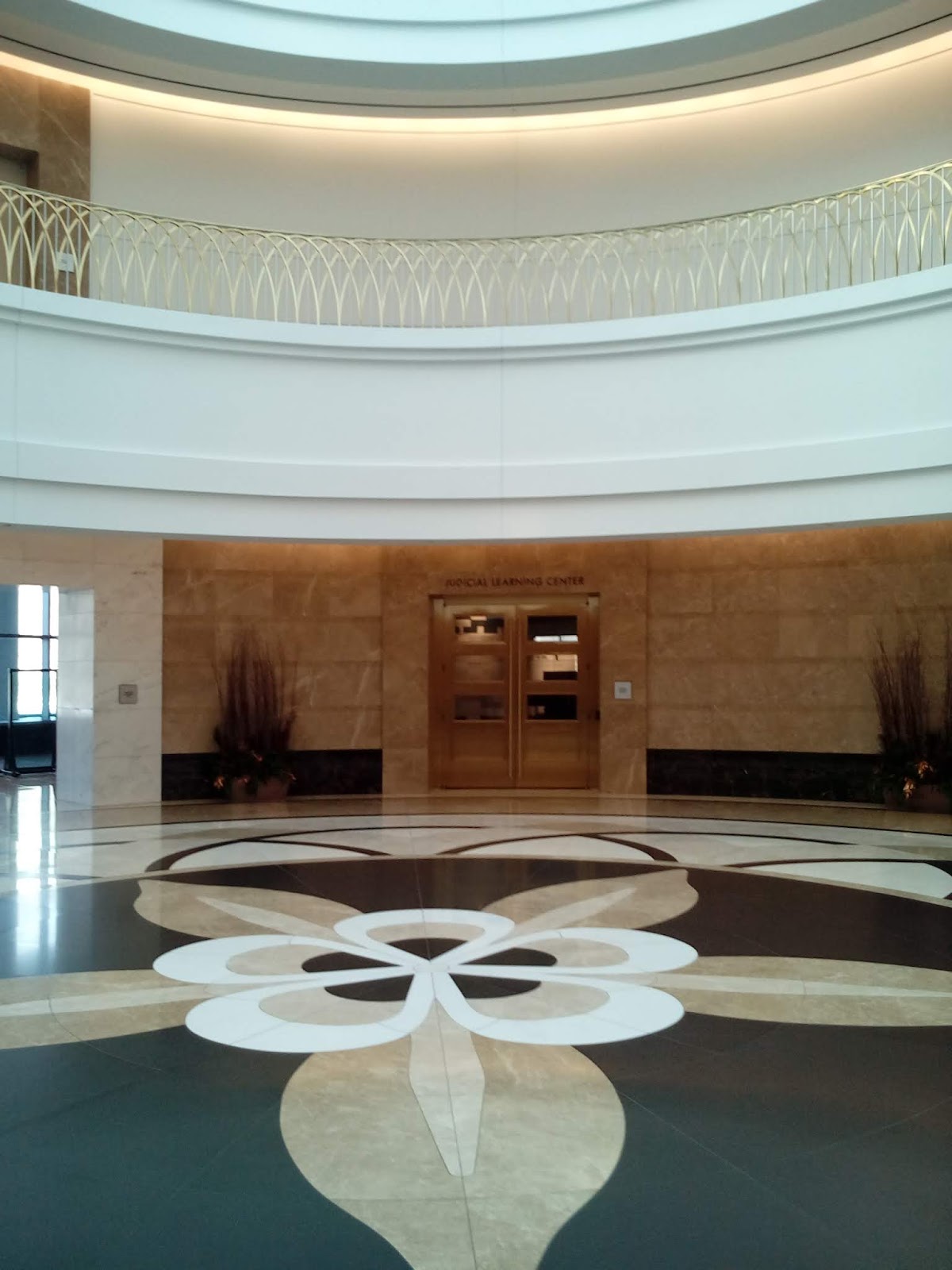
The interior is beautifully adorned with modernist murals and the floor of the rotunda is decorated with a stylistic columbine blossom.


                                                    [Interior of the Ralph Carr Building]

The learning center is just off the main lobby on the first floor. Although photographs would not convey much about the room, if you want to know about the legal process in the United States and Colorado, visit it. This is your complete and fun education of the judicial system. Interactive exhibits let you experience the parts of judges and lawyers. The history of the courts is laid out on columns. And, if that's not enough, plan your visit so you can sit in on a deliberation of the court.

The website is here:

https://www.courts.state.co.us

And, like legislative sessions, you can find recordings of supreme court deliberations on the website.

                                                                       [Pigeons]

In the United States, it's too strong to say that you are controlled by your government (still, if you don't understand how the government works, there's a good chance that you are controlled), but you are regulated. That's not necessarily a bad thing, but does it really make sense to be regulated and not know how you're regulated? In the United States, the courts, legislature and executive branch are transparent. If you want to know how they work, you have every opportunity to do so. If the wool is being pulled over your eyes (so to speak) it's because someone walked up to you and said, "This is wool. I'm going to put it over your eyes and while you can't see, I'm going to do things....you might not like it." Sooooo.....one of the things that every citizen of a country should make it a point to know is how their country works.

A visit to your country's, state's, county's, city's seat of government is fascinating and fun and what you learn there might or might not change your life, but it will certainly help you avoid wool.


Thursday, April 27, 2017


--- Notes on political systems ---

It has been observed that a pure democracy, if it were practicable, would be the most perfect government. Experience has proved that no position in politics is more false than this. The ancient democracies, in which the people themselves deliberated, never possessed one feature of good government. Their very character was tyranny.

Alexander Hamilton

When you see the suffix "-ism" on a word, you should immediately assume a double vision.

We seem to have inherited from our simian cousins a strong us-or-them mentality which is well conveyed by many uses of the "-ism". In that form, the suffix means "I'm a [whatever "-ism" is a suffix of] and we're better than everybody else." Patriotism ("I'm an American and America is the greatest country on the planet"), racism ("I'm white and white people are superior to everyone else"), male chauvinism ("I'm a man and men are superior to women") are common examples of this form.

"-ism" can also indicate a love for the group. This form is slightly different from the other and can even be laudable. For instance, I am an American and I wish greatness for my country so that it can be a  benefit to the rest of the world. I would like the American reputation to be that of friend and cooperant of the other peoples of the world.

But, like Mr. Hamilton, I don't see that democracy has worked that well in history and I can't see it as the panacea of all political ills. I have noticed that some countries have not fared so well under democratic governments.

People vary greatly in personalities so it would be very peculiar if there were not a need for a variety of governments to accommodate those differences. I think that states rights in the United States is a good idea. It would be a better idea if states did not have such a huge need to meddle in others states' business. A state is what it is and, in the US we have choice. If the political climate of one state is not to our liking, then we can move to another.

Well, that's my ideal - of course, it's my naive ideal. For instance, not everyone is mobile enough to find which state works best for them and some states, being what they are, are downright detrimental to their people. I wish people could build things such as compassion and respect for others into their governments, corporations, and such, from the inception, but unfortunately, that rarely happens.

I'm a social psychologist and one who looks at organizations as people in their own rights. Just as maturity brings certain characteristics - self control, empathy, compassion, responsibility, etc. - into a person's life, a healthy, mature organization will also show those qualities but they have to be part of the original design and they must be maintained as the organization develops or else, like an individual that regresses to a more infantile stage of behavior, the organization will go bad.

I've talked about Ashby's Law of Requisite Variety so it should come to no surprise that I value diversity even in the political realm. I think that there should be a variety of governmental forms, but there is good diversity and there is bad diversity. Good diversity builds up, bad diversity breaks down. In the same way, there is good government and there is bad government.

In all things, we should strive to be what makes the world a good place. That kind of -ism is well founded.